CENTUM VP is the Yokogawa DCS you will meet in many refineries, chemical plants and power stations. We go through its stations, control network, I/O families and engineering workflow, then show a quick way to size FCS I/O with spare.
Yokogawa built its DCS family on the CENTUM name, and CENTUM VP is the current generation. We cover its architecture, I/O, engineering steps, releases and selection points, and solve one I/O sizing example.
What is Yokogawa CENTUM VP and how does its architecture work?
Yokogawa CENTUM VP is a distributed control system where operators work on HIS stations, engineers build the database on ENG, and Field Control Stations run the control logic. They talk over Vnet/IP, a dual redundant 1 Gbps network, while FCS reaches field signals through N IO or FIO nodes. For example, a duplexed AFV30D FCS can run a reactor loop while a ProSafe RS SCS handles its trips.
What Is Yokogawa CENTUM VP?
Yokogawa CENTUM VP is the integrated production control system, a distributed control system or DCS, that Yokogawa Electric sells for continuous and batch process plants. Yokogawa announced it on 5 February 2008 as the 8th generation of the CENTUM series, succeeding CENTUM CS 1000 and CS 3000.
- CENTUM was announced on 19 June 1975 as the first DCS, according to Yokogawa.
- Main stations: HIS for operation, ENG for engineering, FCS for control.
- Vnet/IP runs at 1 Gbps with Bus 1 and Bus 2 redundancy.
- FCS I/O comes as N IO (software set) or FIO (fixed type).
- Release 7.01 was launched in June 2025 as the 10th generation of CENTUM.
If you are new to the basic idea of a DCS, first read our guide on the distributed control system. Station names differ by vendor, so our note on DCS components like ES, OS and AS helps you map Siemens style terms to the Yokogawa ones.
Yokogawa says more than 30,000 CENTUM systems have been deployed in over 100 countries.
How Does the Yokogawa CENTUM VP Architecture Work?
The Yokogawa CENTUM VP architecture has three layers: HIS and ENG computers at the top, Field Control Stations in the middle and I/O nodes at the bottom. All stations sit on the Vnet/IP control network, and each FCS reaches its I/O nodes over a dedicated I/O bus.
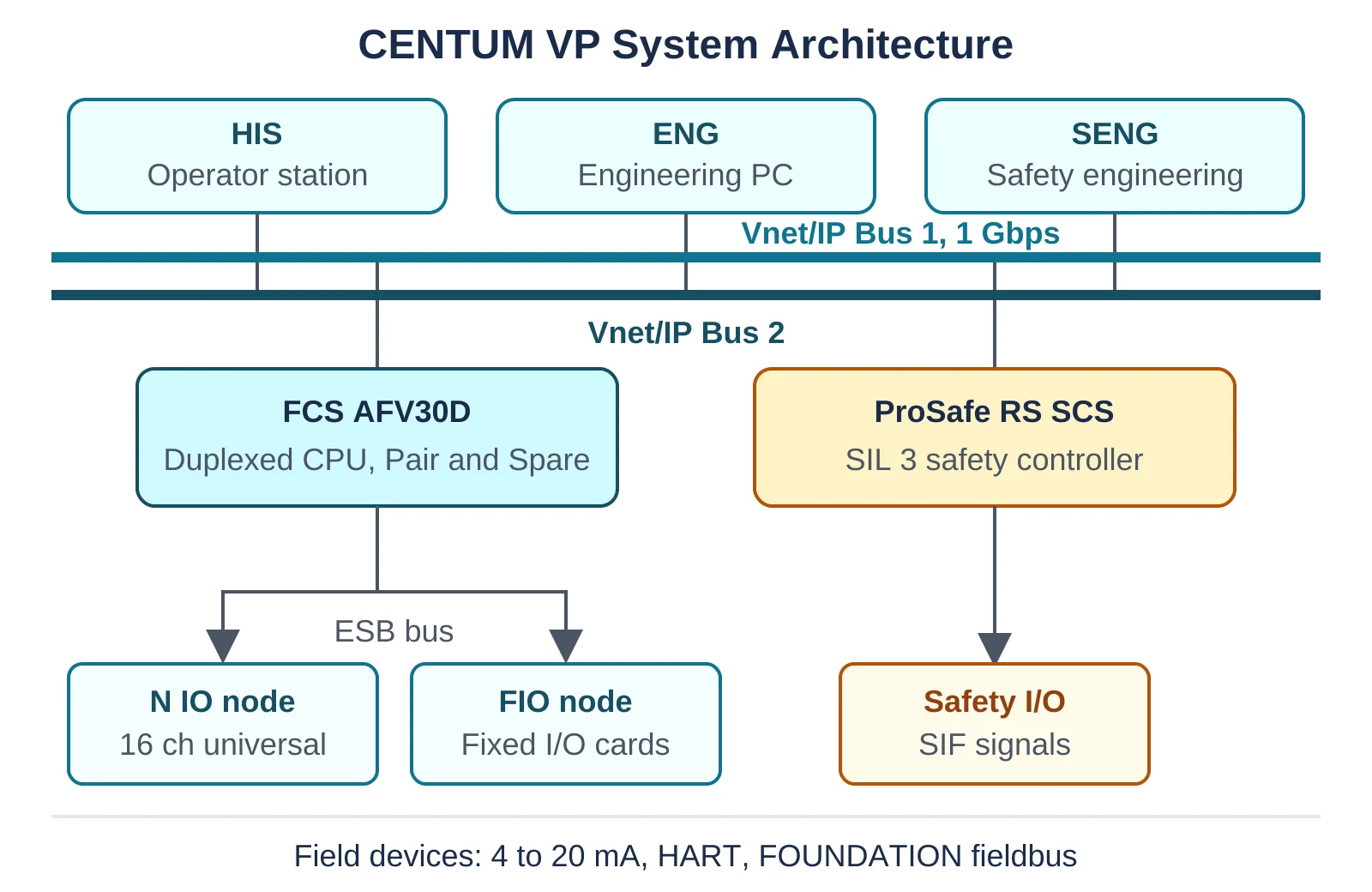
The Human Interface Station, or HIS, is the Windows computer where the operator watches graphics, faceplates, trends and alarms. The ENG holds the builders for stations, I/O, control drawings and graphics, and the Yokogawa overview GS 33K01A10 50E notes that both can run on one computer in small systems.
Vnet/IP is the CENTUM VP control network, a gigabit Ethernet based network with two separate buses called Bus 1 and Bus 2. It switches over automatically if Bus 1 fails, and in 2008 it became part of IEC 61784 part 2, as our note on DCS network redundancy explains for other bus layouts.
Run Bus 1 and Bus 2 through separate switches and cable routes. If both buses share one tray, one fire there can take down both.
What Is the Field Control Station in CENTUM VP?
The Field Control Station, or FCS, is the CENTUM VP controller that reads field inputs, runs the control function blocks and writes outputs. Yokogawa offers it in single and duplexed forms, such as AFV30S and AFV30D for 19 inch rack mounting or AFV40S and AFV40D inside a cabinet.
Duplexed models use the Yokogawa Pair and Spare design, which the 2008 launch release claimed gives 99.99999 percent availability. Our article on DCS controller redundancy types explains how it compares with hot standby schemes.
For I/O the FCS uses two main families. N IO, introduced with R6.01 in 2015, gives 16 point modules where each channel is set by software as AI, AO, DI or DO, while FIO uses modules with a fixed signal type.
| Point | N IO | FIO |
|---|---|---|
| Channel type | Set by software per channel | Fixed by module model |
| Signal conditioning | Built into the module | Often external or separate |
| Redundancy | Single or dual on the same baseplate | Depends on module and node |
| IS barriers | Barriers can mount on the baseplate | Separate barrier panels usual |
| Best use | New plants with late I/O changes | Existing CS 3000 and early VP sites |
Software defined channels help when the instrument I/O list keeps changing, because fixed cards force you to redo DCS I/O allocation for every change.
Inside the FCS, you build logic from function blocks on control drawings. Yokogawa lists PID, PVI, ONOFF and manual loader blocks for regulatory control, plus calculation, sequence table, logic chart, SFC and SEBOL blocks for sequences.
According to GS 33J15C10 01EN, the standard scan period of an FCS is 1 second, with medium and fast scans of 200 or 500 ms for loops that need it. Our DCS function block programming guide shows how such blocks connect in a typical loop.
How Does ProSafe RS Integrate with Yokogawa CENTUM VP?
ProSafe RS is the Yokogawa safety instrumented system, and its Safety Control Station joins the same Vnet/IP network as Yokogawa CENTUM VP. Yokogawa states that the SCS is TUV certified to SIL 3 under IEC 61508.
Operators see SCS data on normal HIS screens, and you engineer safety logic on a separate SENG computer. Keeping safety apart from control is the core idea in our post on SIS and BPCS differences.
CENTUM VP Engineering Workflow Step by Step
A CENTUM VP project flows from the I/O list to FCS definition, control drawings, HIS graphics, virtual testing, FAT and finally download at site. Yokogawa added the Automation Design Suite with R6.01 to keep design documents and control data in one engineering environment.
Plan the alarm philosophy before step 4, because Yokogawa UACS is aligned with ISA 18.2 alarm management.
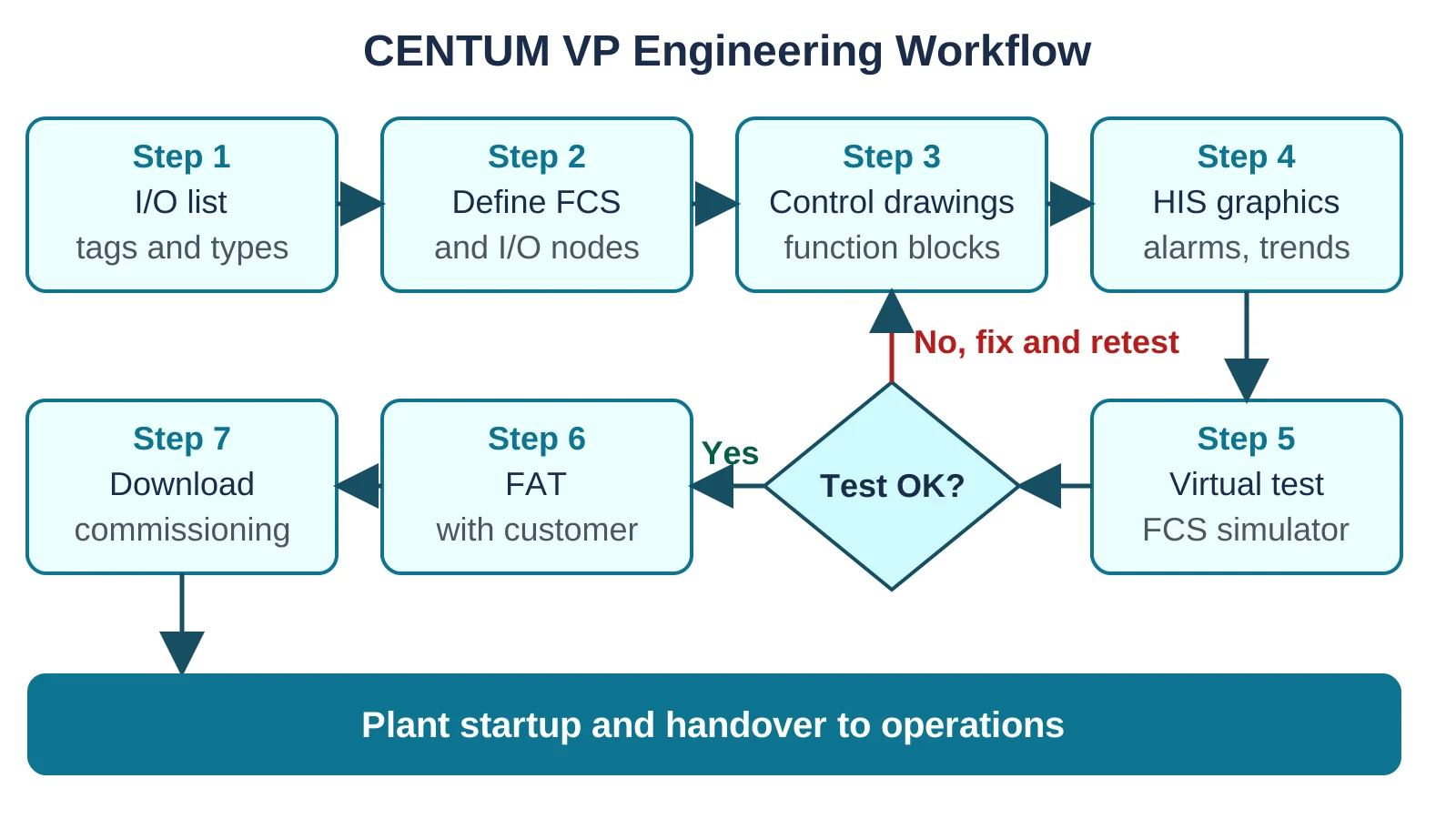
The test loop is where most project time goes, and a clean factory acceptance test is only possible when the simulator test has already caught wrong block connections and wrong ranges.
CENTUM VP Release History from CS 3000 to R7
The Yokogawa CENTUM VP release line runs from the 2008 launch through R5 and R6 to Release 7 in 2025. Each step kept compatibility with older CENTUM data.
| Year | Release | What changed |
|---|---|---|
| 1975 | CENTUM | First DCS, per Yokogawa |
| 1998 | CENTUM CS 3000 | Windows PCs as standard HMI |
| 2008 | CENTUM VP launch | 8th generation, new HIS |
| 2011 | CENTUM VP R5 | Released September 2011 |
| 2015 | CENTUM VP R6.01 | N IO and Automation Design Suite |
| 2025 | CENTUM VP R7.01 | 10th generation, OPC UA client, security |
| Later | CENTUM VP R7.02 | AI control, Windows Server 2025 support |
R7.01 adds an OPC UA client and tools to merge and test several engineering databases, says the June 2025 press release. The product page lists R7.02 with AI control based on the FKDPP reinforcement learning algorithm.
CENTUM VP Release 7 was timed with the 50th anniversary of the first CENTUM.
If your plant still runs CS 3000, our guide on DCS migration and obsolescence management explains how to plan a staged move.
How to Estimate FCS I/O Count with Spare
To estimate Yokogawa CENTUM VP I/O, multiply each signal type count by one plus the spare fraction, round up, then divide by channels per module and round up again. Then compare analog points with the FCS limit.
Modules = ceil(points ÷ channels)
AI: 180 × 1.2 = 216 points, 14 modules
AO: 60 × 1.2 = 72 points, 5 modules
DI: 240 × 1.2 = 288 points, 18 modules
DO: 120 × 1.2 = 144 points, 9 modules
Total = 720 points, 46 modules
Analog load = 288 ÷ 1760 = 16.4 %
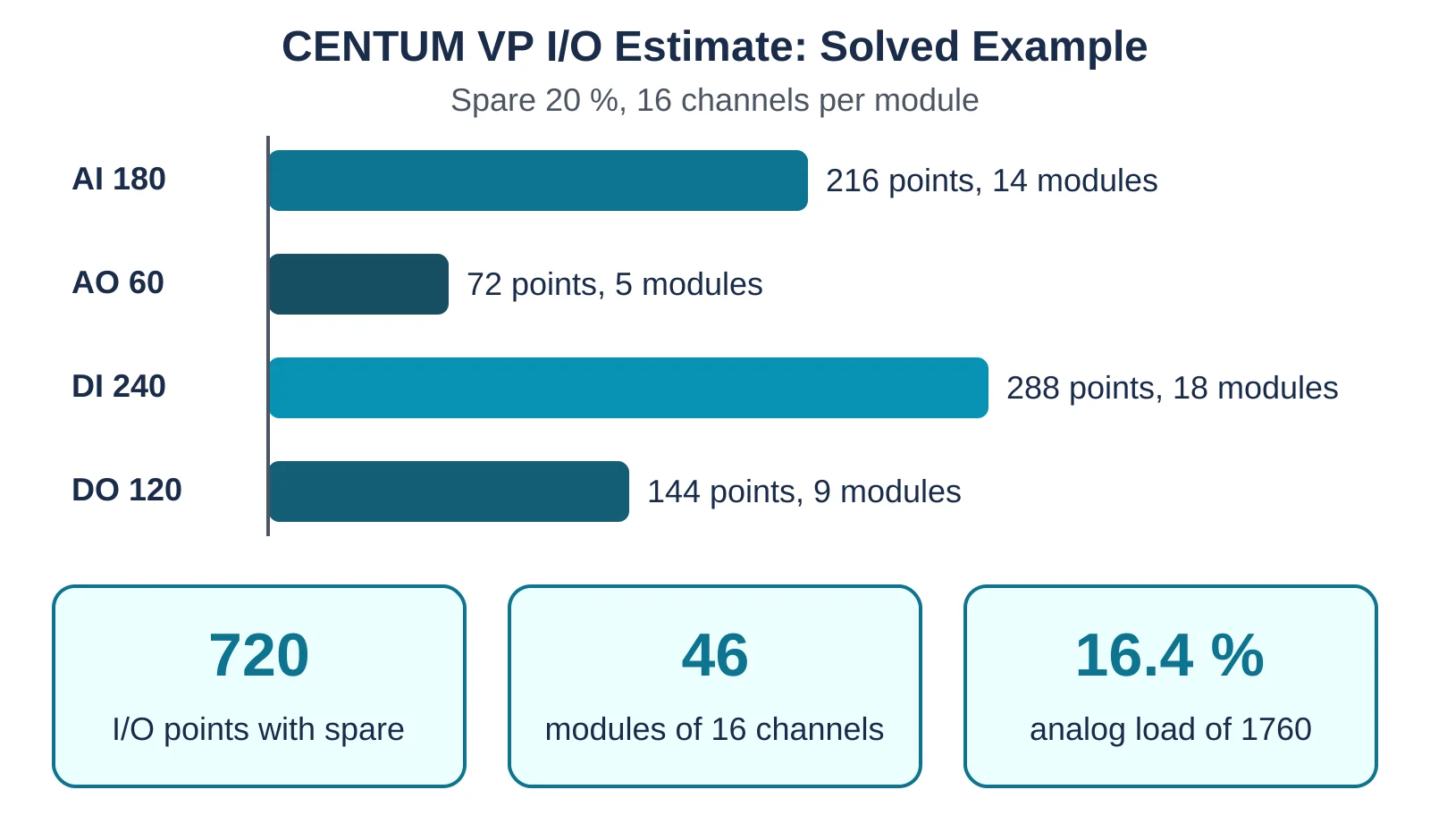
The 1760 figure is the analog I/O limit per FCS listed in GS 33J15C10 01EN for the AFV30 and AFV40 control function. It also lists 4096 contact I/O points, so always check the GS for your release.
Keep spare wired channels in every module. They let you add a transmitter during commissioning without new cables to the marshalling cabinet.
When Is Yokogawa CENTUM VP Selected?
Plants choose Yokogawa CENTUM VP when they need a large, long life DCS with tight integration of control, safety and alarm management. It also makes sense where an older CENTUM system already runs, because Yokogawa keeps backward compatibility with CS 1000 and CS 3000.
- Dual Vnet/IP and duplexed FCS options
- Backward compatible with CS 3000 data
- ProSafe RS operation on the same HIS
- FOUNDATION fieldbus, HART, PROFINET and Modbus support
- Proprietary tools need trained engineers
- Costs more than a small PLC system
- Overkill for a single skid
- Continuous or batch process with many loops?
- SIL 3 safety needed on the same screens?
- Existing CENTUM system to extend?
- FCS I/O sized with spare?
For a small machine or packaged skid, a PLC is usually the better fit, as our DCS vs PLC comparison explains. The Yokogawa video below gives a short overview of CENTUM VP.
Before an interview or a site assignment, test yourself with our DCS objective questions and answers. You can also read the DCS architecture overview at Zenta Engineering for a vendor neutral view.
Common CENTUM VP Problems and Field Checks
Most CENTUM VP site issues come from network, redundancy and I/O faults. Check the system status display on the HIS before you open any cabinet.
| Symptom | Likely cause | First check |
|---|---|---|
| Vnet/IP Bus 1 alarm | Switch, cable or port fault | Check link LEDs and the switch for Bus 1 |
| Standby FCS not ready | Standby processor not synchronised | See FCS status display, reseat or replace CPU |
| IOP alarm on an input | Open loop or wrong range | Measure loop current at the field terminal |
| HIS cannot open FCS faceplate | Station or domain setting | Compare station number and domain with ENG |
| N IO channel not reading | Channel type set wrongly | Confirm AI, AO, DI or DO setting in ENG |
Yokogawa CENTUM VP FAQ
CENTUM VP is used to control and monitor continuous and batch processes such as refining, chemicals and power. It runs loops, sequences and alarms from one database.
Operators work on HIS screens while FCS units run the logic, and one system scales to 256 stations.
HIS is the operator station, ENG is the engineering station and FCS is the controller that runs function blocks. HIS and ENG are Windows computers, while the FCS is dedicated hardware.
For example, you build a PID loop on ENG, download it to the FCS and the operator moves its setpoint on HIS.
N IO lets you set each of the 16 channels as AI, AO, DI or DO by software. FIO modules have a fixed signal type chosen when you order the module.
N IO came with R6.01 in 2015 and suits late I/O changes, while FIO is common on older sites.
Multiply each signal count by one plus the spare fraction and round up. Then divide by channels per module and round up again.
For 180 AI with 20 percent spare you get 216 points and 14 modules of 16 channels. Repeat for AO, DI and DO, then add analog points.
The most common mistake is routing Bus 1 and Bus 2 through the same switch, power feed or cable tray. One fire or power fault then takes down both.
Keep the buses separate end to end and test switchover during FAT by pulling a Bus 1 cable.
ProSafe RS is the Yokogawa safety system designed to integrate with CENTUM VP on the same Vnet/IP network. Its SCS is TUV certified to SIL 3 under IEC 61508.
Operators see SCS data on normal HIS screens. You engineer the safety logic separately on its own SENG computer.
Related Articles
- Distributed Control System (DCS)
- DCS Components ES, OS and AS
- DCS I/O Card Types
- DCS Fieldbus Integration
- SCADA vs DCS Differences
External References
- Yokogawa GS 33K01A10 50E: CENTUM VP System Overview (PDF)
- Yokogawa: Release of Next Generation CENTUM VP (Release 7)
- Wikipedia: Distributed control system
What We Learn Today
- Yokogawa CENTUM VP uses HIS for operation, ENG for engineering and FCS for control, all linked by the dual redundant 1 Gbps Vnet/IP network.
- N IO modules give 16 software configurable channels, while FIO modules have fixed types, and ProSafe RS adds SIL 3 safety on the same HIS.
- Estimate FCS I/O by adding spare to each signal type, rounding up to whole modules and checking analog points against the 1760 point limit.