
Process Safety · Functional Safety · IEC 61511
SIS and BPCS: 5 Critical Differences Every Automation Engineer Must Know
Every hazardous process plant runs two separate systems side by side, and confusing their roles is a genuinely dangerous mistake. This guide explains SIS and BPCS in depth, with real reference diagrams, a comparison table, a video, and a documented real world case.
One System Runs the Plant, the Other Keeps It From Becoming a Disaster
A Basic Process Control System, or BPCS, is the everyday control system that keeps a plant running, continuously adjusting valves, pumps, and heaters to hold pressure, temperature, level, and flow within normal operating targets. A Safety Instrumented System, or SIS, exists for a completely different reason. It sits quietly in the background, doing nothing most of the time, ready to force the process into a safe state the moment BPCS control genuinely fails.
Both systems often use similar hardware, sensors, logic solvers, and final control elements, which is exactly why the two get confused. But their intent could not be more different, and that distinction connects directly to concepts already covered in what SIL actually means for an instrumentation engineer.
The 5 Critical Differences Between SIS and BPCS
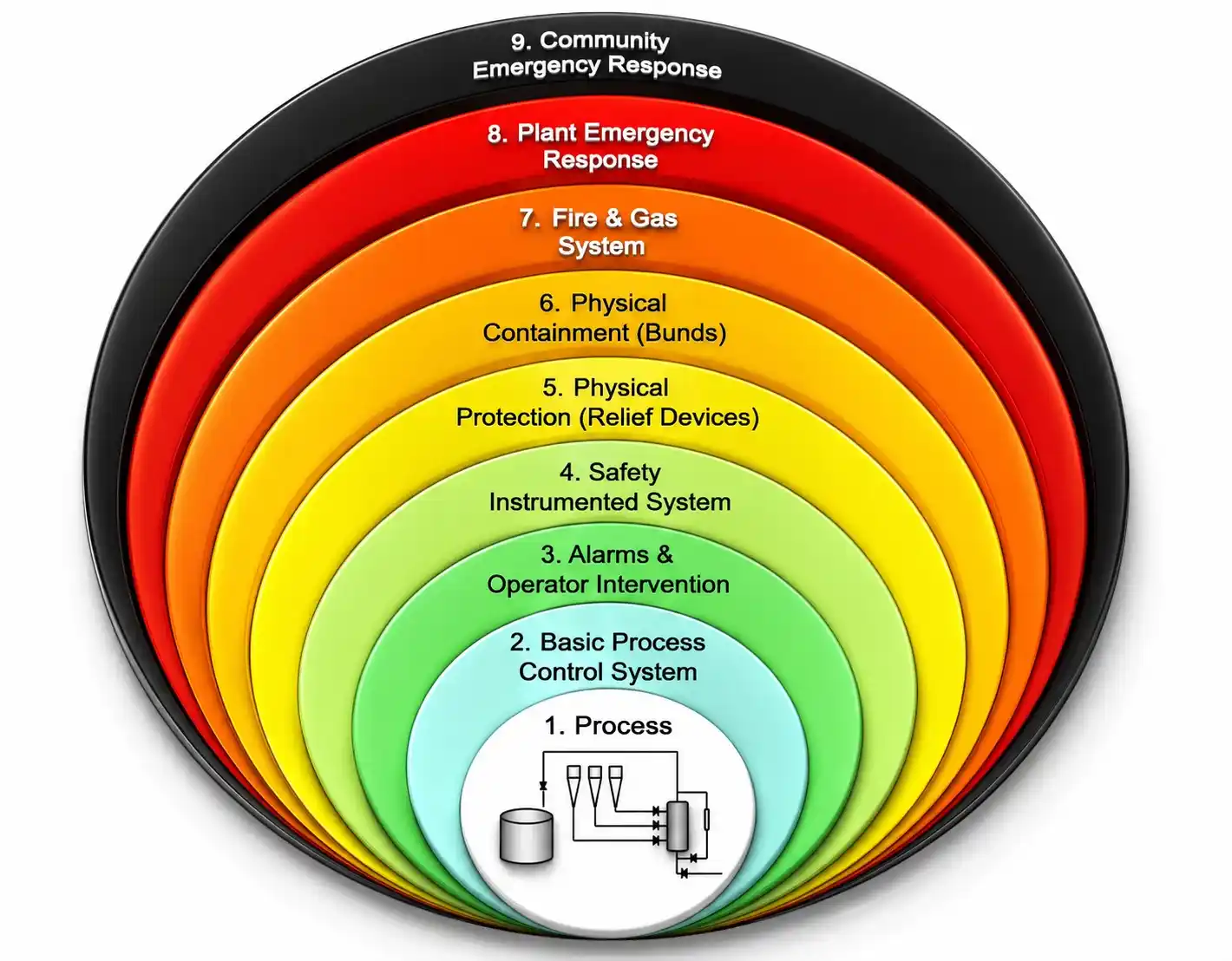
Where Each System Sits in the Layers of Protection
BPCS handles normal control at the core. If that fails, alarms alert an operator. If that also fails, SIS forces a safe state automatically. Physical protection is the final backstop.
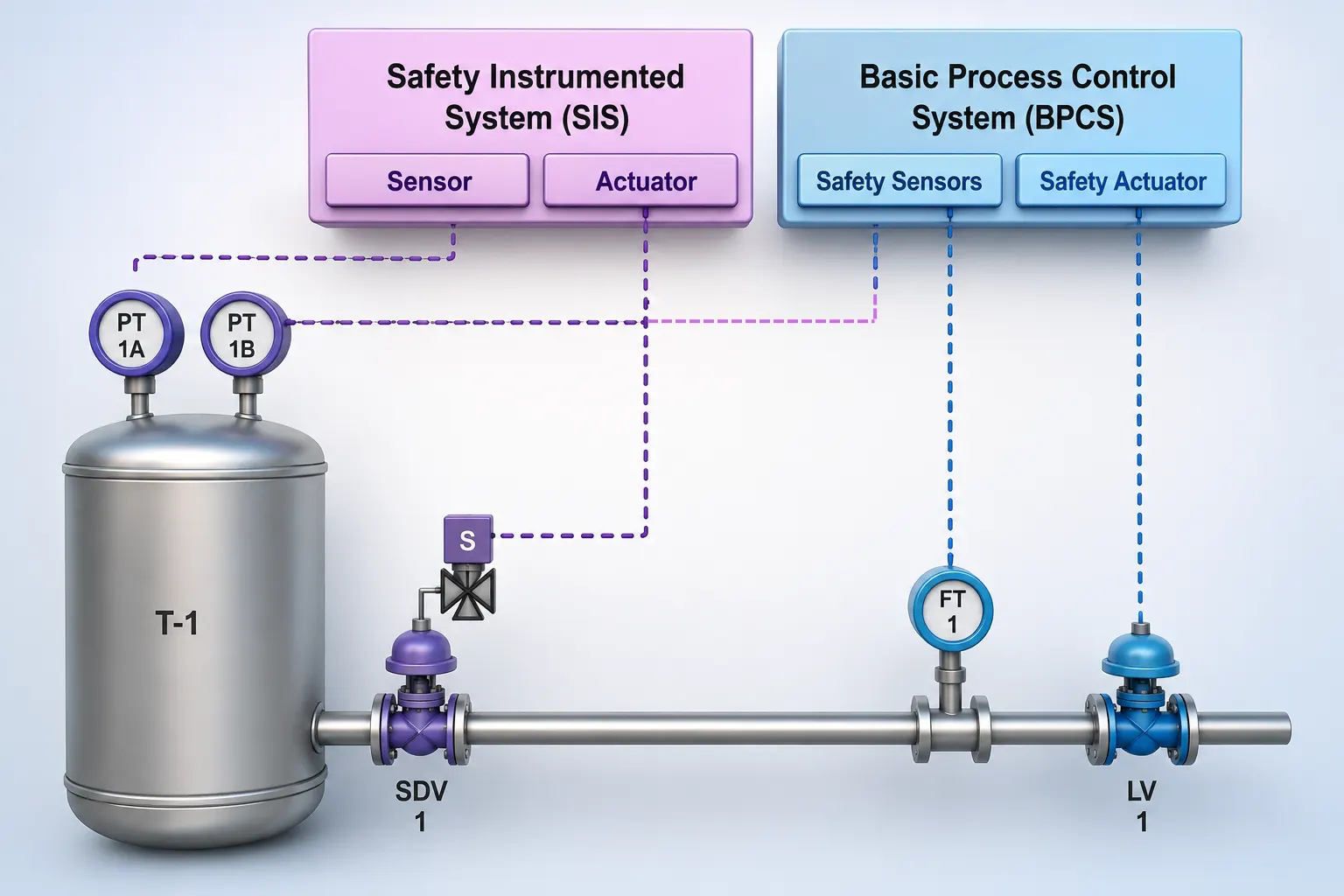
Full Comparison Table: SIS vs BPCS
This table captures the practical distinctions between SIS and BPCS across every angle covered above.
| Feature | BPCS | SIS |
|---|---|---|
| Primary purpose | Continuous process control | Emergency response, safe state on demand |
| Operating state | Active, dynamic, constantly working | Passive, dormant, waits for a demand |
| Independence requirement | Not mandatory | Mandatory wherever practical |
| Governing standard | General control system practice | IEC 61511 / ANSI ISA 84 |
| Typical failure visibility | Usually self revealing | Often hidden until tested or demanded |
| Change management | Routine, standard MOC | Strict, formal MOC with SIL impact review |
| Testing regime | General maintenance schedule | Scheduled proof testing at defined intervals |
Where SIL Fits Into This Picture
Every Safety Instrumented Function inside an SIS is assigned a Safety Integrity Level based on how much risk reduction it must provide, expressed as Probability of Failure on Demand.
| SIL Level | Probability of Failure on Demand (PFD) |
|---|---|
| SIL 1 | Between 1 in 10 and 1 in 100 |
| SIL 2 | Between 1 in 100 and 1 in 1,000 |
| SIL 3 | Between 1 in 1,000 and 1 in 10,000 |
| SIL 4 | Between 1 in 10,000 and 1 in 100,000 |
BPCS has no equivalent SIL rating of its own, though a well designed BPCS loop can occasionally be credited as a risk reduction layer if it independently meets specific performance and independence criteria. For the full picture on how SIL is actually determined, see our complete beginner's guide to SIL.
Watch: BPCS vs SIS, A HAZOP Crash Course
This video explains how BPCS and SIS function as different instrumented safeguards within a HAZOP context.
Why Independence Is Not Just Theory: The 2017 Triton Incident
In 2017, security researchers publicly documented malware, known as Triton or Trisis, that was specifically built to target Schneider Electric Triconex safety controllers at an industrial facility. Unlike malware aimed at general IT systems, Triton was designed to interact directly with the safety logic solver itself, the core of an SIS.
The case became a widely cited example in the functional safety community precisely because it demonstrated a real, documented attempt to compromise the layer of protection specifically meant to be independent and trustworthy when everything else fails. It is a concrete illustration of why standards insist on restricting write access to SIS controllers and keeping engineering access to the SIS in a more secured zone than the general BPCS network.
Quick FAQs: SIS and BPCS
These are the questions engineers ask most often once they start working with SIS and BPCS on a real project.
External References
- InstrumentationTools.com: SIS Design, Safety Instrumented System
- The Automation Blog: Safety Instrumented Systems vs Basic Process Control Systems
- SILSafe: Basic Process Control System (BPCS) in Functional Safety
What we learn today
- SIS and BPCS often share similar hardware, but their purpose is fundamentally different, continuous control versus emergency protection.
- Independence between SIS and BPCS is a formal requirement, not a suggestion, precisely because shared components can defeat two protection layers with a single failure.
- BPCS operates actively and reveals its failures quickly, while SIS operates passively, making diagnostics and scheduled proof testing essential to catch hidden faults.
- Real documented incidents, including the Triton malware case, demonstrate why SIS independence and restricted access are treated as genuinely critical, not just theoretical, requirements.