The line between a distributed control system and a programmable logic controller has blurred, yet the choice still shapes cost, engineering effort and plant uptime for decades. This guide compares both in one table, explains PAC hybrids and walks through real selection examples.
DCS vs PLC is no longer about hardware alone, since both now offer redundancy and PID. This guide compares I/O count, scan time, engineering tools and cost, explains PAC hybrids and gives a loop speed calculator and selection examples.
What Is the Difference Between DCS and PLC?
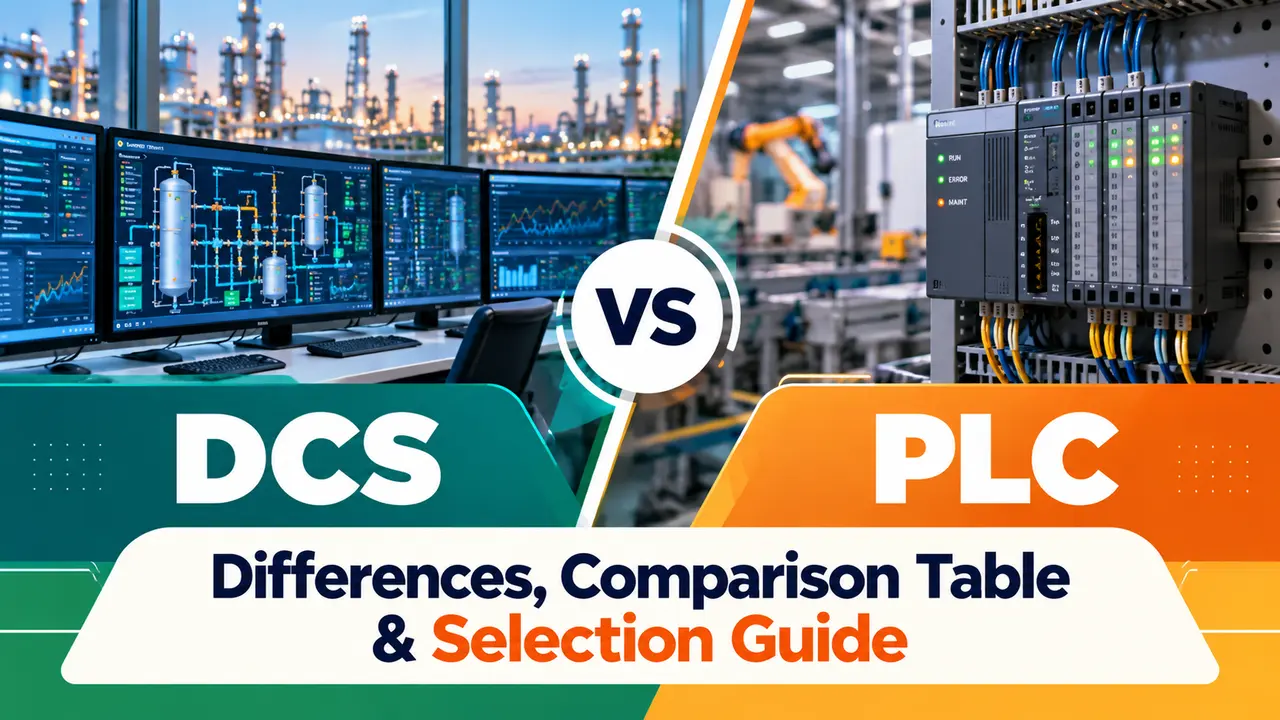
The core DCS vs PLC difference is that a DCS is a plant wide system built for continuous process control with one database, while a PLC is a fast, flexible controller built for discrete and machine control. Our earlier article on the difference between PLC and DCS covers the basics; this guide goes deeper into numbers and selection.
| Feature | DCS | PLC |
|---|---|---|
| Typical size | Thousands to tens of thousands of I/O | Tens to a few thousand I/O |
| Process type | Continuous and batch, analog heavy | Discrete, sequential, machine control |
| Typical scan | 100 to 500 ms for regulatory loops | 10 to 20 ms for motors and drives |
| Programming | Function blocks and SFC from a library | Ladder, structured text, function blocks |
| Database | One global tag and alarm database | Per controller, linked to SCADA or HMI |
| Redundancy | Controllers, I/O and networks as standard | Optional hot standby hardware |
| Engineering style | Top down, standard templates | Bottom up, per machine |
| HMI | Integrated operator stations | Separate HMI or SCADA package |
| Cost | Higher entry cost, efficient per loop at scale | Lower per I/O, cost rises with integration |
| Typical users | Refineries, fertiliser, power, pharma | Packaging, OEM skids, water plants, utilities |
The ladder logic is the popular PLC language while a DCS uses function block programming. For the wider family of controllers, see our glossary of PLC, PAC, RTU, DCS and SCADA terms.
I/O Count and Process Type
The Siemens white paper DCS or PLC lists application size, including the number of I/O points, as a common deciding factor. Its scalable DCS range runs from small systems with tens of I/O to client server systems with tens of thousands.
Wevolver reports that Rockwell sizes PlantPAx systems as small below 2,000 I/O, medium from 2,000 to 10,000 and large at 10,000 or more. Size alone does not decide, because a 300 I/O reactor with 40 PID loops is still a DCS style job.
Modicon built the first PLC in the United States in 1968 to replace hard wired relay panels, as Wevolver recounts. The first DCS products from Honeywell and Yokogawa followed in 1975.
DCS vs PLC Scan Time and Loop Speed
Siemens states that motor and drive control needs a controller scanning at about 10 to 20 ms, while regulatory loops normally scan at 100 to 500 ms. A PLC repeats one cycle as fast as it can, as our guide on how the PLC scan cycle works shows, while a DCS schedules each module at a fixed period.
Wevolver notes that DeltaV control modules can be scheduled from 25 ms up to 60 seconds, and that a Logix periodic task can be set from 0.1 ms to 2000 s with a 10 ms default. In the DCS vs PLC debate, fixed periods give steady PID timing, while fast free running scans suit interlocks and motion.
Samples per time constant = Time constant ÷ Period
Flow loop time constant = 3 s
Required period = 3000 ÷ 10 = 300 ms or faster
Chosen DCS period = 250 ms
Samples = 3000 ÷ 250 = 12.0 per time constant
12.0 is above 10, so the loop is sampled fast enough
In a second example, a winder speed loop with a 0.15 s time constant needs a period of 15 ms or faster. That is PLC or drive territory, and our PID tuning guide explains why slow sampling also hurts tuning.
The ten samples per time constant figure is a common rule of thumb, not a standard. For loops with large dead time, check the loop with a step test before you fix the execution period.
Redundancy and Availability
A DCS treats redundant controllers, power supplies, I/O and networks as normal options, described in our guide to DCS controller redundancy. PLC makers now offer hot standby too, covered in PLC redundancy and hot standby.
Wevolver quotes a Siemens S7 1500 R/H fail over time of 300 ms or 50 ms, depending on the link type. It also notes that DeltaV redundancy reduces CPU free time by about 10 % and needs a licence, so redundancy is never free in either platform.
Engineering Tools and Programming
DCS engineering uses a library of tested function blocks, so a PID loop with alarms is built from one template, as explained in DCS function block programming. Siemens describes this as top down engineering, with heavy upfront design that shortens the schedule.
PLC engineering is usually bottom up, machine by machine, using the IEC 61131 3 languages such as ladder and structured text. The HMI, alarms and historian are often separate packages that must be mapped tag by tag.
PLC Based Hybrid Systems: The PAC
A programmable automation controller, or PAC, is a PLC class controller with DCS style features such as tag databases, process libraries and redundancy. Systems like Rockwell PlantPAx, built on ControlLogix, sit right between DCS vs PLC, as our ControlLogix 5590 article shows.
Integrated controllers, I/O, operator stations and one engineering database from one vendor.
Standalone PLCs linked to a SCADA or HMI package, engineered per machine or unit.
PLC hardware with process libraries, global tags and redundancy.
Both a DCS and a PLC based system still need a separate, certified safety system for trips. The basic process control system is not credited as a safety layer in the same way.
DCS vs PLC Selection Guide With Examples
Use the examples below to test your own project; our guide on how to select the right PLC helps once the PLC route is chosen.
| Project | Key features | Best fit | Reason |
|---|---|---|---|
| Bottle filling line | 300 digital I/O, fast motion | PLC | Fast scan, low cost, machine logic |
| Effluent treatment plant | 150 I/O, few slow loops | PLC with SCADA | Small, simple, local service |
| Fertiliser ammonia unit | 3,000 I/O, 250 PID loops | DCS | Analog heavy, high downtime cost |
| Pharma batch plant | 800 I/O, recipes, audit trail | DCS or PAC | Batch control, validation needs |
| Cement plant | 2,000 I/O, many drives | PLC based DCS | Mixed discrete and process |
- Total I/O now and in ten years
- Share of analog I/O and PID loops
- Batch, recipe and audit needs
- Cost of downtime per hour
- Redundancy required and its budget
- Skills of the site maintenance team
- Vendor support and spares in India
- Migration path and obsolescence plan
Separate safety functions from the choice, as explained in our article on SIS and BPCS differences. For existing sites, our guide on DCS migration and obsolescence explains what changes when you replace old controllers.
DCS vs PLC Pros and Cons
- One database for tags, alarms and history.
- Redundancy and diagnostics built in.
- Strong PID, batch and advanced control.
- Consistent standards across a large plant.
- Fast scan for interlocks and motion.
- Lower cost per I/O for small systems.
- Wide choice of makers and skills.
- Easy to fit on machines and skids.
DCS vs PLC Myths
When comparing quotes, ask both bidders for the cost per loop including HMI, historian and engineering. A cheap PLC price can double once integration is added.
Common Field Problems on Each Platform
| Symptom | Platform | Likely cause | First check |
|---|---|---|---|
| Loop slow to respond | DCS | Module period too long | Execution period vs time constant |
| Watchdog fault | PLC | Scan time too long | Loops and communication blocks |
| Tags differ between HMI and controller | PLC | Mapping errors | Tag export and addresses |
| Switchover alarm | Both | Primary controller or sync link fault | Redundancy diagnostics |
Most of these issues appear first at FAT and SAT, so test loop timing and switchover there.
Siemens DCS or PLC White Paper PDF
Video on DCS vs PLC
DCS vs PLC FAQ
A DCS is a plant wide system with one database, built for continuous process control with many PID loops. A PLC is a fast controller built mainly for discrete, sequential and machine control.
Modern products overlap, since PLCs run PID and some DCS ranges are small. The real difference now lies in engineering tools, integration and lifecycle cost.
Neither is better for every job, because each suits a different type of process. A DCS fits large, analog heavy plants where downtime is very costly.
A PLC fits machines, skids and smaller plants that need fast logic at low cost. Many sites use both, with PLCs on packaged units reporting to a central control system.
Process plants have hundreds of interacting loops, alarms and batch steps that must run for years without a break. A DCS gives one database, tested function blocks and redundancy at every level.
This reduces engineering effort, wiring errors and testing time on large projects. Siemens advises a DCS when batch value is high and downtime is dangerous.
A PLC usually scans faster, often around 10 to 20 ms for motor and drive control according to Siemens. A DCS runs most regulatory loops at fixed periods of 100 to 500 ms.
Faster is not always better for PID, because steady timing matters more. Both platforms can run fast tasks when the application really needs them.
A PAC, or programmable automation controller, is a PLC class controller with process features such as global tags and libraries. It blurs the DCS vs PLC line for mid size plants.
Rockwell PlantPAx running on ControlLogix hardware is a widely used example of this approach. A PAC suits sites that mix discrete machines with a moderate number of process loops.
A PLC system with SCADA can replace a small DCS, and PLC based process systems can handle medium plants. The effort shifts to engineering the database, alarms and redundancy yourself.
For very large analog heavy plants, a DCS is usually easier to engineer and maintain. Compare full lifecycle cost before you decide on a replacement.
Related Articles
- Difference Between PLC and DCS
- PLC, PAC, RTU, DCS and SCADA Automation Terms
- DCS Components: ES, OS and AS
- PLC vs RTU
- Distributed Control System
External References
- DCS or PLC? White Paper, Siemens
- Difference Between PLC and DCS, Wevolver
- Distributed Control System, Wikipedia
What We Learn Today
- DCS vs PLC is now decided by process type, loop count, engineering tools and downtime cost rather than by hardware alone.
- PLCs scan at about 10 to 20 ms for motors and drives, while DCS regulatory loops normally run at fixed periods of 100 to 500 ms.
- PAC and PLC based process systems sit between the two and suit mid size plants that mix machines with process loops.