
Table of Contents
ToggleCommunication Protocols in DCS Systems: Introduction
Modern process industries such as oil & gas, power plants, chemical plants, pharmaceuticals, food processing, and water treatment plants depend heavily on Distributed Control Systems (DCS) for automation and control.
A DCS system cannot function properly without reliable communication between field instruments, controllers, servers, operator stations, and engineering workstations.
This communication is made possible through industrial communication protocols.
Communication protocols act like a common language that allows different devices to exchange data accurately and efficiently. Without these protocols, transmitters, control valves, PLCs, analyzers, drives, and DCS controllers would not be able to communicate with each other.
In older plants, communication was mainly based on analog 4-20mA signals. But modern process plants now use digital communication protocols that provide much more information, higher accuracy, diagnostics, remote configuration, and faster communication.
In this article, we will understand the major communication protocols used in DCS systems, how they work, their advantages, limitations, and where they are commonly used in industries.
Why Communication Protocols are Important in DCS Systems
A DCS system contains many interconnected devices such as:
1. Field Instruments
Pressure transmitters, flow meters, temperature transmitters, analyzers, level transmitters, and control valves.
2. Controllers
Process controllers that perform PID calculations and control strategies.
3. Human Machine Interface (HMI)
Operator stations used for monitoring and controlling the process.
4. Engineering Stations
Used for programming, configuration, and diagnostics.
5. Historians and Servers
Used for data storage, reporting, and plant analysis.
All these devices continuously exchange information such as:
- Process variables
- Alarm status
- Device diagnostics
- Control commands
- Setpoints
- Historical data
- System health information
Communication protocols ensure this data transfer happens correctly, quickly, and safely.
1) HART Protocol
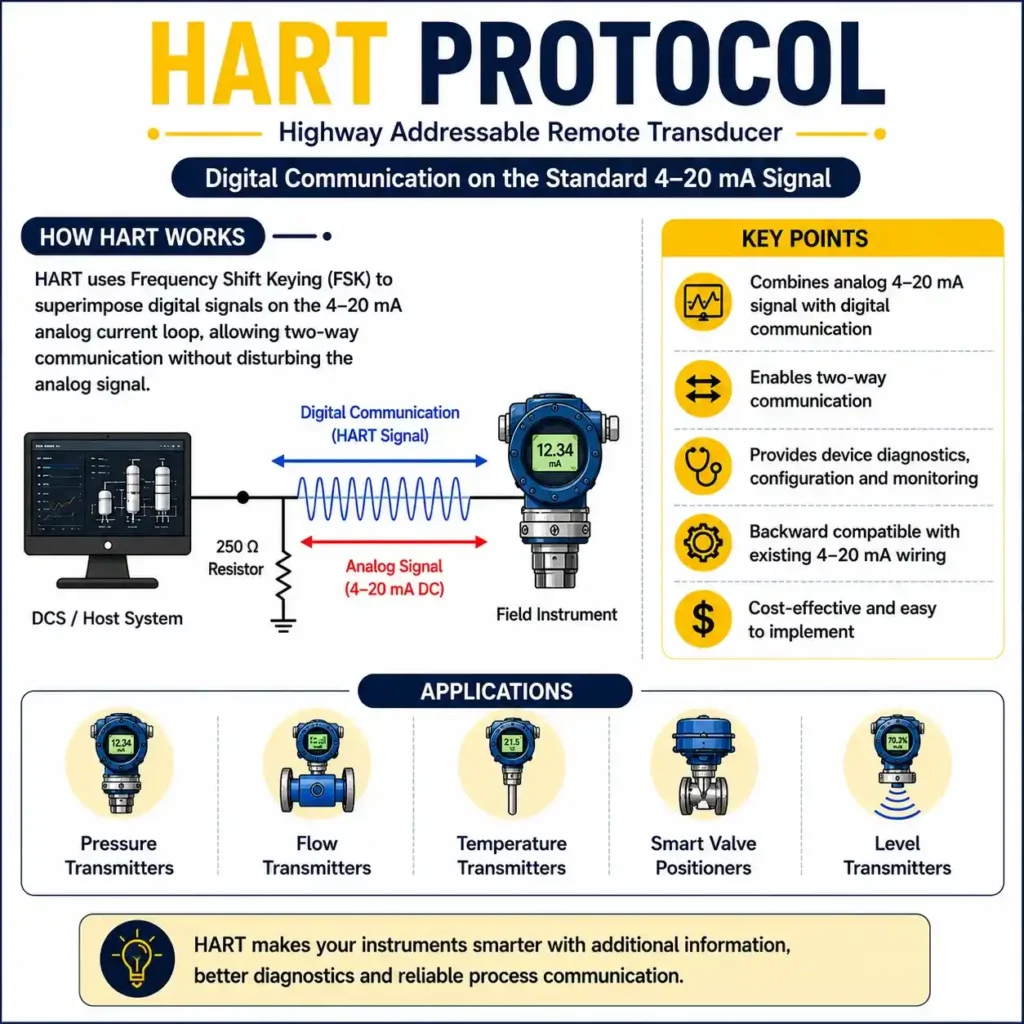
HART stands for Highway Addressable Remote Transducer.
It is one of the most widely used communication protocols in process industries.
HART combines traditional analog 4-20mA signals with digital communication. This means the instrument can still send the main process variable through the analog signal while simultaneously sending additional digital information.
How HART Works
HART uses Frequency Shift Keying (FSK) technology to superimpose digital signals on the analog 4-20mA current loop.
This allows communication without disturbing the analog measurement signal.
Information Available Through HART
Using HART communication, engineers can access:
- Process variable
- Device diagnostics
- Sensor status
- Calibration information
- Device tag number
- Range settings
- Device temperature
- Fault alarms
Advantages of HART Protocol
- Works with existing 4-20mA wiring
- Easy to implement
- Low installation cost
- Provides remote diagnostics
- Widely supported by instrument manufacturers
Limitations of HART Protocol
- Communication speed is relatively slow
- Limited multidrop capability
- Not suitable for very large high-speed networks
Common Applications of HART
- Pressure transmitters
- Flow transmitters
- Temperature transmitters
- Smart valve positioners
2) Modbus Protocol
Modbus is one of the oldest and most commonly used industrial communication protocols.
It was originally developed by Modicon in 1979 for PLC communication.
Today, Modbus is widely used in DCS systems because of its simplicity and low cost.
Types of Modbus
- Modbus RTU
Uses serial communication, mainly RS-485. - Modbus ASCII
Less commonly used serial communication format. - Modbus TCP/IP
Uses Ethernet networks for faster communication.
How Modbus Works
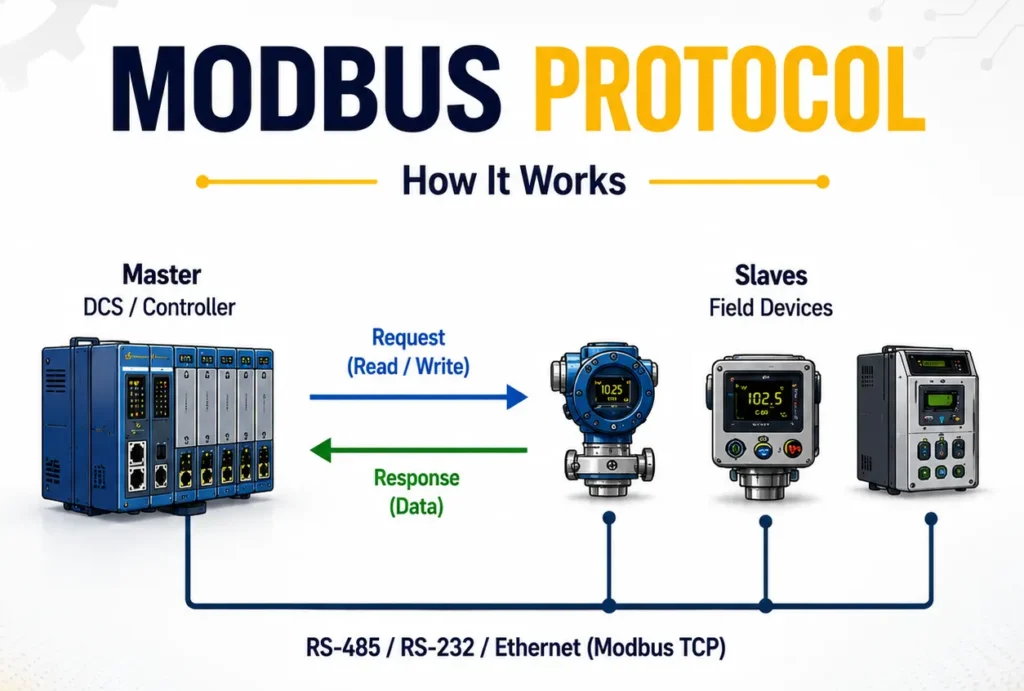
Modbus uses a master-slave communication method.
- The master device requests information
- Slave devices respond to the request
In DCS systems:
- DCS controller often acts as master
- Field devices act as slaves
Advantages of Modbus
- Simple protocol structure
- Easy integration with third-party devices
- Low implementation cost
- Widely accepted worldwide
- Supports long communication distances using RS-485
Limitations of Modbus
- Limited security features
- Lower speed compared to modern Ethernet protocols
- Basic diagnostics capability
Common Applications of Modbus
- Energy meters
- VFDs
- PLC communication
- Remote I/O systems
- Water treatment plants
3) Profibus Protocol
Profibus stands for Process Field Bus.
It was developed in Germany and became very popular in process automation and factory automation industries.
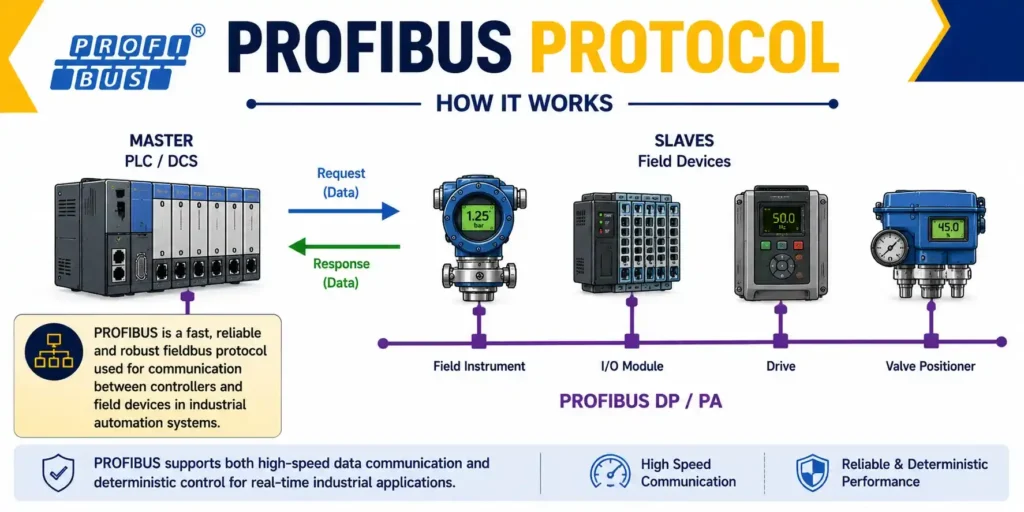
Profibus allows multiple field devices to communicate on a single communication cable.
Types of Profibus
- Profibus DP
Used for high-speed communication between controllers and remote I/O devices. - Profibus PA
Designed specifically for process automation and hazardous areas.
Features of Profibus PA
Profibus PA is widely used in process plants because:
- It supports intrinsically safe communication
- Devices can receive power and communication on the same cable
- Suitable for hazardous areas
Advantages of Profibus
- Reduces wiring costs
- Supports many field devices
- Good diagnostics capability
- Reliable communication
- Suitable for hazardous locations
Limitations of Profibus
- Installation requires skilled engineers
- Troubleshooting can become difficult in large networks
- Network configuration is more complex than Modbus
Common Applications of Profibus
- Chemical plants
- Oil & gas plants
- Pharmaceutical industries
- Process automation systems
4) FOUNDATION Fieldbus
FOUNDATION Fieldbus is one of the most advanced digital communication protocols used in process automation.
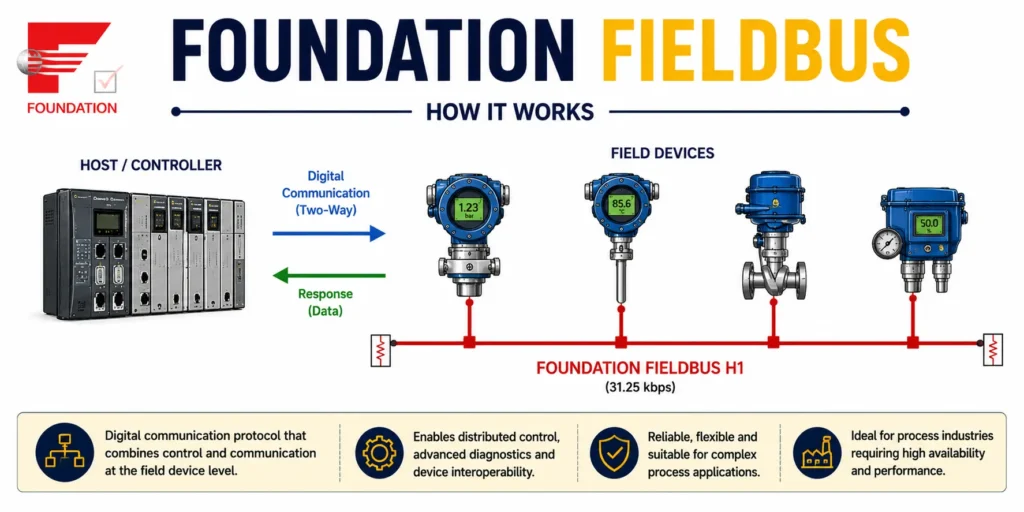
Unlike traditional systems where the controller performs all PID calculations, FOUNDATION Fieldbus allows control functions to be distributed into field devices themselves.
This is called distributed control in the true sense.
Key Features of FOUNDATION Fieldbus
- Fully digital communication
- Multiple devices on one cable
- Advanced diagnostics
- Distributed control capability
- Reduced wiring requirements
Types of FOUNDATION Fieldbus
- H1 Fieldbus
Used for field-level devices. - High-Speed Ethernet (HSE)
Used for higher-level communication.
Advantages of FOUNDATION Fieldbus
- Excellent diagnostics
- Reduced control room wiring
- Better asset management
- Improved device intelligence
- Higher process information availability
Limitations of FOUNDATION Fieldbus
- Complex engineering requirements
- Higher initial cost
- Requires skilled maintenance personnel
Common Applications of FOUNDATION Fieldbus
- Refineries
- Large process plants
- Advanced automation systems
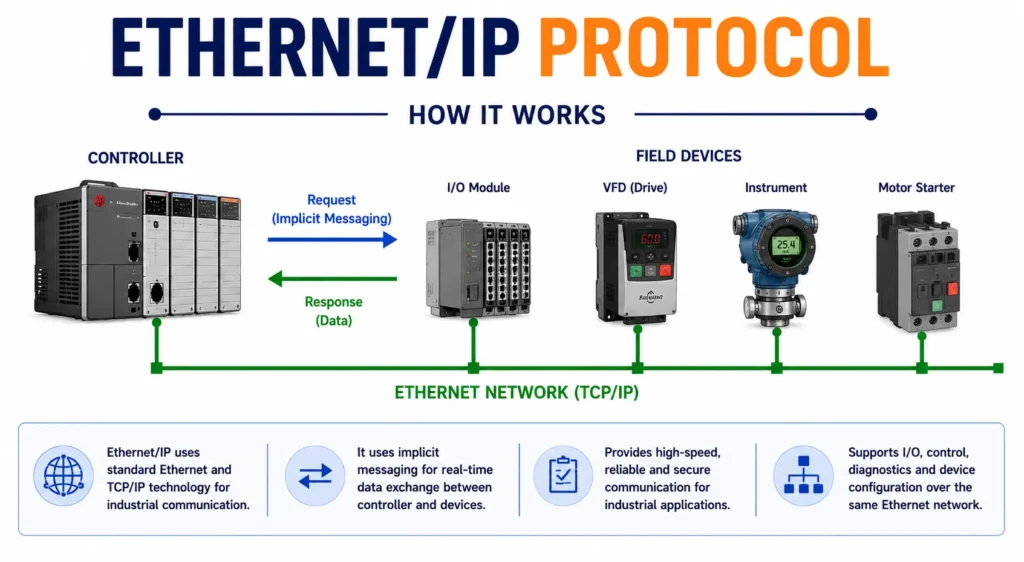
5) Ethernet/IP Protocol
Ethernet/IP stands for Ethernet Industrial Protocol.
It is based on standard Ethernet technology and is widely used in modern industrial automation systems.
Ethernet/IP allows high-speed communication between industrial devices over Ethernet networks.
Advantages of Ethernet/IP
- High communication speed
- Easy integration with IT systems
- Supports large data transfer
- Scalable network structure
- Widely used in modern plants
Limitations of Ethernet/IP
- Higher network traffic management required
- Proper cybersecurity protection is essential
Common Applications of Ethernet/IP
- Modern DCS systems
- PLC communication
- Motor control systems
- Plant-wide industrial networks
6) Profinet Protocol
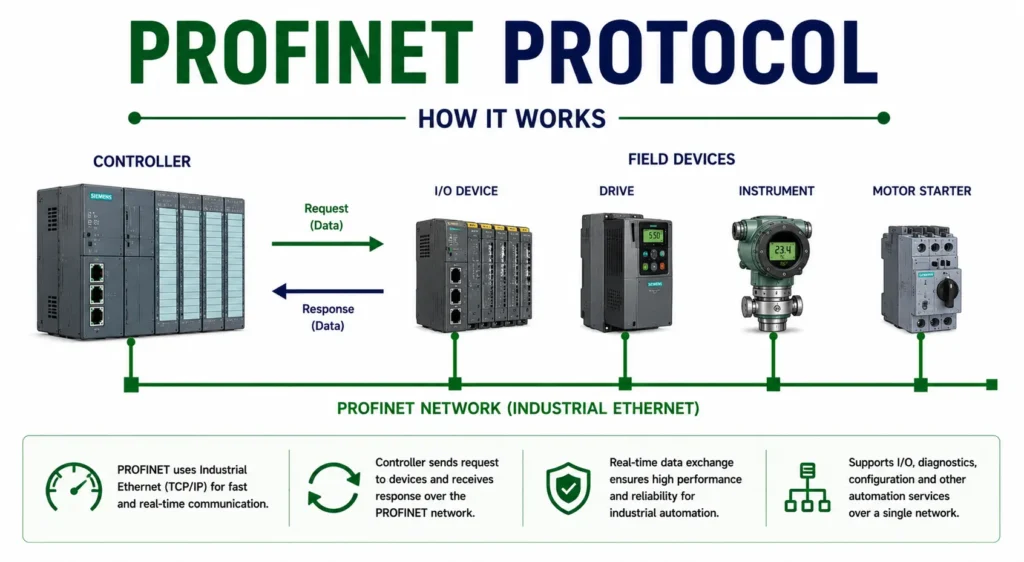
Profinet is an industrial Ethernet protocol mainly developed for automation systems.
It is widely used with Siemens automation systems but also supports many third-party devices.
Profinet provides very fast communication and supports real-time industrial control applications.
Advantages of Profinet
- Very high-speed communication
- Real-time data exchange
- Easy Ethernet integration
- Supports diagnostics and redundancy
Common Applications of Profinet
- Manufacturing plants
- Process industries
- High-speed automation systems
7) OPC and OPC UA
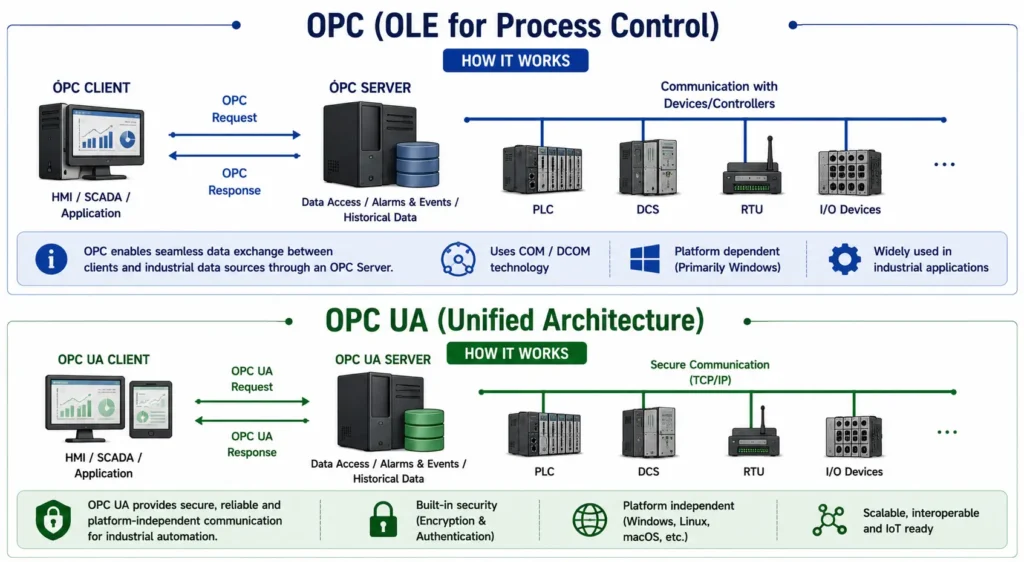
OPC stands for Open Platform Communications.
OPC is not directly a field communication protocol like Modbus or Profibus. Instead, it acts as a communication bridge between different industrial software and hardware systems.
Why OPC is Important
In many plants, devices from different manufacturers need to exchange data.
For example:
- DCS
- SCADA
- Historians
- MES systems
- ERP software
OPC enables seamless data exchange between these systems.
OPC UA vs Traditional OPC
OPC UA is the modern version with:
- Better cybersecurity
- Platform independence
- Improved reliability
- Better scalability
Advantages of OPC UA
- Vendor-independent communication
- High cybersecurity support
- Scalable architecture
- Secure remote communication
Common Applications of OPC UA
- Industrial IoT
- Smart factories
- Cloud integration
- Data analytics systems
Redundancy in DCS Communication Networks
Communication failure in a process plant can lead to serious operational problems.
Therefore, modern DCS systems use network redundancy.
Redundancy means having backup communication paths.
If one communication cable, switch, or controller fails, communication automatically shifts to the backup path without shutting down the process.
Common Redundancy Methods
- Ring topology
- Dual Ethernet networks
- Redundant switches
- Redundant controllers
Redundancy is extremely important in:
- Refineries
- Power plants
- Petrochemical plants
- Critical process industries
Cybersecurity in Modern DCS Communication
As DCS systems become connected to Ethernet networks and cloud systems, cybersecurity has become a major concern.
Common cybersecurity risks include:
- Unauthorized access
- Malware attacks
- Ransomware
- Network intrusion
- Data theft
Modern DCS communication systems now include:
- Firewalls
- VLAN segregation
- Secure OPC UA communication
- Access control
- Network monitoring
- Industrial cybersecurity standards
Common Communication Problems in DCS Systems
In real industrial plants, communication problems are very common which includes:
- Loose communication wiring
- Incorrect baud rate settings
- Address conflicts
- Grounding problems
- Network noise and EMI
- Damaged communication cables
- Improper termination resistors
- Switch failures
- Power supply instability
FAQs
1. What is the most commonly used communication protocol in DCS systems?
HART and Modbus are among the most commonly used communication protocols in DCS systems due to their simplicity, reliability, and wide industry acceptance.
2. What is the difference between Profibus and FOUNDATION Fieldbus?
Profibus mainly focuses on fast communication between controllers and devices, while FOUNDATION Fieldbus also supports distributed control functions directly in field devices.
3. Why is OPC UA important in modern industries?
OPC UA enables secure and reliable data exchange between different industrial systems, cloud platforms, and software applications.
4. Which communication protocol is best for hazardous areas?
Profibus PA and FOUNDATION Fieldbus are widely used in hazardous areas because they support intrinsically safe communication.
5. Why is redundancy important in DCS communication networks?
Redundancy provides backup communication paths, ensuring continuous plant operation even if a network cable, switch, or controller fails.
What we learn today?
Communication protocols are essential for reliable communication in DCS systems. Protocols like HART, Modbus, Profibus, FOUNDATION Fieldbus, Ethernet/IP, Profinet, and OPC UA help connect field devices, controllers, and operator systems efficiently.
As industries move toward smart manufacturing and Industrial IoT, understanding these protocols becomes increasingly important for modern instrumentation and automation engineers.


I hope you like above blog. There is no cost associated in sharing the article in your social media. Thanks for Reading !! Happy Learning