SCADA and DCS both put plant data on an operator screen, yet they were built for very different jobs and distances. This guide compares them side by side, shows where each fits in Indian plants and explains why most large sites now run both.
SCADA vs DCS is a question of geography and control depth: SCADA supervises dispersed sites, while a DCS closes loops inside one plant. This guide gives a full comparison table, architecture notes, a polling calculator and a selection checklist.
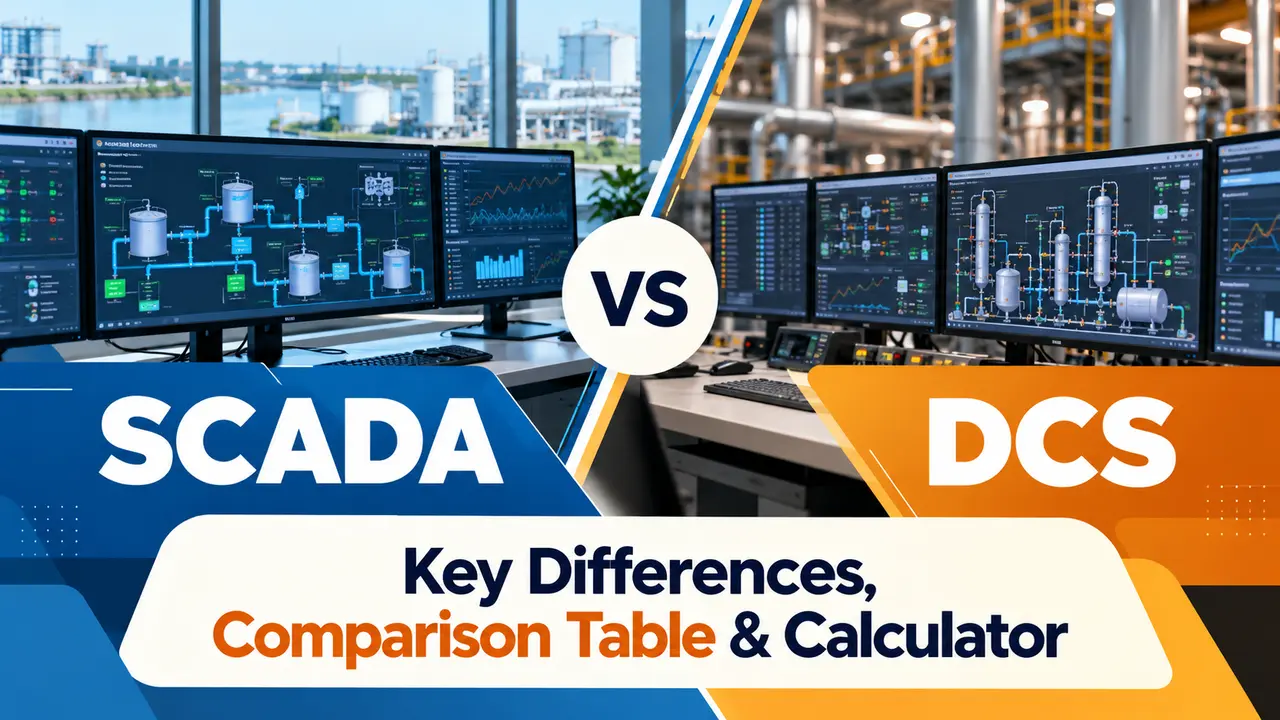
What Is the Difference Between SCADA and DCS?
The main SCADA vs DCS difference is that SCADA supervises and collects data from equipment spread over a wide area, while a distributed control system directly runs continuous control loops inside one plant. Control.com sums it up neatly: SCADA is data oriented and a DCS is process oriented.
| Feature | SCADA | DCS |
|---|---|---|
| Main job | Supervisory monitoring and data collection | Continuous closed loop process control |
| Geography | Dispersed sites, from kilometres to thousands of kilometres | One plant or one site |
| Field controllers | RTUs and PLCs at each site | Vendor DCS controllers with I/O |
| Network | Radio, fibre, GPRS, leased lines, satellite | High speed redundant plant LAN |
| Typical update | Seconds to minutes per site, often by exception | 100 to 500 ms for regulatory loops |
| Control logic | Mostly in the RTU or PLC | Function blocks in the controller |
| Redundancy | Servers and links, site by site | Controllers, networks and I/O as standard |
| Database | Tags built per site, often by hand | One global database for all tags |
| Cost model | Low per site, grows with sites | Higher entry cost, lower cost per loop at scale |
| Typical users | Pipelines, water, power grids, gas distribution | Refineries, fertiliser, petrochemicals, power plants |
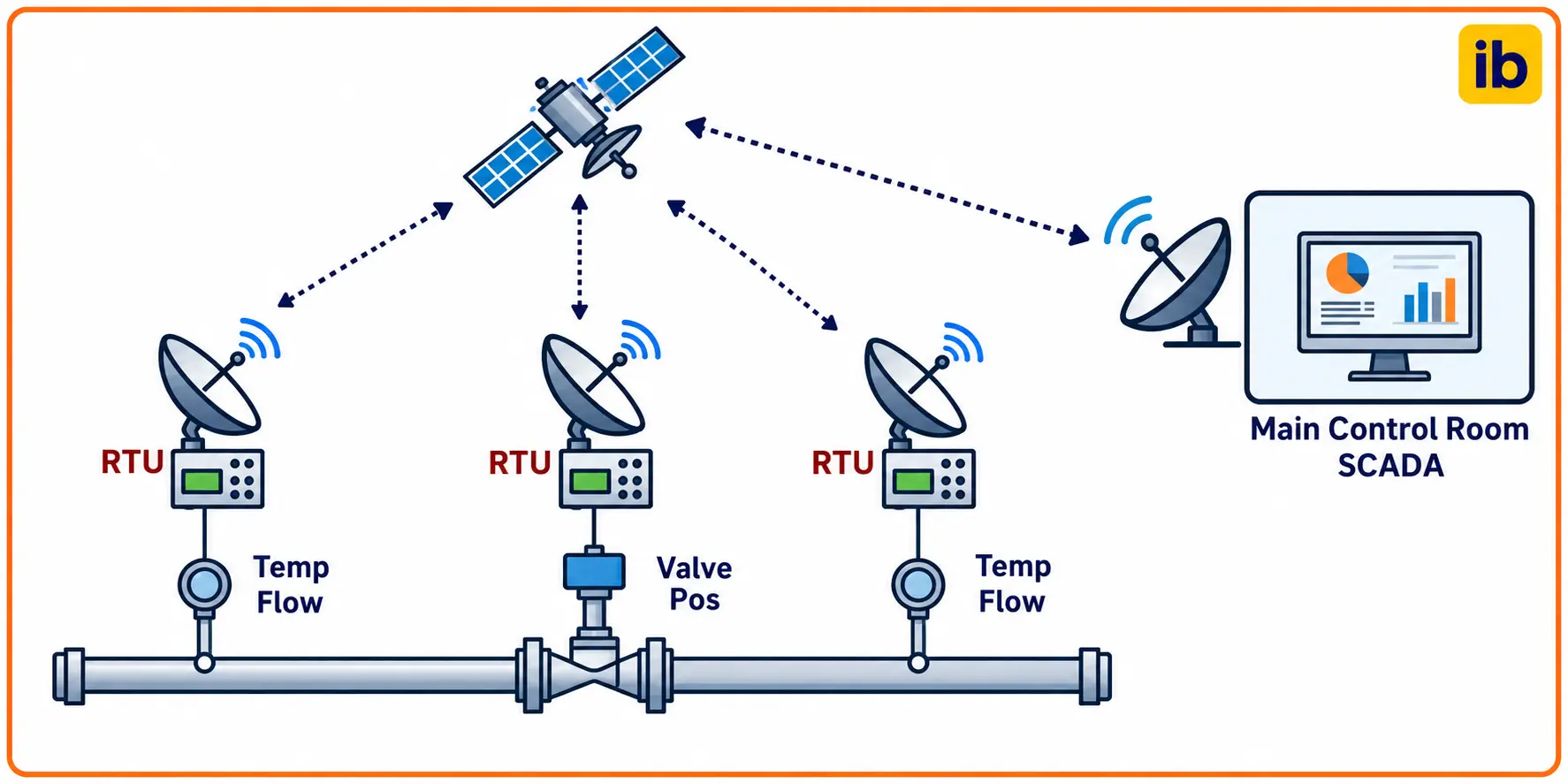
Please see above figure. It shows SCADA watching a pipeline from a regional control centre. Before you go deeper, our glossary of PLC, PAC, RTU, DCS and SCADA terms sets out the basic vocabulary.
SCADA and DCS Architecture Compared
A SCADA system has a master station with servers, HMI clients and a historian, a wide area network and many remote sites. Each site has an RTU or a PLC that does the local control and reports to the centre.
A DCS has engineering, operator and controller stations on one plant network, as our article on DCS components ES, OS and AS explains. All controllers share one database, one alarm system and one engineering tool, which is the core of the SCADA vs DCS design gap.
NIST SP 800 82 describes SCADA as highly distributed systems for geographically dispersed assets, built to cope with long distance delays and data loss. It describes a DCS as controlling production within the same geographic location over local area networks, which matches the Purdue model levels above.
NIST notes that real control systems are often hybrids that blur the line between DCS and SCADA. A large refinery can run a DCS inside the fence and a SCADA system for its crude pipeline.
Control vs Supervisory: Who Closes the Loop?
In a DCS, the controller itself runs PID loops, cascades and sequences, using the DCS control strategies built into its function block library. Control.com gives the example of a reactor, where a DCS holds temperature steady with PID instead of just opening a valve.
In SCADA, the master station sends set points and start or stop commands, while the RTU or PLC runs the local loop. Forbes Marshall describes SCADA as event driven, acting when a parameter changes, while a DCS runs closed loop control continuously.
If a loop must keep running when the radio link fails, its logic belongs in the RTU or PLC at site. Never place a fast control loop across a wide area link.
Scan Rate and Polling Calculation With Solved Example
The Siemens white paper DCS or PLC states that regulatory control loops normally scan in the 100 to 500 ms range. A SCADA master polling many sites over a slow link refreshes each site far less often, unless it uses report by exception with DNP3 or IEC 60870 5 104.
SCADA scan = Number of RTUs × Poll time
Request = 8 bytes, response = 85 bytes (40 registers)
Bits = 93 × 11 = 1023 bits at 9600 baud
Transmit time = 1023 ÷ 9600 = 106.6 ms
Poll time = 106.6 + 100 latency = 206.6 ms
SCADA scan = 20 × 206.6 ms = 4.13 s
Ratio = 4.13 s ÷ 0.5 s = 8.3 times a DCS loop scan
The 11 bits per byte come from one start bit, eight data bits, one parity bit and one stop bit on a serial link. In a second example, a 4G link at 115200 baud with 300 ms latency gives about 309 ms per poll, so latency, not baud rate, dominates.
This is why SCADA engineers move to DNP3 or IEC 60870 5 104 with time stamped events, and why store and forward at site keeps data when the link drops.
Redundancy, Availability and Security
A DCS ships with redundant controllers, power supplies and networks as a normal option, covered in our guide to DCS controller redundancy. SCADA redundancy focuses on hot standby servers, dual communication paths and spare RTU power, as shown in our SCADA redundancy architecture article.
Control.com points out that SCADA moves a lot of data over wide networks, so network security becomes a priority. A DCS keeps data local, but both need the zone and conduit approach of IEC 62443.
SCADA vs DCS Pros and Cons
- Covers sites hundreds of kilometres apart.
- Low cost per site using RTUs or PLCs.
- Easy to add new sites and tags.
- Works over radio, GPRS and satellite.
- Fast, deterministic closed loop control.
- One database, alarm list and engineering tool.
- Redundancy built in at every level.
- Strong batch and advanced control.
SCADA weaknesses are slow updates, dependence on the link and tag databases spread across many devices. A DCS has a higher entry price and vendor lock in, and Control.com notes it is harder to scale across wide areas.
Control.com notes that SCADA started as a way of collecting and storing data for archival purposes. Control features grew later as RTUs and PLCs became more capable.
Which Is Better: SCADA or DCS?
Neither is better in general; the SCADA vs DCS choice depends on distance, control depth and how costly a stop is. Use the type cards below as a quick guide.
Assets spread over a city, state or pipeline route; supervisory control with local logic at each site.
One plant with hundreds of PID loops, interlocks and batch control, where downtime is very costly.
A DCS inside the plant plus SCADA for remote assets, linked through a historian or gateway.
In hybrid systems the SCADA vs DCS line blurs, and the DCS often takes data from remote RTUs, or a SCADA layer gathers data from several DCS units for a corporate control room. A shared historian usually ties the two together.
SCADA vs DCS Selection Checklist
- Distance between assets and the control room
- Number of PID loops and their speed
- Cost of an unplanned stop or a bad batch
- Available links: fibre, radio, cellular or satellite
- Redundancy needed for controllers, servers and networks
- In house skills and vendor support in India
- Cybersecurity zones under IEC 62443
- Future expansion of sites or units
Common vendors include AVEVA, Siemens WinCC and Inductive Automation Ignition for SCADA, and Emerson DeltaV, Honeywell Experion, Yokogawa CENTUM VP and ABB 800xA for DCS. If your choice is really between controllers, see our comparisons of PLC vs RTU and PLC and DCS.
SCADA vs DCS Myths
When a SCADA screen shows stale values, check the communication status tag for that site before trusting the number. Good SCADA displays grey out values whose link has failed.
SCADA vs DCS Troubleshooting Tips
| Symptom | More likely in | Likely cause | First check |
|---|---|---|---|
| Values frozen for one site | SCADA | Link down or RTU failed | Comms status, RTU power |
| Slow screen updates | SCADA | Too many polls on a slow channel | Poll time and channel loading |
| Events out of order | SCADA | Clock drift between RTUs | Time sync source |
| Controller switchover alarm | DCS | Primary controller fault | Diagnostics, redundancy link |
| Loop oscillating | DCS | Poor tuning or valve problem | Trend PV, OP and valve position |
For field fixes, see our guides on SCADA communication problems and SCADA time synchronisation.
NIST Guide to Industrial Control Systems Security PDF
Video on SCADA vs DCS
SCADA vs DCS FAQ
SCADA supervises and gathers data from equipment spread over a wide area, such as pipelines and water networks. A DCS directly controls a process inside one plant using fast closed loops.
SCADA leaves most control to RTUs and PLCs at each site. A DCS runs its control logic in its own controllers on a plant network.
No, they are two different types of industrial control system, although NIST notes that real systems are often hybrids. SCADA is built for dispersed assets and slow or unreliable links.
A DCS is built for one site with a fast, redundant network and a single database. Both can share the same historian and operator style screens.
Neither is better in every case, because each one solves a different problem. SCADA is the better fit when assets are far apart and need supervisory control.
A DCS is the better fit for a large continuous process plant with many PID loops and a high cost of downtime. Many plants use both and link them through a historian.
Yes, but the control is normally done by the PLC or RTU at site, while SCADA sends set points and commands. Keeping the loop local means it keeps running when the link fails.
For plants with hundreds of interacting loops, a DCS is easier to engineer and maintain. That is the core of the SCADA vs DCS decision.
A DCS is a complete system of controllers, I/O, networks and software supplied as one package by the vendor. Control.com describes it as mostly hardware that runs the process directly.
SCADA is mostly a software layer on servers and HMI clients. It depends on RTUs or PLCs from one or many makers for its field connection.
Refineries have hundreds of interacting loops, interlocks and advanced control that must run without a break for years. A DCS gives fast loop scans, redundancy at every level and one engineering database.
The cost of an unplanned stop in a refinery is very high. Remote pipelines and tank farms linked to the refinery often still use a SCADA system for remote monitoring.
Related Articles
- PLC, PAC, RTU, DCS and SCADA Automation Terms
- DCS Components: ES, OS and AS
- PLC vs RTU
- How SCADA Systems Work
- Distributed Control System
External References
- Guide to Industrial Control Systems (ICS) Security, NIST SP 800 82
- DCS vs SCADA: What Is the Difference, Control.com
- SCADA, Wikipedia
What We Learn Today
- SCADA vs DCS comes down to geography and control depth: SCADA supervises dispersed sites, while a DCS closes fast loops inside one plant.
- DCS regulatory loops scan in the 100 to 500 ms range, while a polled SCADA channel may take several seconds to refresh every site.
- Many large plants run both, with a DCS inside the fence and SCADA for pipelines, water systems and other remote assets.