
Your next transformer failure may already have started, quietly, in the oil, the windings or a loose joint. Good transformer maintenance reads those early warning signs through eight simple checks, so a small defect never grows into a sudden plant outage.
Transformers rarely fail without warning, because rising temperature, degrading oil and loose joints usually tell the story first. This practical transformer maintenance guide explains eight checks, a schedule, a DGA gas table and an ageing calculator for Indian plants.

What Is Transformer Maintenance?
Transformer maintenance is the planned set of inspections, tests and corrective actions that keeps a power or distribution transformer healthy through its service life. Its real goal is not to repair failures but to detect deterioration early, long before it turns into a breakdown, which is the core idea of predictive and preventive maintenance.
A transformer rarely fails without a story. Rising temperature, degrading oil, electrical imbalance, loose connections and weak protection usually appear months earlier, and ignoring them turns a manageable job into an unexpected outage.
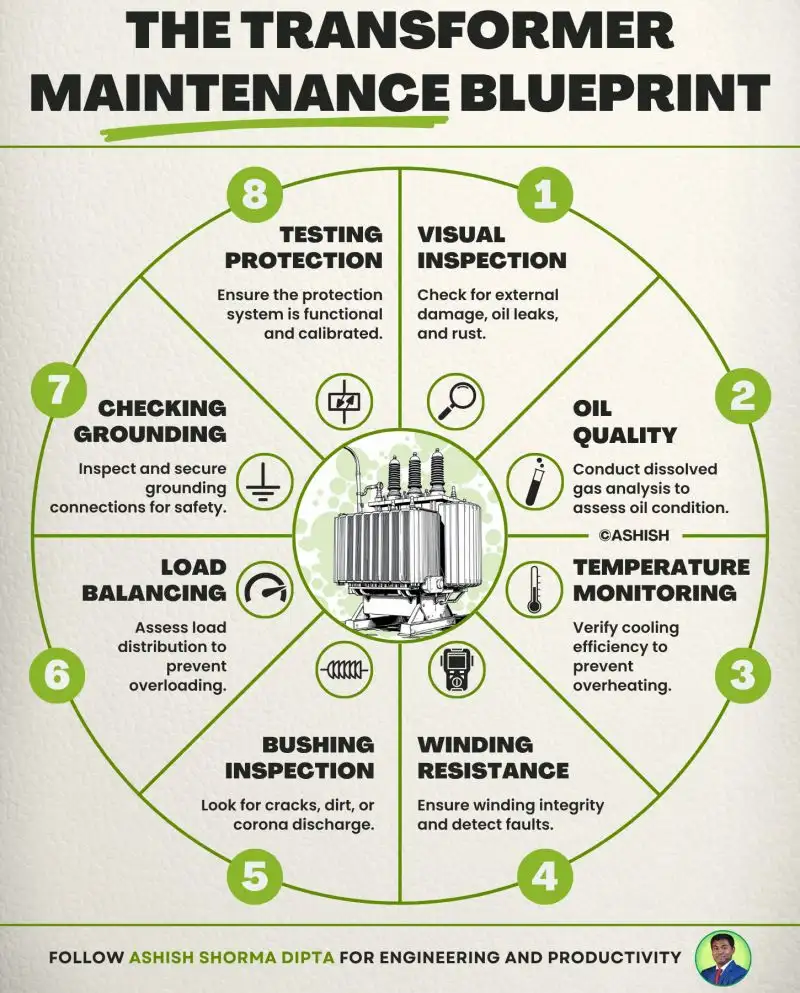
The infographic above groups the work into eight checks around the tank, oil, windings, bushings, load, earthing and protection. In India the main code of practice is IS 10028 Part 3 for maintenance, while IS 1866 and IEC 60422 cover in service oil.
8 Essential Transformer Maintenance Checks
Each check looks at a different failure path, so skipping one leaves a blind spot. Together they form a complete condition picture that a small maintenance team can manage with a sensible calendar.
Check 1: Visual Inspection of Tank and Fittings
Start every transformer maintenance round by walking around the unit to look for oil leaks at gaskets, valves, radiators and the conservator, along with rust and paint damage on the tank. Check bushings for cracks or chipped sheds, and look for discoloured lugs that show loose or overheated connections.
Also note the oil level gauge, silica gel breather colour, cooling fan condition and any unusual hum. A quick scan with a thermal camera, explained in infrared thermography, turns a hidden loose joint into a clear hot spot.
Photograph every leak point with the date and a marked outline on the tank. Next month you can tell at a glance whether the leak is stable or growing.
Check 2: Oil Testing and DGA in Transformer Maintenance
For transformer maintenance, oil is both the coolant and part of the insulation, so it carries a record of what happens inside. A routine sample shows internal problems long before any external symptom appears.
The key oil tests are breakdown voltage (BDV), moisture content in ppm, acidity, interfacial tension (IFT), colour and dissolved gas analysis. IS 1866 and IEC 60422 set in service limits that tighten as the voltage class rises, and IS 335 or IEC 60296 covers new oil.
| Key Gas | Likely Fault | What It Suggests |
|---|---|---|
| Hydrogen (H2) | Partial discharge | Corona in gas voids or wet insulation |
| Methane and ethane | Low temperature thermal | Overheated oil below about 300 °C |
| Ethylene (C2H4) | High temperature thermal | Hot joints or core faults above 300 °C |
| Acetylene (C2H2) | Arcing | High energy discharge, act quickly |
| CO and CO2 | Paper overheating | Cellulose insulation is ageing |
Dissolved gas analysis is interpreted with IEC 60599 ratio methods or the IEEE C57.104 guide, often plotted on a Duval triangle. The rate of gas increase matters more than a single number, so always compare with earlier samples.
Acetylene forms in oil only at very high temperatures, so even a few ppm of it usually points to arcing. That is why a sudden acetylene rise is treated as a warning that needs an early retest.
Electrical4u recommends half yearly checks of BDV, water content and acidity, with DGA every year for units up to 132 kV and every two years above that. Many Indian utilities follow a similar plan in their transformer maintenance manuals.
Check 3: Temperature Trends and Insulation Ageing
In transformer maintenance, track temperature trends, not single readings. A steady rise in winding temperature, a high top oil reading or an abnormal rise over ambient points to overload, blocked radiators or failed fans, so review the ONAN and ONAF cooling system too.
Persistent overheating ages the paper insulation, which cannot be renewed. The IEC 60076 7 loading guide states that, for normal kraft paper, the ageing rate doubles for about every 6 °C rise in hot spot temperature above 98 °C.
Life used = V × operating hours
θh is the winding hot spot temperature in °C, reference 98 °C for non upgraded paper
Example:
θh = 110 °C for 24 hours
(110 minus 98) ÷ 6 = 2
V = 2 ^ 2 = 4.00
Life used = 4.00 × 24 = 96.0 hours
So one day at a 110 °C hot spot consumes four days of normal life. In the same way, the USBR FIST 3 30 manual warns that operating only 10 °C above rating can cut transformer life roughly in half.
Insulation Ageing Calculator
Now try a cooler case with a hot spot of 92 °C. The exponent becomes minus 1, V falls to 0.50 and 24 hours of operation use only 12 hours of normal life, which shows why good cooling pays back.
Check 4: Winding Resistance Testing for Transformer Maintenance
Measure DC winding resistance on every phase and tap with a micro ohmmeter or winding resistance test set, then compare the phases. A clear difference between phases points to poor joints, broken strands, winding faults or tap changer contact problems.
Correct readings to a common temperature using R2 = R1 × (235 + T2) ÷ (235 + T1) for copper, then compare with factory values from the routine test report. Trending each tap over years adds real value, especially on an on load tap changer.
Always discharge the winding fully after a resistance test, because the stored inductive energy can give a severe shock. Also demagnetise the core when possible, since residual flux raises the next inrush current.
Residual magnetism left by DC tests increases switching stress, as covered in transformer inrush current. Pair this check with an insulation resistance test with a Megger and polarisation index for a fuller view.
Check 5: Bushing Inspection and Tan Delta
As part of transformer maintenance, inspect bushings for cracks, contamination, oil leakage from the head, surface tracking marks and abnormal heating at the terminal. A small bushing defect can flash over or explode and become a major outage, sometimes with a tank fire.
On condenser bushings, measure capacitance and tan delta (dissipation factor) and compare with nameplate values. A rising tan delta or a clear change in capacitance shows moisture entry or shorted foil layers inside the bushing.
Check 6: Load and Phase Balance Monitoring
Monitor load continuously through the energy meter or SCADA, not only during rounds. Overloading, phase imbalance and repeated peak loading all add thermal stress, so compare real demand with the rating worked out in transformer kVA rating calculation.
Imbalance is the largest deviation from the average phase current divided by that average. For phase currents of 400, 360 and 380 A, the average is 380 A, the largest deviation is 20 A and the imbalance is 5.26 percent.
Better load management, such as shifting loads between feeders, cuts heating and improves asset life. Non linear loads also add stray losses, so review harmonic distortion and THD on drive heavy buses.
Check 7: Grounding System Inspection
Good transformer maintenance also checks the tank earth, neutral earth and surge arrester earth connections for tightness, corrosion and continuity. Measure earth pit resistance in dry season and compare with design, using the method in earthing resistance calculation.
A healthy earth protects people from dangerous touch voltage and gives fault current a clear return path. It is also essential for surge arresters, which cannot clamp lightning surges without a low impedance earth.
Earth resistance rises when soil dries, so a pit that reads well in the monsoon may read much higher in May. Testing in the driest month gives you the true worst case.
Check 8: Protection System Testing
Never assume the protection will operate when needed. Protection that is not tested is protection you are trusting, not verifying, so test it on a fixed schedule.
- Verify relay settings against the approved setting sheet.
- Inject secondary current and check pickup and timing.
- Test trip circuits and trip circuit supervision.
- Check CT and VT circuits for polarity, ratio and earthing.
- Confirm protection logic, interlocks and SCADA alarms.
- Operate the breaker and record trip time.
- Test Buchholz, PRV, OTI and WTI alarm and trip contacts.
Main protection usually includes 87T differential protection, restricted earth fault and overcurrent with IDMT relay settings. Check the current transformer wiring carefully, since a reversed CT can cause a false differential trip.
Transformer Maintenance Schedule for Indian Plants
| Frequency | Main Tasks |
|---|---|
| Daily | Oil level, OTI and WTI readings, load, silica gel colour, leaks, noise |
| Monthly | Breather check, fans and pumps, bushing cleanliness, earth connections |
| Half yearly | BDV, moisture, acidity of oil |
| Yearly | DGA up to 132 kV, IR and PI, winding resistance, relay tests, thermography |
| Two yearly | OTI and WTI calibration, bushing tan delta, DGA above 132 kV |
Adjust the transformer maintenance frequency to the unit age, loading and criticality. Compact substations feeding a ring main unit need the same discipline as large plant transformers.
- Finds faults before they cause outages.
- Extends insulation and asset life.
- Improves safety for operators.
- Supports planned shutdowns and spares.
- Needs trained staff and test kits.
- Some tests need a shutdown.
- Oil labs take time to report.
- Data is useless if no one trends it.
What Is Your Biggest Transformer Maintenance Challenge?
Is it manpower, time, testing equipment or interpreting diagnostic data at your site? Here are practical answers for each one.
Train operators to do daily checks and keep tests for specialists.
Group shutdown tests into one annual outage plan.
Hire or share oil labs and test kits.
Trend every value in one sheet against past results.
Share your own challenge in the comments below, along with the tests you find most useful. If you are new to these devices, start with the transformer vector group basics.
USBR Transformer Maintenance Manual
Transformer Maintenance Testing Video
Transformer Maintenance FAQ
It is the planned work of inspecting, testing and correcting a transformer through its life. The aim is to find deterioration early and act before it turns into a failure.
It covers the tank, oil, windings, bushings, load, earthing and protection. A good programme combines daily rounds, periodic tests and careful trending of every result.
Electrical4u suggests BDV, moisture and acidity tests every six months for most units. DGA is usually done yearly up to 132 kV and every two years above that.
The USBR manual also asks for DGA one month after energising a new unit. Increase the frequency when the gas levels or the moisture content start to rise.
Acetylene is the most serious gas because it points to arcing inside the tank. Ethylene shows high temperature heating in the oil, while hydrogen often indicates partial discharge in voids.
Carbon monoxide and carbon dioxide show that paper insulation is overheating. Good transformer maintenance always judges the rate of increase using IEC 60599 or IEEE C57.104 methods.
Heat ages the paper insulation, and paper cannot be replaced without rewinding. The IEC 60076 7 guide says ageing doubles for about every 6 °C above the reference hot spot.
A hot spot of 110 °C therefore uses life four times faster than normal. Keeping radiators clean and fans working is therefore one of the cheapest ways to extend life.
It finds poor joints, broken strands, shorted turns and tap changer contact problems. The method compares phases with each other and with factory values after temperature correction.
Test every tap position so that a worn tap selector contact does not stay hidden. Trending these readings across years shows slow degradation that a single test during transformer maintenance would never reveal.
Look for cracks, dirt, oil leaks, tracking marks and hot terminals during every round. These small defects can quickly lead to a flashover, a tank fire or a long outage.
On condenser bushings, measure capacitance and tan delta every two years. A rising trend means moisture or internal damage, so plan a replacement during the next transformer maintenance shutdown.
First verify the relay settings against the approved sheet, then inject secondary current to check pickup and timing. Also test trip circuits, CT and VT wiring and the breaker itself.
Operate Buchholz, PRV, OTI and WTI contacts and confirm the alarm and trip reach the breaker. Record every result in the transformer maintenance log so the next test can be compared with this one.
Related Articles
- Transformer Differential Protection 87T
- Transformer Cooling Methods ONAN and ONAF
- Transformer Routine and Type Tests
- Insulation Resistance Test With Megger
- Predictive vs Preventive Maintenance
External References
- FIST 3 30 Transformer Maintenance, US Bureau of Reclamation
- Maintenance of Transformers Checklist, Electrical4u
- Dissolved Gas Analysis, Wikipedia
What We Learn Today
- Good transformer maintenance aims to detect deterioration early, using eight checks on the tank, oil, windings, bushings, load, earthing and protection.
- Oil tests such as DGA, BDV, moisture and acidity reveal internal faults long before any outside symptom, especially when results are trended.
- Under IEC 60076 7, insulation ageing doubles for about every 6 °C rise in hot spot temperature, so good cooling directly extends asset life.