
Electrical · Medium Voltage Switchgear · Preventive Maintenance
Ring Main Unit Maintenance: 8 Essential Checks Every Power Engineer Must Perform
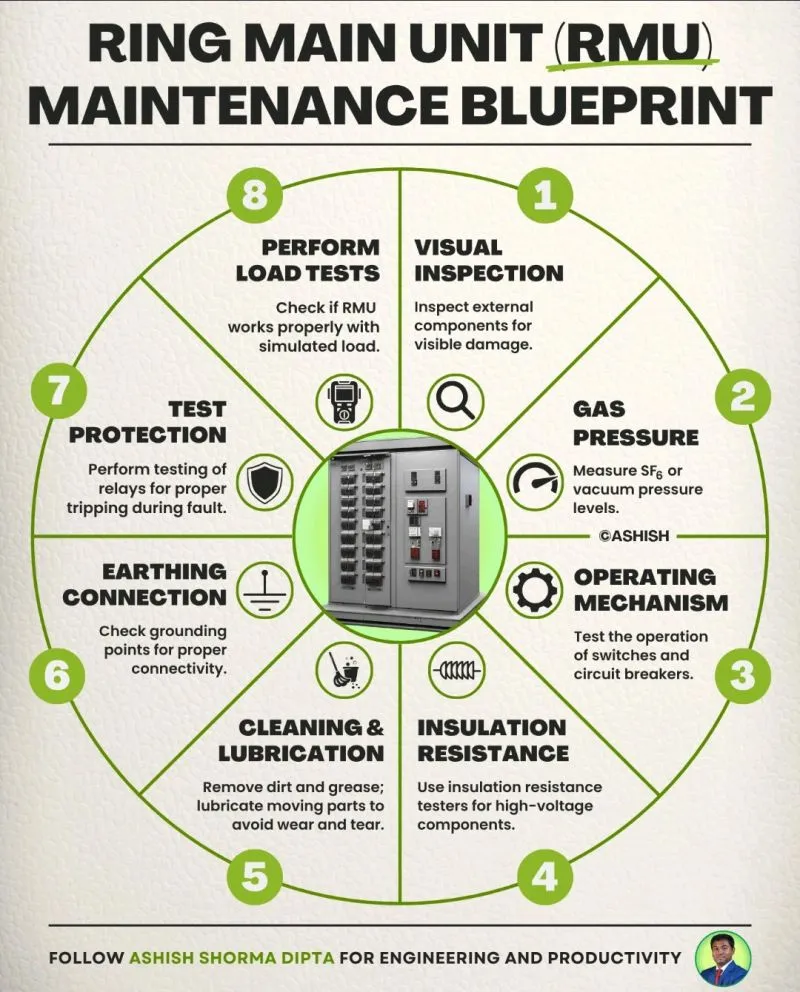
Most RMUs don't fail because they're old. They fail because small warning signs go unnoticed until it's too late. This guide covers real ring main unit maintenance checks, the engineering reason RMU reliability depends so heavily on upkeep, and a video showing the actual components involved.
Ring Main Unit Maintenance: Why Small Issues Compound Into Outages
A gradual SF6 leak. A sticky operating mechanism. A loose earth connection. An unnoticed hotspot. Individually, each one seems minor. Together, they're exactly how a reliable distribution network quietly becomes an unreliable one.
A Ring Main Unit sits at a genuinely strange point in its own service life. For most of its 20 to 30 year lifespan, it does almost nothing, silently holding a closed or open position while power flows normally through the ring. Then, the moment a fault actually occurs somewhere on the network, it has to switch instantly and correctly, rerouting supply through the other side of the loop before anyone even notices an interruption. This guide, based on maintenance practices shared by Ashish Shorma Dipta, walks through the 8 checks that keep an RMU ready for that one critical moment.
What a Ring Main Unit Actually Does
A Ring Main Unit is a compact, factory sealed switchgear assembly installed at connection points along a medium voltage ring distribution network, typically anywhere from 7.2 kV up to 36 kV. Picture a closed loop of cable feeding several transformers, but deliberately operated with one point left open. If a fault happens anywhere on that loop, the RMU nearest the fault isolates the damaged section, and the open point elsewhere on the ring can be closed to restore supply from the opposite direction. That's the entire value of the ring topology, a single cable fault doesn't have to mean a blackout.
Inside the unit, two ring feeders handle this switching job, each built around a load break switch, an isolator, and an earth switch, often combined into a single three position mechanism, closed, open, or earthed, that physically prevents the wrong two positions from ever being selected at once. A third section, the transformer feeder, protects the actual distribution transformer using either a fuse switch combination or a full circuit breaker with relay protection, depending on how much fault current needs clearing.
8 Essential Ring Main Unit Maintenance Checks
Watch: Components of a Ring Main Unit Explained
This video breaks down each physical component referenced in the maintenance checks above.
Real Ring Main Unit Specifications Worth Knowing
| Parameter | Typical Value |
|---|---|
| Rated voltage range | 7.2 kV to 36 kV (commonly 11, 12, 24 kV) |
| Ring switch full load rating | Up to 630 A |
| SF6 gas pressure (sealed system) | Around 1.4 bar, monitored continuously |
| Short-time withstand current | 16 to 25 kA for 1 to 3 seconds, per project spec |
| Internal Arc Classification (IAC) | e.g. IAC AFL 20 kA/1s, per installation requirement |
| Operating cycle life | Around 2,000 operations over a 20 to 30 year service life |
Why Some Ring Main Units Are Moving Away From SF6
SF6 gas has been the standard insulating medium in RMUs for decades, prized for compressing switchgear into a genuinely small footprint. It's also an extremely potent greenhouse gas, which is why the EU's F-Gas Regulation (EU) 2024/573 is phasing out new SF6 filled medium voltage switchgear on a defined timeline. Manufacturers including ABB, Siemens, and Schneider Electric now offer SF6-free alternatives, using dry air or similar natural-origin gases with a global warming potential near zero, built into the same footprint and interface as their SF6 equivalents. For a facility planning a new installation or a major RMU replacement, this shift is worth factoring into procurement decisions now, not after a regulatory deadline forces the issue.
Do's and Don'ts for Ring Main Unit Maintenance and Isolation
- Follow the safe isolation sequence strictly: open the circuit breaker, open the isolator, close the earth switch, then verify before starting maintenance.
- Check the gas pressure gauge before every switching operation, not just during scheduled maintenance.
- Log every maintenance check with a date and result, so gradual trends, like a slowly dropping insulation resistance, actually get noticed.
- Keep feeder tags, one-line diagrams, and open-point identification updated after any network change.
- Don't operate an RMU if the ambient temperature or gas pressure falls outside the manufacturer's stated limits, many units should not be switched below roughly 5°C.
- Don't assume a sealed, gas-insulated design means zero maintenance is needed, sealed reduces maintenance, it doesn't eliminate it.
- Don't skip earthing verification after proving a circuit dead, always re-verify immediately before applying earths.
- Don't ignore a slow, sluggish mechanism as a minor issue, it's often the earliest visible sign of developing internal wear.
Quick FAQs: Ring Main Unit Maintenance
- Redundant Power Supply: 4 Ultimate Rules for Zero Downtime Panels
- Earthing Resistance Calculation: Hidden Factors Every Engineer Must Know
- Transformer Turns Ratio and Secondary Voltage: Reliable Calculations Explained
- How to Calculate Short Circuit Fault Current: 4 Reliable Steps for Safe Panel Design
- Types of Failures in Industrial Automation Systems: 8 Costly Risks Every Engineer Must Know
External References
- Wikipedia: Ring Main Unit
- Electrical Engineering Portal: A Practical Guide to the Operation of Ring Main Units
- ABB: SafeRing and SafePlus Gas Insulated Switchgear
What we learn today
- Ring main unit maintenance matters precisely because an RMU sits idle for years, then must switch correctly the instant a real fault occurs.
- The 8 essential checks, visual inspection, gas pressure, mechanism operation, insulation resistance, cleaning, earthing, protection relays, and thermal performance, cover the full range of ways an RMU can quietly degrade.
- Real specs like SF6 pressure, short-time withstand current, and IAC rating aren't just paperwork, they define whether the unit can actually survive a fault safely.
- Regulatory pressure, particularly the EU F-Gas Regulation, is pushing the industry toward SF6-free alternatives, worth factoring into any new RMU procurement decision.