
A column of zinc oxide blocks that behaves like an open circuit at normal voltage and a short path to earth during a surge.
A surge arrester limits lightning and switching overvoltages by conducting surge current to earth and then returning to a high resistance state. It protects the insulation of transformers, cables and switchgear.
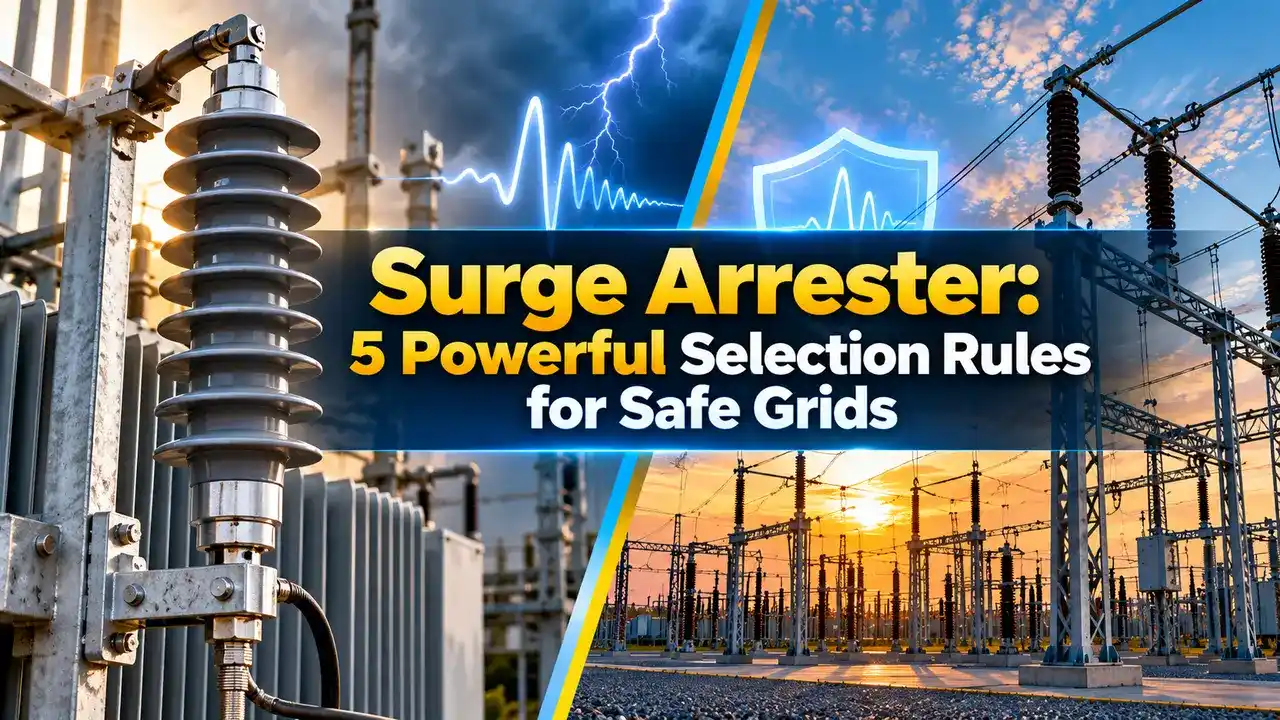
What Is a Surge Arrester?
A surge arrester is a protective device connected between a live conductor and earth that clamps overvoltages to a safe level. Modern units use zinc oxide blocks, a much larger cousin of the varistor.
At normal system voltage, the zinc oxide blocks conduct only a tiny leakage current. When a surge arrives, their resistance collapses and they carry thousands of amps to earth.

Once the surge passes, the blocks return to high resistance without interrupting the system. Older gapped silicon carbide designs have largely been replaced by gapless metal oxide units.
CHINT explains that the term lightning arrester often refers to outdoor devices on lines and poles. In practice, both names describe the same voltage limiting principle.
How the Arrester Clamps a Surge
The voltage left across the arrester during discharge is called the residual voltage or protective level. It must be comfortably below the basic insulation level, or BIL, of the protected equipment.
A low resistance earth connection is essential, since surge current must reach the ground quickly. Follow the practices in earthing resistance calculation for the arrester earth.
5 Powerful Surge Arrester Selection Rules
Rule 2 depends on neutral earthing. On isolated or resistance earthed systems, healthy phases rise close to line voltage during an earth fault, so the arrester needs a higher rating.
Neutral earthing choices are covered in neutral grounding resistor sizing and in TN, TT and IT earthing systems.
Protective Margin and Lead Length Formula
Protective margin = (BIL ÷ Voltage at equipment minus 1) × 100
Worked example, 11 kV transformer:
BIL = 95 kV, arrester residual voltage = 30 kV
Lead length 1.5 m at about 1 µH per m, di/dt = 10 kA per µs
Lead voltage = 1.5 µH × 10 kA per µs = 15 kV
Voltage at equipment = 30 + 15 = 45 kV
Protective margin = (95 ÷ 45 minus 1) × 100 ≈ 111 percent
The lead voltage adds directly to the residual voltage seen by the equipment. Long, looping leads can cut the protective margin in half, so keep connections short and straight.
Guides such as the Hubbell application guide recommend keeping a healthy margin for lightning surges. Distance between the arrester and the protected equipment also raises voltage through travelling wave reflections.
MCOV Selection by Earthing Type
| System Earthing | Earth Fault Voltage on Healthy Phases | MCOV Guidance |
|---|---|---|
| Solidly earthed | Close to phase to earth voltage | At least phase to earth voltage |
| Resistance earthed | Near line voltage for fault duration | Higher rating for TOV |
| Isolated neutral | Line voltage, possibly for hours | Rating near full line voltage |
| Example 11 kV solid | Max 12 kV, so 6.93 kV to earth | MCOV at least 6.93 kV |
For an 11 kV solidly earthed system, the highest system voltage is about 12 kV, so the phase to earth value is 12 divided by the square root of 3. That gives 6.93 kV as the minimum MCOV.
Choosing too low an MCOV leads to overheating and failure. Choosing far too high reduces protection, so balance both sides carefully.
Where a Surge Arrester Is Installed
At low voltage, the equivalent device is the SPD, selected using IEC 61643 SPD selection rules. Coordinated protection uses arresters at MV and SPDs at LV.
For sensitive electronics, see our guide to surge protector types, which covers Type 1, 2 and 3 devices.
Protective Margin Calculator
The calculator assumes about 1 µH per metre of lead. Try 4 m of lead to see how quickly the margin shrinks.
- Clamps lightning and switching surges.
- No interruption of service.
- Gapless metal oxide design is reliable.
- Protects expensive transformers and cables.
- Wrong MCOV causes overheating.
- Long leads reduce protection.
- Poor earthing defeats the arrester.
- Failed units need prompt replacement.
Metal Oxide Surge Arrester Application Guide
Surge Arrester Working Video
Surge Arrester FAQ
Related Articles
- SPD Selection per IEC 61643
- Surge Protector Types
- What Is a Varistor
- Earthing Resistance Calculation
- TVS Diode Explained
External References
- Metal Oxide Arrester Application Guide, Hubbell
- Arrester Types Compared, CHINT
- Fundamentals of Arresters, Eaton
- Lightning Arrester, Wikipedia
What We Learn Today
- Zinc oxide blocks clamp surges and recover without interrupting service.
- MCOV and rated voltage depend on system earthing and temporary overvoltages.
- Short leads and close mounting preserve the protective margin.