
kVA looks like a simple multiplication problem. Voltage times current, divide by a thousand, done.
Stop there and a transformer that checks out perfectly on paper can still overheat at altitude, on a hot day, or five years after the load grows.
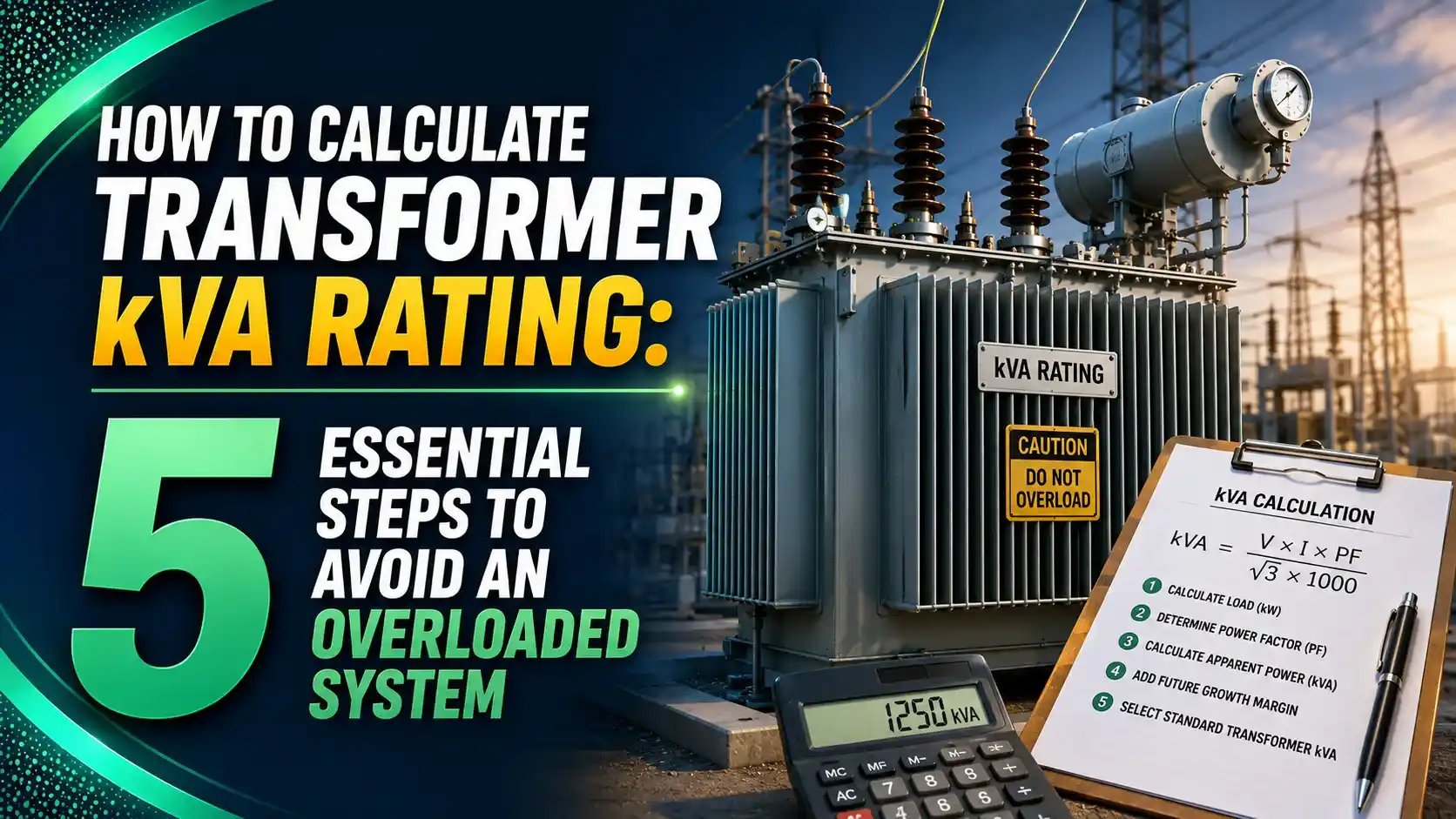
How to calculate transformer kVA rating starts with a simple voltage times current formula, then adjusts for phase count, standard sizing, spare capacity, and real installation conditions like altitude and ambient temperature.
kVA stands for kilovolt-amperes, the unit of apparent power. It's not quite the same as kW, the unit of real, usable power.
That distinction matters the moment power factor enters the picture, and it's the first thing worth understanding before touching a single formula.
The 5 Steps to Calculate Transformer kVA Rating
Follow these five steps in order for a rating that holds up in the real world, not just on a datasheet.
Determine the Load
Get the actual voltage and current, or real power in kW plus the load's power factor.
Apply the Correct Formula
Use the single-phase or three-phase kVA formula depending on the supply configuration.
Round Up to a Standard Size
Transformers come in fixed catalog sizes. Always round up, never down, to the next available rating.
Add Spare Capacity
Build in roughly 20 percent headroom for load growth and to avoid running at the transformer's absolute limit.
Apply Altitude and Temperature Derating
Check installation elevation and ambient temperature against IEEE C57.12.00 derating factors.
Single-Phase vs Three-Phase Formula
The core math is the same, with one extra constant for three-phase systems.
Single-Phase
Straightforward voltage times current. No phase constant needed since there's only one power waveform.
Three-Phase
Adds the square root of 3 (1.732) since the three phases don't reach peak power simultaneously.
kVA vs kW: Apparent Power vs Real Power
A transformer is rated in kVA, not kW, for a specific reason tied to how it actually generates heat.
Winding losses and heating depend on current, not on how much of that current is doing useful work. A low power factor load can push a transformer toward its thermal limit even while its kW output looks modest.
kVA Formulas and Worked Examples
Here's both formulas applied to real numbers.
kVA = (240 x 60) / 1000 = 14.4 kVA
Three-phase example: V = 415V, I = 139A
kVA = (415 x 139 x 1.732) / 1000 = approximately 100 kVA
Standard Transformer kVA Sizes
Always round a calculated result up to the nearest commercially available size.
| Category | Common Standard Sizes (kVA) |
|---|---|
| Small single-phase | 0.5, 0.75, 1, 1.5, 2, 3, 5, 7.5, 10, 15, 25 |
| Distribution three-phase | 30, 45, 75, 112.5, 150, 225, 300, 500 |
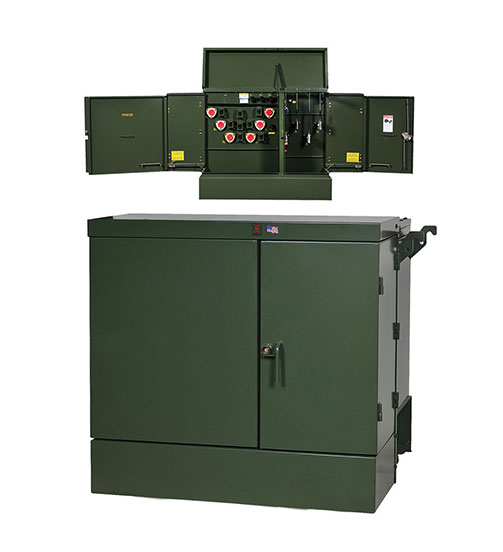
| Pad-mount three-phase (utility) | Up to 2500 to 3000 kVA per unit |
Altitude and Temperature Derating (IEEE C57.12.00)
Standard nameplate ratings assume specific reference conditions. Real installations often don't match them.
| Condition | Reference Standard | Typical Derating |
|---|---|---|
| Elevation above 1000m (liquid-filled) | IEEE C57.12.00 | Roughly 1% per 100m above 1000m |
| Elevation above 1000m (dry-type) | IEC 60076-2 | Roughly 0.3 to 0.5% per 100m above 1000m |
| Ambient above 30 degrees C (24hr average) | IEEE C57.91 | Roughly 1 to 1.5% per degree C above 30 |
Where Correct kVA Sizing Matters Most
Industrial Plants
Motor starting inrush and harmonic loads both affect real sizing.
Commercial Buildings
HVAC and lighting loads combined with future tenant growth.
Utility Distribution
Pad-mount and pole-mount transformers serving neighborhood loads.
Data Centers
High density, low power factor loads needing careful derating.
Remote / High Altitude Sites
Mining and mountain installations where altitude derating is mandatory.
Renewable Energy
Solar and wind step-up transformers matched to inverter output.
Do's and Don'ts of Transformer kVA Sizing
✓ Do
- Use actual measured or nameplate load data, not rough estimates
- Round up to the nearest standard catalog size, never down
- Apply altitude derating for any site above 1000 meters elevation
- Account for future load growth with spare capacity margin
✗ Don't
- Confuse kVA with kW when a load's power factor is well below 1.0
- Ignore harmonic-heavy loads that need K-factor rated transformers
- Load a transformer above roughly 80% of nameplate on a routine basis
- Assume single-phase and three-phase formulas are interchangeable
Live Transformer kVA Calculator
Select the phase configuration and enter voltage and current to calculate the required kVA rating.
Harmonic Loads: The Derating Factor Most Calculations Skip
Non-linear loads like VFDs, LED drivers, and switch-mode power supplies inject harmonic currents a standard kVA calculation never accounts for.
These currents raise winding eddy and stray losses well beyond what the fundamental current alone would suggest, per IEEE C57.110.
The fix is either a K-factor rated transformer sized for the load's actual harmonic content, or oversizing a standard unit enough to absorb the extra heating. Skipping this step is a common reason a "correctly sized" transformer still runs hot.
Reference Materials on Transformer kVA Sizing
FAQs on How to Calculate Transformer kVA Rating
External References
- Transformer kVA Calculator and Formula Reference, Maddox Transformer
- Transformer kVA Ratings Guide, ELSCO
- Elevation Derating for Transformers, Larson Electronics
- Three-Phase Pad-Mount Transformer Brochure, ERMCO
- Altitude Correction Factor for Transformers, IJAREEIE
What we learn today
- How to calculate transformer kVA rating starts with kVA = (V x I) / 1000 for single-phase, or (V x I x 1.732) / 1000 for three-phase.
- kVA measures apparent power, not real power, which is exactly why transformers are rated in kVA rather than kW.
- Always round a calculated kVA result up to the next standard catalog size, and build in roughly 20 percent spare capacity.
- IEEE C57.12.00 requires evaluating derating for installations above 1000 meters elevation or above 30 degrees C average ambient temperature.
- A low power factor load needs a larger kVA rated transformer than its kW output alone would suggest.