A glass thermometer looks simple, but dip it to the wrong depth and the reading can be off by more than a degree. We go through the bulb, capillary and scale, then correct the emergent stem with a worked example.
Glass stem thermometers are still used in labs and plants, and reading one correctly depends on how it is built, what liquid it holds, how deep it is immersed and how it was calibrated. The emergent stem correction formula is worked through with a calculator and a solved example.
What is a liquid in glass thermometer and how does it work?
Liquid in glass thermometer readings come from thermal expansion: mercury or alcohol sealed in a glass bulb expands more than the glass and climbs a fine capillary against a scale. If part of the column sits outside the bath, add the stem correction K × n × (t1 minus t2). For mercury with n = 70 and a 60 °C difference, that is 0.672 °C.
What Is a Liquid in Glass Thermometer?
A liquid in glass thermometer is a direct reading temperature instrument in which a liquid sealed inside a glass bulb expands into a narrow capillary tube and the length of the column is read against a scale. It needs no power, no wiring and no electronics, which is why labs still use it as a working reference.
- Principle: the liquid expands more than the glass, so the column rises with temperature
- Mercury freezes near minus 38.8 °C, which sets its low limit
- Three immersion types: total, partial (often 76 mm) and complete
- Stem correction = K × n × (t1 minus t2), K about 0.00016 for mercury
You will find this instrument in QC labs, boiler houses, cold rooms and teaching labs across India. If you are new to the wider family, start with our overview of industrial temperature sensor types.
Like every thermometer, it relies on the zeroth law of thermodynamics: the bulb and the process reach the same temperature after enough time. That is why a cold thermometer dipped quickly into hot oil gives a low first reading.
Wikipedia records that Daniel Gabriel Fahrenheit began making mercury thermometers around 1713 and was selling them by 1717.
How Does a Liquid in Glass Thermometer Work?
It works on differential thermal expansion: the liquid in the bulb expands far more than the glass around it, so the extra volume has only one place to go, up the capillary. Because the bore is very fine, a tiny volume change becomes a long, easily read movement of the column.
The bulb holds most of the liquid, so its size and wall thickness decide sensitivity and speed. A thin walled bulb settles faster, a trade off we also discuss in sensor response time.
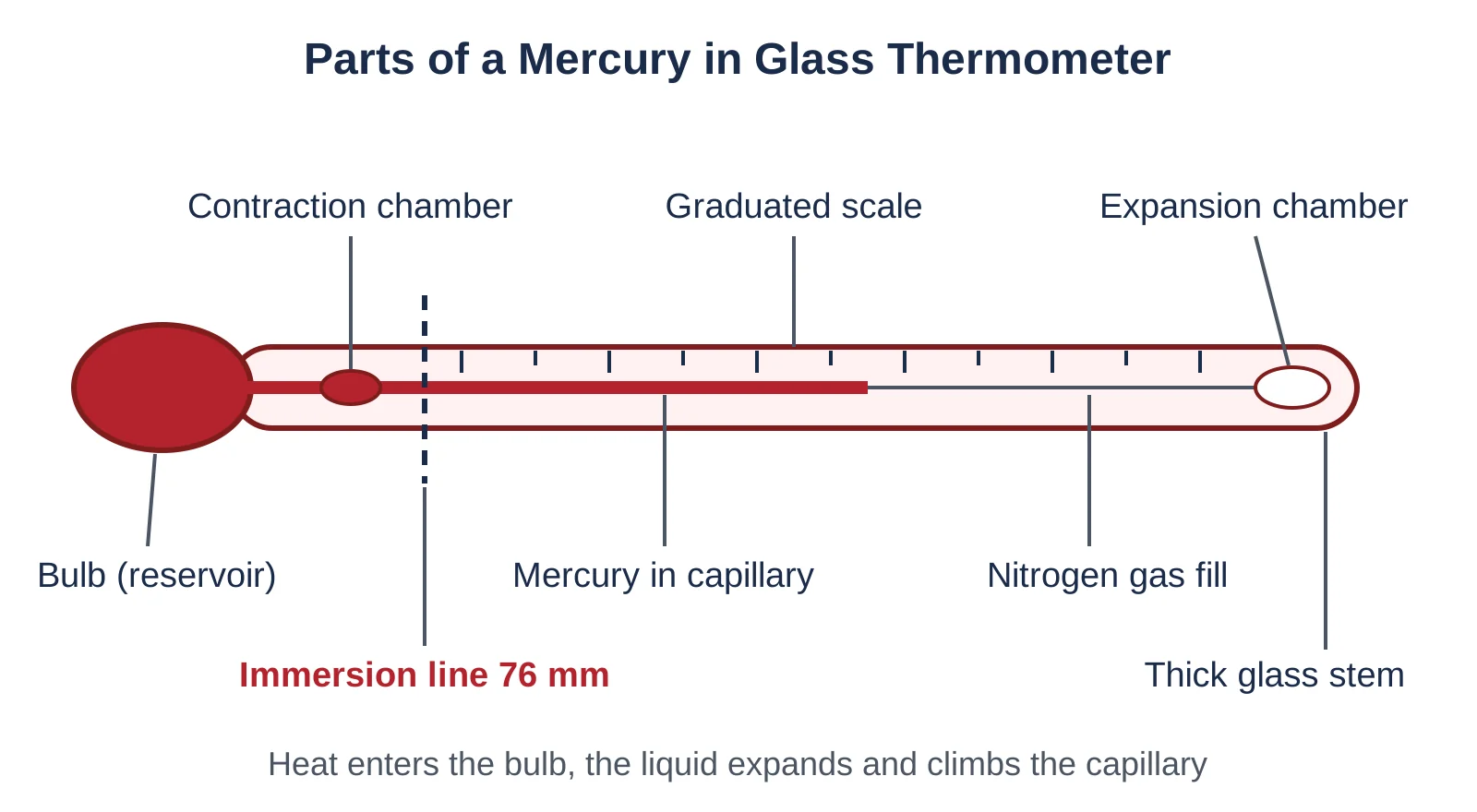
The part descriptions follow NBS Monograph 150 by Jacquelyn Wise. NBS adds that total immersion thermometers graduated above 150 °C must be gas filled, normally with dry nitrogen, to stop the mercury distilling and the column separating.
Mercury vs Alcohol Thermometer: Which Liquid Is Better?
Mercury is better for accuracy and higher temperatures, while alcohol and other organic liquids are better for low temperatures and wherever mercury is restricted. The ranges below come from Wikipedia and the K values from NBS.
| Fill liquid | Useful range | K value | Notes |
|---|---|---|---|
| Mercury | About minus 37 to 356 °C | 0.00016 | Opaque, does not wet glass, toxic |
| Mercury with nitrogen in quartz | Up to about 800 °C | 0.00016 | Special high range designs |
| Mercury thallium | Down to about minus 56 °C | Similar to mercury | Extends the low end |
| Alcohol, toluene (spirit) | Below the mercury limit | 0.001 | Dyed red or blue, wets the glass |
| Galinstan | Mercury free option | Maker data | Gallium, indium and tin alloy |
The organic liquid K is about six times the mercury value, so stem errors grow much faster with a spirit fill.
Read a mercury column at the top of its convex meniscus and a spirit column at the bottom of its concave meniscus. Keep your eye level with the meniscus to avoid parallax.
Compared with a bimetallic dial thermometer or a gas filled thermometer, the glass design reads finer but is less rugged and cannot send a remote signal.
What Are Total, Partial and Complete Immersion Thermometers?
The immersion type tells you how much of the thermometer must be inside the measured medium for the scale to read correctly. NBS Monograph 150 defines three types.
Reads correctly when the bulb and the whole liquid column are at the measured temperature.
Reads correctly when the bulb and a fixed stem length, marked by a line such as 76 mm, are immersed.
Reads correctly only when the entire thermometer, including the expansion chamber, is at the measured temperature.
NBS notes that partial immersion accuracy of 0.1 to 0.3 °C in the 0 to 100 °C range is possible only if the emergent stem temperature is known. In a plant room at 35 °C, check which stem temperature the certificate assumed.
How to Calculate Emergent Stem Correction
Multiply the coefficient K by the number of emergent degrees n and by the difference between the bulb temperature t1 and the mean stem temperature t2. Add the result to the observed reading.
K = 0.00016 for mercury in glass (°C)
K = 0.001 for organic liquids (°C)
n = reading minus bath surface mark
True temperature = t1 + correction
NBS gives K for mercury in normal glass as about 0.000158 at 0 °C rising to 0.000183 at 400 °C, and accepts 0.00016 when the glass type is unknown. ICL Calibration Laboratories lists 0.00009 for Fahrenheit mercury scales, so match K to the scale unit.
Solved example: a total immersion mercury thermometer reads 90 °C with the bath surface at the 20 °C mark, so n is 70. An auxiliary thermometer halfway up the emergent column reads 30 °C.
Correction = 0.00016 × 70 × (90 minus 30)
= 0.00016 × 70 × 60
= 0.672 °C
True temperature = 90 + 0.672 = 90.67 °C
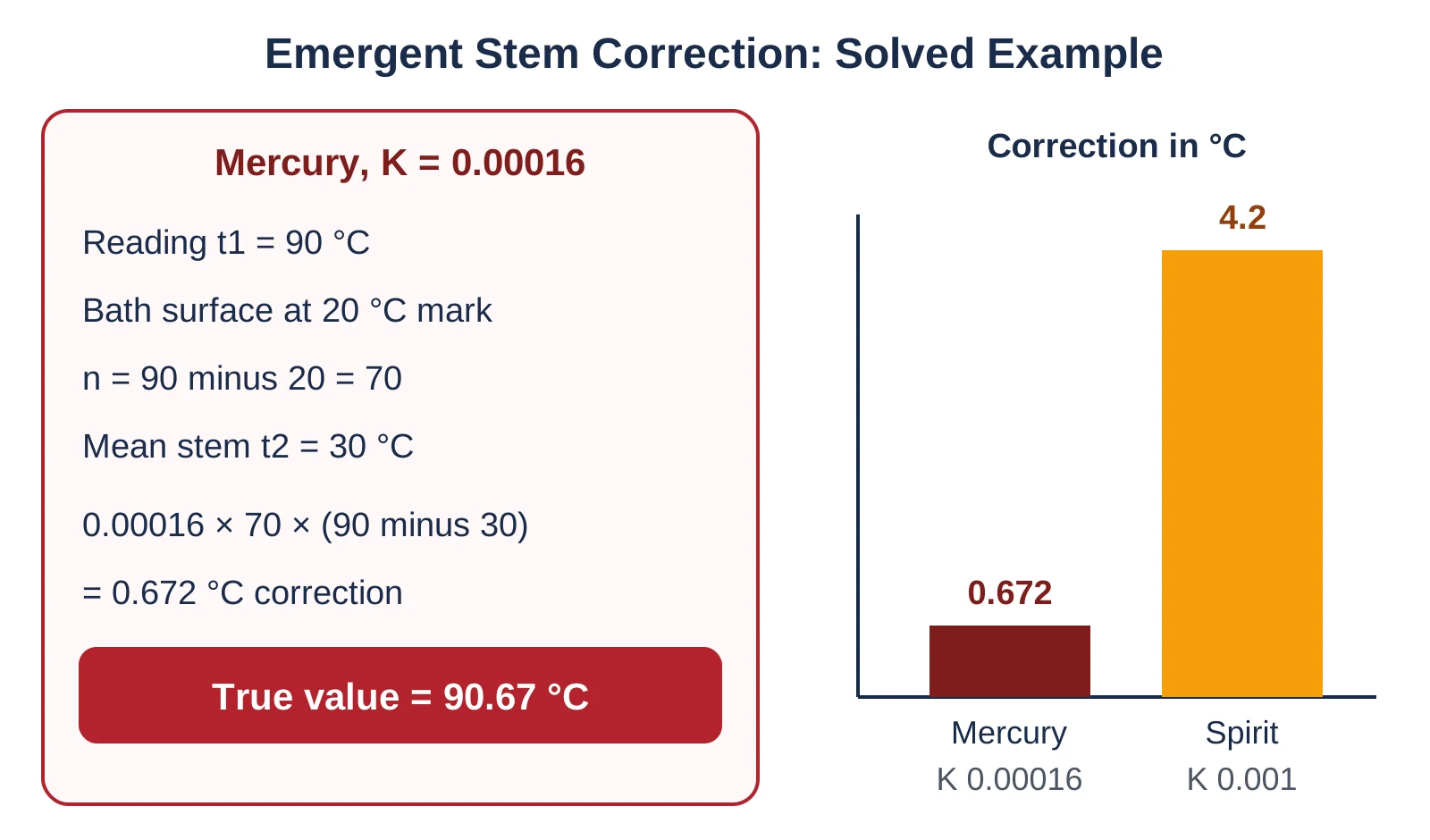
With a spirit fill and the same numbers, the correction becomes 0.001 × 70 × 60 = 4.2 °C. NBS warns that the correction can reach 20 degrees when the emergent column is long and the temperature difference is large.
ICL points out that the stem temperature is hard to measure precisely. Put its uncertainty in your measurement uncertainty budget.
How to Calibrate a Liquid in Glass Thermometer Against a Reference
You calibrate it by comparison in a stirred bath against a reference thermometer with a traceable certificate, reading both at several points and then confirming the ice point. The steps follow the NBS comparison method.
NBS advises reading the ice point after the thermometer has rested at least 3 days near 23 °C, and a careful ice point can be realised to better than 0.01 °C. Once calibrated, an ice point check alone confirms the calibration if the instrument has not been abused.
For the reference side you can use a dry block calibrator with a liquid insert or a stirred bath. The chain back to national standards is covered in our calibration traceability guide.
What Causes Errors in a Glass Thermometer?
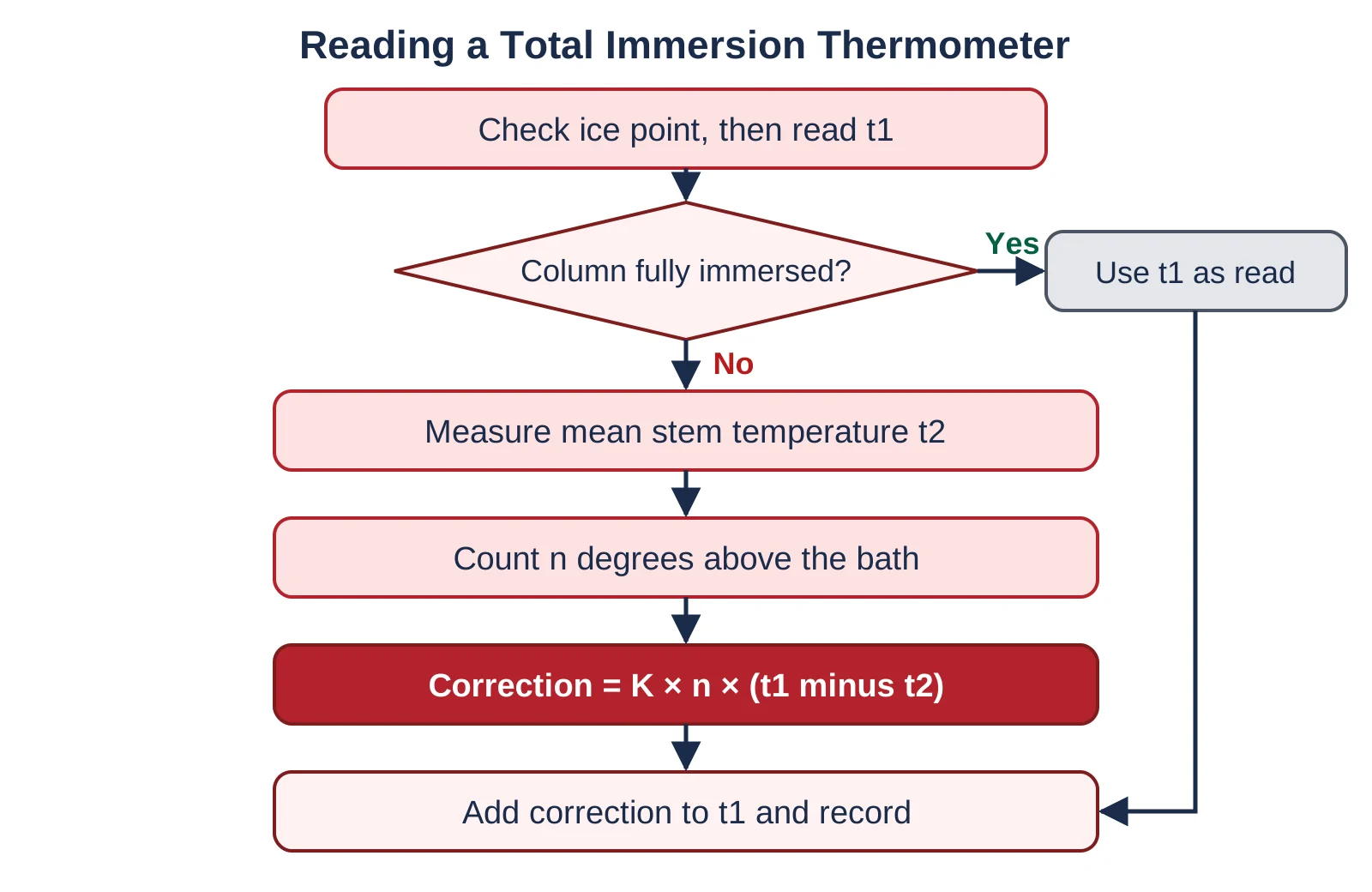
Most errors come from wrong immersion, separated columns, parallax, slow response and ice point drift. Follow the flowchart before every important reading.
| Symptom | Likely cause | Field fix |
|---|---|---|
| Reading low in a hot bath | Emergent stem cooler than bulb | Immerse to the mark or apply the stem correction |
| Gap in the column | Column separation after a knock | Cool the bulb gently to rejoin, then recheck the ice point |
| Ice point shifted | Glass ageing or overheating | Record the new ice point and shift all corrections |
| Different readings by two people | Parallax at the meniscus | Read with the eye level to the column top |
NBS also observes that horizontal use may raise a reading by a few hundredths of a degree. For causes across all sensors, see temperature measurement errors.
Advantages and Limitations of Glass Stem Thermometers
You get a cheap, stable, power free reading with fine resolution. The price is fragile glass and a reading you can only see on the spot.
- Needs no power supply or wiring
- Fine resolution on precision types
- Good long term stability with care
- Low cost and easy ice point check
- Glass breaks easily and mercury is toxic
- No remote output for DCS or PLC logging
- Slow response with thick bulbs
- Accuracy depends on immersion depth
For a 4 to 20 mA loop, an RTD sensor in a thermowell is the usual replacement.
The European Union restricted mercury in measuring devices under Directive 2007/51/EC from 3 April 2009, as Wikipedia notes. ASTM E2251 now specifies ASTM pattern thermometers with low hazard precision liquids as replacements.
Where Is a Liquid in Glass Thermometer Still Used?
Laboratories, standard test methods and local spot checks still use it wherever they need a cheap, independent reference that runs without power.
ASTM E1 covers the specification of ASTM glass thermometers, ASTM E77 their inspection and verification, and ISO 386 the design, construction and use of laboratory types. For Fahrenheit pattern readings, a temperature unit converter saves time.
- Confirm the immersion type and depth marked on the stem
- Check the column for gaps and bubbles
- Verify the ice point against the certificate
- Apply K for the right liquid and scale unit
After a bath comparison, put the test and reference readings into our calibration error calculator to see whether the thermometer meets its tolerance.
Video: How a Glass Thermometer Works
This short video shows the bulb, capillary and expansion principle in action. It is worth watching before you try the stem correction example.
Before you trust an old lab thermometer, hold it against a light and scan the whole column for small gaps. A separated column is the most common hidden fault.
Liquid in Glass Thermometer FAQ
It works because the liquid in the bulb expands more than the glass as temperature rises. The extra liquid climbs a fine capillary, and you read the column height on the scale, roughly 0.016 percent volume change per degree for mercury relative to glass.
A total immersion thermometer must have its whole liquid column in the bath, while a partial immersion type is dipped only to a marked line such as 76 mm. Using a total immersion unit at 76 mm depth needs a stem correction to read correctly.
Find n as the reading minus the scale mark at the bath surface, then measure the mean stem temperature t2. Multiply 0.00016 by n and by t1 minus t2, so 70 degrees and a 60 °C difference give 0.672, added to the reading.
Alcohol and other organic liquids are better below about minus 38 °C because mercury freezes there. Mercury is the better choice above room temperature, where its smaller K value of 0.00016 and clean meniscus give lower uncertainty than spirit fills.
A gap usually means column separation caused by a knock, rapid cooling or shipping vibration. You can often rejoin it by gently cooling the bulb so the mercury retreats into it, then you must recheck the ice point before using it again.
A full multipoint calibration is normally done when the thermometer is new and after damage or overheating. Between full calibrations, NBS advises that an ice point check confirms the calibration, so set a regular ice point check interval in your quality system.
Related Articles
- Bimetallic Thermometer Working Principle
- How Does a Gas Filled Thermometer Work
- Types of Temperature Sensors
- Temperature Gauge Calibration
- Temperature Measurement Errors
External References
- NBS Monograph 150, Liquid in Glass Thermometry (PDF)
- ICL Calibration Laboratories: Using a total immersion thermometer partially immersed
- Wikipedia: Mercury in glass thermometer
What We Learn Today
- A liquid in glass thermometer works because the liquid expands more than the glass, pushing a column up a fine capillary against a scale.
- Total, partial and complete immersion types each read correctly only at their own depth, so always check the mark on the stem first.
- Emergent stem correction equals K times n times t1 minus t2, with K about 0.00016 for mercury and 0.001 for organic liquids.