Dry Block Calibrator: 4 Parts Behind the Accuracy

Share:
Instrumentation
Dry Block Calibrator: 4 Parts Behind the Accuracy

No oil bath, no spill risk, and no cleanup, yet this device still gets a technician within a fraction of a degree of a certified reference.

That combination of portability and precision is exactly why it has become the default field tool for RTD and thermocouple calibration.

Dry Block Calibrator RTD Calibration Thermocouple Calibration Temperature Well

A Dry Block Calibrator heats or cools a metal insert to a set temperature and lets a technician compare a sensor under test against a built in or external reference, all without a drop of liquid media.

Hello everyone, today we are going to look at what actually sits inside this kind of temperature calibrator, how it stacks up against a liquid bath, and what to check before trusting a reading from one in the field.

We will cover the core components, typical temperature ranges across real manufacturers, insert selection, and the safety habits that keep both the sensor and the technician protected.
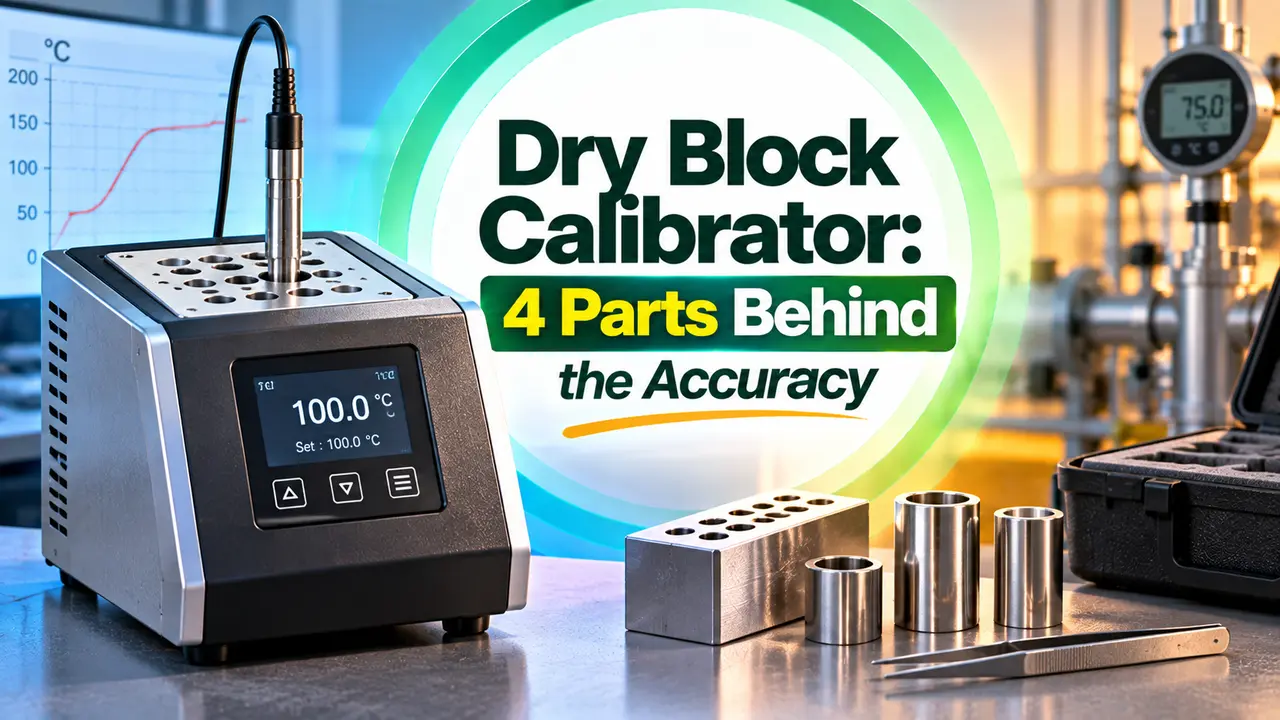
Dry Block Calibrator
Advertisement

4 Core Parts Inside a Dry Block Calibrator

1
Insert Hole
A metal block drilled with bores sized to match whichever sensor is being calibrated at that moment.
2
Heating Coils
Electric elements that raise the block to the required setpoint, with cooling elements added on wider range models.
3
Reference Thermometer
Fixed inside the block to determine and display the actual block temperature during the test.
4
PID Controller
Holds the block steady at the setpoint and manages the heating and cooling cycle automatically.

A removable sleeve or insert then sits inside that hole, and swapping inserts is how one calibrator handles sensors of very different diameters without changing the whole unit.

Temperature Range Varies a Lot by Model

Model FamilyTypical Temperature Range
Fluke 9190A Field Metrology WellMinus 95 to 140 degrees Celsius
Jofra CTC 650 and 660 seriesAbout 28 to 660 degrees Celsius
Additel 875 seriesMinus 40 to 660 degrees Celsius, depending on model
High temperature dry block models300 to 1200 degrees Celsius

Accuracy tracks the range too, with a high precision field well reaching roughly plus or minus 0.05 degrees Celsius using an external reference probe, while a general purpose unit is closer to plus or minus 2 degrees Celsius.

Advertisement

Dry Block Versus Liquid Bath

Dry Block

Portable, no spill or fume risk, and no fluid to contaminate the sensor, but more sensitive to heat conduction losses along the sensor stem.

Liquid Bath

Better stability and uniformity from stirred fluid, and handles odd shapes and large batches, but stays lab bound and needs fluid handling.

A dry block also struggles with short stem sensors, tri clamp fittings, and transmitter heads, all of which usually still need a liquid bath or a small portable microbath instead.

Did You Know
A common rule of thumb for insertion depth is roughly fifteen times the probe diameter plus the sensor length. Insert the sensor shallower than that and heat conduction along the stem can quietly bias the reading, even though the display looks perfectly stable.

Where a Dry Block Gets Used in the Field

RTD Calibration
Compared against a reference probe in the same block
Thermocouple Calibration
Common types E, J, K, N, and T checked at set points
Transmitter Loop Checks
Verified in place thanks to the unit's portability
Process Spot Checks
Freezers, autoclaves, and general process temperature points
Advertisement

Selecting Inserts and Staying Safe

1
Match the insert bore diameter to the sensor outside diameter, since a loose fit slows heat transfer badly.
2
Choose a multi hole insert when several sensors of different sizes need calibrating in the same session.
3
Never add thermal grease or fluid into the well, since contamination can damage the internal heater and reference sensor.
4
Use the manufacturer supplied tool to remove a hot insert, and allow the stated cooldown period before handling it.
Tip
A good rule for picking the reference standard itself is a four to one accuracy ratio against the sensor being tested. If the sensor under test carries a tolerance of plus or minus 0.8 degrees Celsius, the dry block reference should be accurate to at least plus or minus 0.2 degrees Celsius.

Watch: How This Calibrator Works

Dry Block Calibrator Questions Engineers Ask

How does a dry block compare in accuracy to a liquid bath?
A liquid bath usually offers better stability and uniformity, since stirred fluid creates a more even calibration environment overall.
Can a dry block calibrate a short stem sensor?
Not well, since short or oddly shaped sensors usually need a liquid bath or a small portable microbath instead.
Why do dry blocks come with several inserts?
Each insert has bores sized for a different sensor diameter, letting one unit calibrate several sensor types over time.
Is a dry block safe to use at very high temperatures?
Yes with care, since high range models reaching 1200 degrees Celsius still need proper cooldown time before insert removal.
How deep should a sensor be inserted for an accurate reading?
Roughly fifteen times the probe diameter plus its length, which limits stem conduction error at the sensing tip.

Related Articles on This Site

External References

Advertisement

What We Learn Today

  • This kind of calibrator uses an insert, heating coils, a reference thermometer, and a PID controller to hold a set temperature.
  • It trades some stability against a liquid bath for portability, cleanliness, and zero spill risk in the field.
  • Insert selection and proper insertion depth matter as much as the calibrator itself for an accurate result.
I hope you like above blog. There is no cost associated in sharing the article in your social media. Thanks for reading!! Happy Learning!!

Leave a Reply

Your email address will not be published. Required fields are marked *