
Temperature Measurement · Mechanical Instruments · Bourdon Tube
How Does a Gas Filled Thermometer Work? 6 Facts Every Engineer Should Know
No battery, no wiring, no signal loop, and it still reads temperature accurately from -200°C to 650°C. This guide explains how a gas filled thermometer works, the real physics behind it, and a video showing the mechanism in motion.
How a Gas Filled Thermometer Actually Works
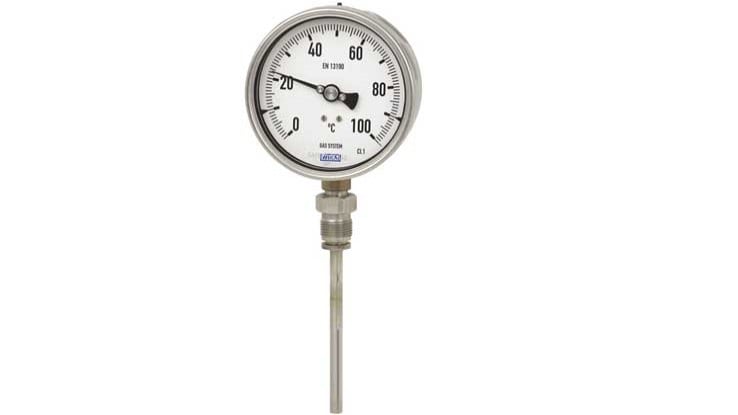
A gas filled thermometer measures temperature by sealing an inert gas inside a fixed volume and reading the pressure that builds up as it heats. That pressure change bends a Bourdon tube, and the bend itself becomes the pointer movement you read on the dial.
The whole system, sensing bulb, capillary tube, and Bourdon tube, is welded shut and filled with gas under pressure at the factory. Nothing enters or leaves once it's sealed. Heat the bulb, and the trapped gas has nowhere to expand, so its pressure rises instead. That pressure is exactly what a Bourdon tube is built to measure, a curved metal tube that straightens slightly under internal pressure, and that small mechanical movement gets amplified through a linkage into a full pointer sweep across the dial.
This is genuinely different from how a thermocouple or RTD works. Those are electrical sensors, producing a voltage or resistance that a transmitter converts into a signal. A gas filled thermometer produces nothing electrical at all. It's pure mechanics, sealed gas, pressure, and a spring shaped tube, which is exactly why it needs no power supply and works reliably in areas where running an electrical signal would be a genuine hazard.
Some modern designs go a step further, using a carbon-based molecular sieve inside the bulb. This material adsorbs gas at lower temperatures and releases it as temperature rises, which lets manufacturers use a lower initial system pressure while still achieving the same full-scale reading. Lower internal pressure means less mechanical stress on the Bourdon tube over its service life, directly extending how long the instrument holds calibration before needing replacement.
6 Facts About Gas Filled Thermometers Every Engineer Should Know
Watch: How Does a Gas Filled Thermometer Work?
This video walks through the operating principle, internal design, and ambient temperature compensation in detail.
A Worked Example: Seeing the Gas Law in Action
Suppose a bulb is sealed at 20°C with an initial gas pressure of 2,000 kPa. Since the system volume never changes, pressure and absolute temperature stay directly proportional, exactly what the ideal gas law predicts for a constant volume process.
Given: P1 = 2,000 kPa at T1 = 293.15 K (20°C)
Find: P2 at T2 = 393.15 K (120°C)
P2 = P1 × (T2 / T1) = 2,000 × (393.15 / 293.15) = 2,682 kPa
A 100°C rise in bulb temperature produces roughly a 34% increase in system pressure here. That pressure change is precisely what the Bourdon tube converts into pointer movement, and it's why the dial scale can be evenly, linearly marked across the full range.
Gas Filled vs Bimetal vs Vapor Filled Thermometers
Choosing between mechanical temperature gauges usually comes down to these three technologies, and the differences matter more than they first appear. A bimetal thermometer has no fill fluid at all, relying purely on the differential expansion of two bonded metal strips, which keeps it simple and inexpensive but limits it to direct mounting only, no remote capillary option exists for a true bimetal design. A vapor filled, or Class II, system partially fills the bulb with a volatile liquid like methyl chloride or toluene, and reads the vapor pressure above that liquid rather than the pressure of a fixed gas volume.
| Property | Gas Filled (Class III) | Bimetal | Vapor Filled (Class II) |
|---|---|---|---|
| Typical range | -200°C to 650°C | -70°C to 600°C | Limited by liquid's boiling/critical point |
| Pressure/temperature relationship | Linear | N/A, mechanical deflection | Nonlinear |
| Response time (10 to 90°C step) | ~30 seconds | ~90 seconds | Moderate |
| Remote capillary option | Yes, up to 60 to 100m | No | Yes |
| Typical accuracy | ±1% of full span | ±1-2% of full span | ±1-2%, worse near range limits |
For a temperature transmitter that outputs a 4-20mA signal instead of a purely mechanical dial reading, the working principle and construction are almost entirely different. See our guide on what a temperature transmitter is and how it works for that comparison.
Advantages and Disadvantages of Gas Filled Thermometers
- No electrical power required, intrinsically safe by design
- Genuinely linear pressure-temperature relationship
- Fast response compared to bimetal and vapor filled systems
- Rugged, no head or elevation error affecting the reading
- Long capillary runs possible for safe remote reading
- Ambient temperature at the dial can introduce error without compensation
- More expensive than a comparable bimetal thermometer
- Purely local or capillary-connected reading, no digital output on its own
- A damaged capillary can compromise the entire sealed system
Where Gas Filled Thermometers Are Actually Used
The combination of wide range, no power requirement, and remote capillary mounting makes this technology a natural fit anywhere an electrical sensor would face real installation obstacles.
Wide range and remote mounting suit hazardous, high-temperature process areas.
Rugged Bourdon tube design tolerates vibration near turbines and rotating equipment.
No power requirement suits explosive atmosphere zones without added barriers.
Remote capillary mounting keeps operators away from corrosive process zones.
Sanitary bulb designs allow local reading without electrical components nearby.
Movementless design resists wear from continuous rotating machinery vibration.
Bulb mounting style matters too. A union-connected bulb threads securely into a thermowell for pressurized or corrosive service, while a plain bulb, with no fittings at all, suits open tanks, sinks, or vats where the process itself is at atmospheric pressure. Getting this choice wrong is a common, avoidable installation mistake, since a plain bulb forced into a pressurized line has no reliable seal at all.
Quick FAQs: Gas Filled Thermometers
- Thermocouple vs RTD: 7 Critical Differences That Decide Which Sensor You Actually Need
- Thermistor vs Thermocouple: 6 Key Differences and Which One Wins for Your Application
- What Is a Thermowell? Types, Selection and Design Explained
- What Is a Temperature Transmitter?
- Basics of Pressure Measurement: 5 Essential Concepts Explained
External References
These sources go into greater technical depth on the Bourdon tube mechanism, ASME classification, and specific product ranges available for gas actuated instruments.
- WIKA: Temperature Gauge, Gas-Actuated Working Principle
- tec-science: How Does a Gas Filled Thermometer (Gas-in-Metal) Work?
- Ashcroft: When to Use Gas-Actuated Thermometers
What we learn today
- A gas filled thermometer seals inert gas inside a fixed volume, converting temperature-driven pressure rise into a Bourdon tube deflection that moves a dial pointer.
- Its pressure-temperature relationship is genuinely linear, thanks to the ideal gas law, giving it evenly spaced scale markings unlike vapor filled systems.
- Ambient temperature at the dial itself is a real, compensated-for error source, corrected using a bimetallic strip and a deliberately oversized bulb-to-system volume ratio.
- It trades the convenience of electronic signal output for genuine ruggedness, fast response, and true power-free operation in hazardous or remote locations.