
Table of Contents
ToggleRTD Temperature Sensor: Introduction
Temperaturemeasurement is very important in industrial automation and process industries. Whether it is a boiler, heat exchanger, reactor, or pipeline, accurate temperature monitoring helps maintain product quality, process efficiency, and plant safety.
Among all industrial temperature sensors, the RTD Temperature Sensor is considered one of the most accurate and reliable devices for precise temperature measurement.
RTDs are widely used in industries because of their excellent accuracy, repeatability, and long-term stability.
In this article, we will understand the RTD Temperature Sensor working principle, common RTD types, checking procedures, applications, advantages, and common faults.
What is an RTD Temperature Sensor?
RTD stands for Resistance Temperature Detector.
It is a temperature sensor that works on the principle that the electrical resistance of a metal changes with temperature.
As temperature increases, the resistance of the RTD element also increases in a predictable and nearly linear manner.
The sensing element inside an RTD is usually made from platinum because platinum provides:
1. Excellent accuracy
2. Stable resistance characteristics
3. Wide temperature range
4. Long-term reliability
The most commonly used RTD in industries is the PT100 RTD.
RTD Working Principle
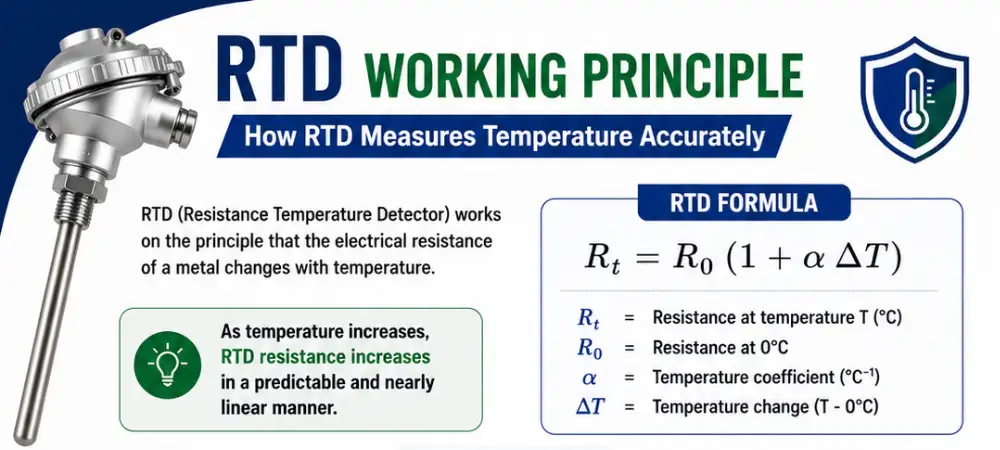
The RTD Temperature Sensor works based on the resistance-temperature relationship of metals.
The basic RTD principle can be represented as:
Rt=R0(1+αΔT)
Where:
1. Rt = Resistance at temperature T
2. R0 = Resistance at 0°C
3. α = Temperature coefficient
4. ΔT = Change in temperature
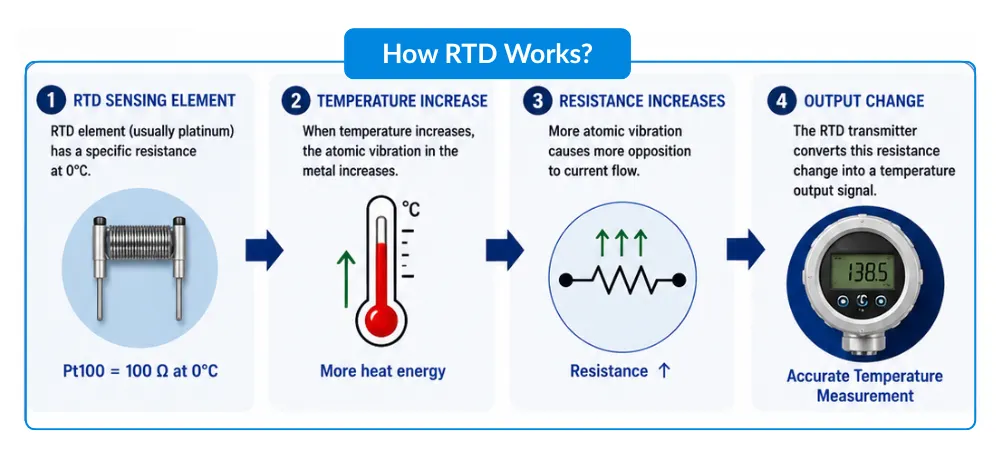
When temperature rises, resistance increases.
For example, in a PT100 RTD:
1. At 0°C → Resistance = 100 Ω
2. At 100°C → Resistance ≈ 138.5 Ω
Because the resistance change is highly predictable, RTDs provide very accurate temperature measurements.
Common RTD Types
Different RTD types are available depending on resistance value and application requirements.
1. PT100 RTD
The PT100 is the most widely used RTD sensor in industrial automation.
Features:
1. Resistance = 100 Ω at 0°C
2. High accuracy
3. Good stability
4. Suitable for most industrial applications
2. PT1000 RTD
The PT1000 operates similarly to PT100 but has higher resistance.
Features:
1. Resistance = 1000 Ω at 0°C
2. Better noise immunity
3. Useful for long cable runs
4. Improved sensitivity
3. NI100 RTD
The NI100 uses nickel instead of platinum.
Features:
1. Economical option
2. Faster response
3. Limited temperature range compared to platinum RTDs
RTD Construction
An RTD Temperature Sensor typically consists of:
1. Sensing Element (Platinum/Nickel)
2. Protection Sheath
3. Terminal Block
4. Connection Head
5. Extension Wires
The sensing element is protected inside a stainless steel sheath to withstand harsh industrial environments.
RTD Wiring Configurations
RTDs are available in different wiring configurations.
2-Wire RTD
Simplest configuration but less accurate because lead wire resistance affects measurement.
3-Wire RTD
Most commonly used in industries.
It compensates for lead wire resistance and provides better accuracy.
4-Wire RTD
Highest accuracy configuration.
Completely eliminates lead wire resistance effects.
Used in laboratories and critical process applications.
Also read our article: Difference Between 2 wire RTD, 3 wire RTD and 4 wire RTD?
Basic RTD Checking Procedure
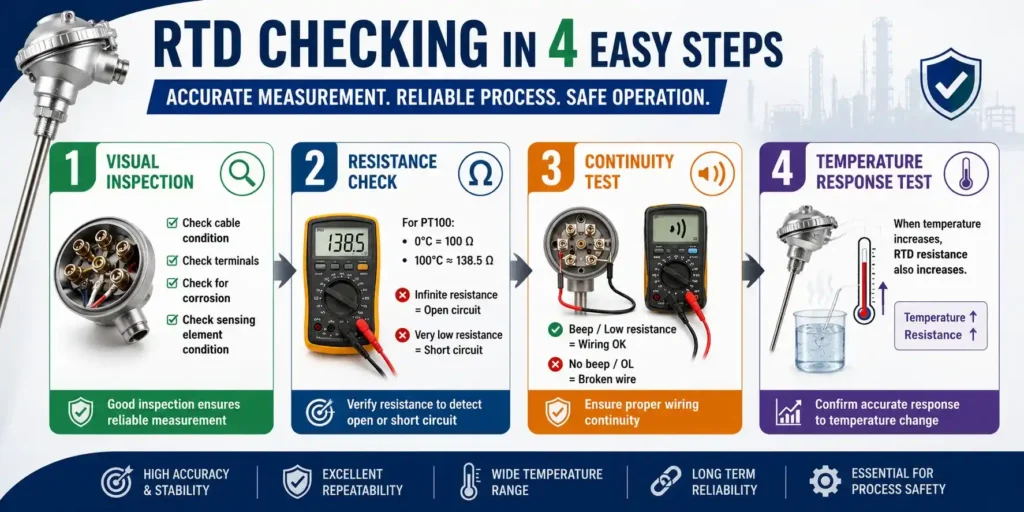
Proper RTD testing is important to ensure reliable process measurement.
1. Visual Inspection
First, visually inspect the RTD sensor.
Check for:
1. Damaged cable
2. Loose terminals
3. Corrosion
4. Moisture ingress
5. Broken sensing element
Many RTD failures can be identified during visual inspection itself.
2. Resistance Check
Measure the resistance using a digital multimeter.
For PT100 RTD:
1) 0°C = 100 Ω
2) 25°C ≈ 109.7 Ω
3) 50°C ≈ 119.4 Ω
4) 100°C ≈ 138.5 Ω
Compare the measured value with the standard RTD resistance table.
Important Fault Indications:
1. Infinite resistance → Open circuit
2. Very low resistance → Short circuit
If resistance values are abnormal, the RTD may be damaged.
3. Continuity Test
Use the multimeter continuity mode to check wiring continuity.
Results:
1. Beep/Low resistance → Wiring OK
2. No beep/OL → Broken wire or open connection
4. Temperature Response Test
Apply heat gently using warm water or a heat gun.
Observe the resistance value.
The resistance should increase smoothly with temperature.
If the reading fluctuates or does not change properly, the RTD may be faulty.
Common RTD Faults
Several problems can affect RTD performance.
1. Open Circuit
Occurs due to broken wires or damaged sensing elements.
Symptoms:
1. Infinite resistance
2. No temperature reading
2. Short Circuit
Occurs when wires touch each other internally.
Symptoms:
1. Very low resistance
2. Incorrect low temperature reading
3. Moisture Ingress
Water entering the sensor causes unstable readings and corrosion.
4. Wrong Wiring Connection
Incorrect 2-wire/3-wire connections can create measurement errors.
Please check our article: Top 3 RTD Sensor Connections: 2-Wire, 3-Wire & 4-Wire Explained
5. Calibration Drift
Over time, RTD accuracy may shift due to aging or harsh operating conditions.
Advantages of RTD Temperature Sensors
RTDs offer several advantages over other temperature sensors.
1. High Accuracy
RTDs provide very precise temperature measurement.
2. Excellent Stability
Long-term measurement stability is very good.
3. Repeatability
RTDs produce consistent results over repeated cycles.
4. Wide Temperature Range
Suitable for low and high-temperature applications.
5. Better Reliability
RTDs are highly reliable in industrial environments.
Industrial Applications of RTD Temperature Sensors
RTD Temperature Sensors are widely used across industries.
1. Boilers
Used for steam and water temperature monitoring.
2. Heat Exchangers
Helps maintain proper heat transfer efficiency.
3. Power Plants
Used in turbines, generators, and cooling systems.
4. Oil & Gas Industries
Critical for pipeline and process temperature monitoring.
5. Pharmaceutical Industries
Ensures precise temperature control for product quality.
6. Food & Beverage Industries
Used in hygienic process temperature measurement.
What we learn today?
The RTD Temperature Sensor is one of the most accurate and dependable temperature measurement devices used in industrial automation.
Its predictable resistance change with temperature makes it ideal for applications requiring precision, stability, and reliability.
Proper RTD testing procedures such as visual inspection, resistance measurement, continuity testing, and temperature response checks help ensure accurate process control and safe plant operation.
Understanding RTD working principles and common faults can significantly reduce troubleshooting time and improve instrumentation reliability in industrial processes.


I hope you like above blog. There is no cost associated in sharing the article in your social media. Thanks for Reading !! Happy Learning