
Two thermowells can look identical in a catalog photo and still fail on completely different timelines, because the process fluid, not the geometry alone, decides how long a thermowell actually survives.
Most thermowell failures trace back to one of two root causes: the wrong material for the process chemistry, or flow induced vibration nobody checked for before installation.
This guide focuses on the decision that actually determines service life, material selection against real process conditions, and the failure mechanism that catches engineers off guard most often.
A calculator recommends a starting material based on temperature and service type, and a worked failure case shows exactly how vibration cracks a thermowell at its base.
A thermowell guide focused on material selection and failure prevention matters more than one focused only on geometry. Most in service thermowell failures come from choosing a material that cannot survive the actual process chemistry, or from flow induced vibration resonating with the thermowell's own natural frequency until it cracks at the base.
A thermowell's job looks simple, protect a temperature sensor from process pressure and flow, but the material choice behind that simple job carries real consequences if it goes wrong.
Two failure paths account for most real world thermowell problems: a material that cannot handle the actual corrosive or erosive service, and vibration nobody checked against the thermowell's natural frequency.
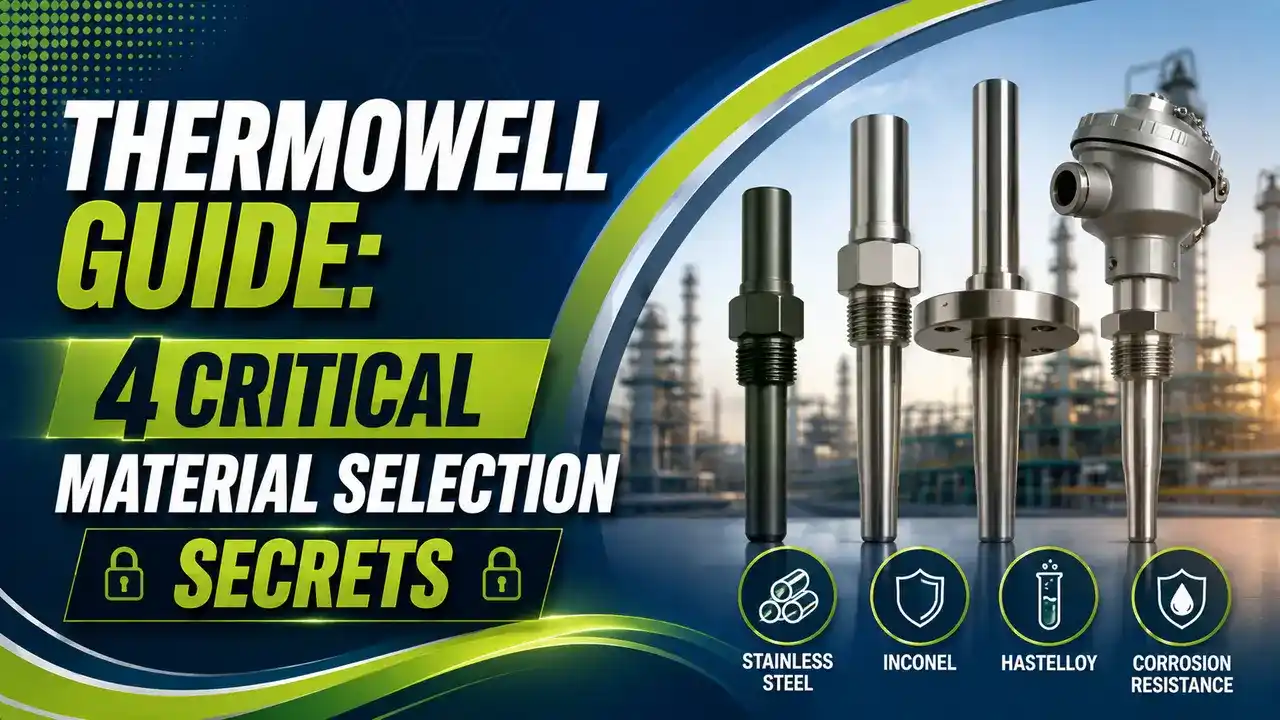
This article works through material selection against real process conditions, how vibration fatigue actually breaks a thermowell, and a calculator that recommends a starting material for a given service.
Why Material Selection Decides Service Life
316 or 316L stainless steel covers most general industrial service, offering solid corrosion resistance at a reasonable cost for moderate temperature, non aggressive process fluids.
Carbon steel only belongs in low temperature, low pressure, non corrosive service, since its resistance to corrosive chemicals is genuinely poor compared to stainless alternatives.
Premium alloys, Hastelloy, Inconel, Incoloy and Monel, earn their higher cost in genuinely demanding service: strong acids, chloride environments prone to pitting, or temperatures beyond what standard stainless steel tolerates.
Corrosion Service vs Erosion Service Need Different Answers
Corrosive service, acids or chloride bearing fluids, attacks a thermowell chemically, thinning the wall from the outside in until it can no longer hold process pressure safely.
Erosive service, fluids carrying solid particles, wears a thermowell mechanically instead, and calls for a tougher, wear resistant material along with a heavier wall profile, not just better corrosion resistance.
Treating both problems the same way, by simply upgrading to a premium alloy without considering wall thickness or particle loading, solves the corrosion case while leaving the erosion case still exposed.
Four Material Families and Where They Fit
316/316L Stainless Steel
The default choice for general industrial service, moderate temperature, and non aggressive process fluids.
Hastelloy and Inconel
Premium alloys for strong acids, chloride service, or temperatures beyond what standard stainless steel tolerates.
Carbon Steel
Only appropriate for low temperature, low pressure, non corrosive service, where cost matters most.
Ceramic and Silicon Carbide
Reserved for extreme temperature service beyond what any metallic alloy can reliably handle.
Thermowell Material Compatibility Advisor
Enter the process temperature and service type to get a starting material recommendation. This is a planning starting point, not a substitute for a full engineering review.
How Flow Induced Vibration Actually Breaks a Thermowell
Vortex shedding forces grow with the square of flow velocity, so a modest increase in process flow rate produces a disproportionately larger vibration force on the thermowell.
The dangerous condition is resonance: when the vortex shedding frequency lands close to the thermowell's own natural frequency, the thermowell can lock into that frequency and the vibration force rapidly amplifies.
Failure almost always starts at the base, where bending stress concentrates the most, not partway up the shaft where the surface simply looks the most exposed to flow.
Telling a Vibration Failure Apart From a Corrosion Failure
| Failure Mode | Where It Starts | What It Looks Like |
|---|---|---|
| Flow induced vibration fatigue | The base, where bending stress concentrates | A clean fatigue crack, minimal surface pitting nearby |
| Corrosion | Anywhere wetted by the aggressive fluid | General wall thinning, pitting, or surface roughening |
| Erosion | The upstream face facing flow and particles | Smooth, polished wear pattern, thinning concentrated on one side |
Correctly identifying which failure mode actually occurred matters, since fixing a vibration problem with a better corrosion resistant material solves nothing if resonance was the real cause.
Thermowell Material and Vibration Do's and Don'ts
✓ Do
- Match material to the actual process chemistry, not just the temperature rating alone
- Check vortex shedding frequency against the thermowell's natural frequency before installation
- Inspect a failed thermowell's crack location before assuming the failure cause
- Treat erosive service as a wall thickness problem, not only a material hardness problem
✗ Don't
- Assume a premium alloy automatically solves a vibration resonance problem, it usually doesn't
- Use carbon steel anywhere near corrosive or high pressure service
- Ignore a modest flow rate increase, vibration force grows with the square of velocity
- Confuse a base fatigue crack with corrosion damage, the root cause and fix are different
Resources on Thermowell Material Selection and Failure
Thermowell Guide Questions Engineers Ask
External References
- IQS Directory: Specifications, Designs, and Classifications of Thermowells
- Processing Magazine: How to Save Thermowells From Vortex Induced Vibrations and Mechanical Fatigue
What We Learn Today
- Material selection driven by real process chemistry, not just temperature, decides most thermowell service life outcomes.
- Corrosive service and erosive service need different fixes, chemical resistance versus wall thickness and hardness.
- Flow induced vibration resonance, not chemical attack, causes many in service thermowell fractures, almost always starting at the base.
- Correctly diagnosing the failure mode matters, since the fix for vibration and the fix for corrosion are not interchangeable.