
Burnout Function in Temperature Transmitters: How It Protects Your Process
Imagine a temperature transmitter measuring the temperature of a furnace operating at 800°C. Suddenly, the thermocouple cable breaks.
What temperature should the transmitter send to the control system?
Should it show 0°C?
Should it hold the last measured value?
Or should it immediately indicate that something has gone wrong?
This is where the Burnout Function comes into play.
The burnout function is one of the most important safety features built into modern temperature transmitters. It helps operators, technicians, and control systems quickly identify sensor failures and prevent dangerous process conditions.
In this article, we’ll explain how burnout works, why it is necessary, and how Burnout High and Burnout Low are used in industrial automation systems.
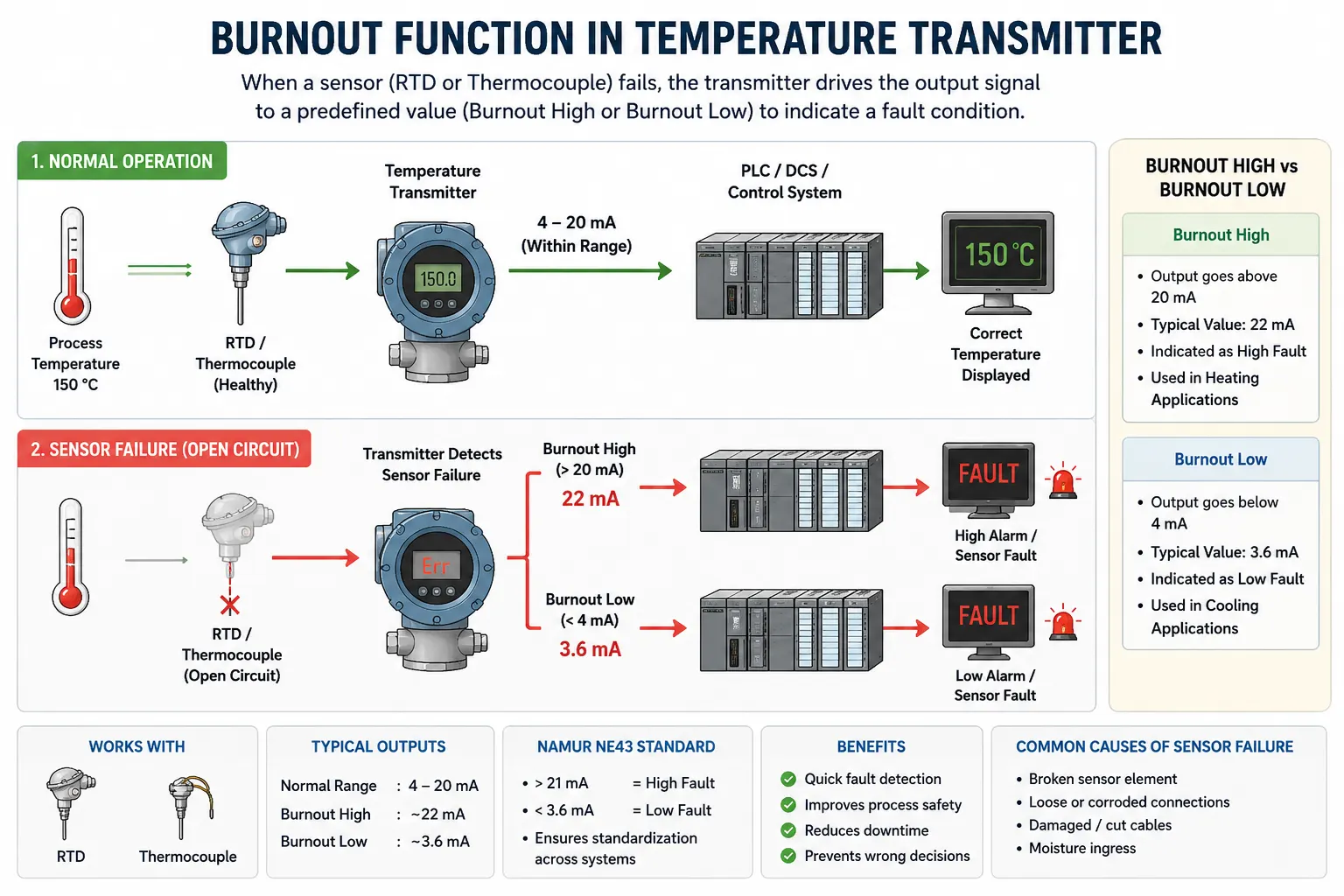
What is the Burnout Function?
The burnout function is a transmitter feature that forces the output signal to a predefined value whenever an RTD or thermocouple sensor fails.
Instead of transmitting an incorrect temperature value, the transmitter sends a special fault signal that alerts the PLC, DCS, or operator that the sensor is no longer providing valid measurements.
This makes troubleshooting faster and improves process safety.
Why is Burnout Protection Required?
Temperature sensors are often installed in harsh industrial environments.
Common causes of sensor failure include:
Broken thermocouple wires
Open RTD circuits
Loose terminal connections
Corroded junction boxes
Damaged extension cables
Mechanical vibration
Without burnout protection, the control system may continue operating based on false temperature readings.
This can result in:
Product quality issues
Equipment damage
Process instability
Safety hazards
Production losses
How Does the Burnout Function Work?
Under normal operation, a temperature transmitter converts the sensor signal into a standard 4-20 mA output signal.
For example:
4 mA = 0°C
20 mA = 400°C
If the sensor fails, the transmitter detects the fault and automatically drives the output outside the normal operating range.
This abnormal output informs the control system that a sensor failure has occurred.
What is Burnout High?
Burnout High forces the transmitter output above the normal measurement range during a sensor failure.
Typical output:
22 mA
21.8 mA
22.5 mA
depending on the manufacturer.
Example
Suppose a transmitter is measuring a reactor temperature.
Normal range:
0°C = 4 mA
200°C = 20 mA
If the thermocouple breaks, the transmitter may immediately drive the output to 22 mA.
The PLC interprets this as a sensor fault rather than a valid temperature measurement.
What is Burnout Low?
Burnout Low forces the transmitter output below the normal operating range when a sensor failure is detected.
Typical output:
3.6 mA
3.8 mA
depending on the configuration.
Example
An RTD monitoring a storage tank becomes disconnected.
Instead of displaying an incorrect temperature, the transmitter drives the signal to 3.6 mA, allowing maintenance personnel to quickly identify the fault.
Burnout High vs Burnout Low
| Feature | Burnout High | Burnout Low |
|---|---|---|
| Output Signal | Above 20 mA | Below 4 mA |
| Typical Value | 22 mA | 3.6 mA |
| Fault Indication | High Signal | Low Signal |
| Common Use | Heating Applications | Cooling Applications |
| Sensor Failure Response | Maximum Fault Output | Minimum Fault Output |
Burnout Function for Thermocouples
Thermocouples are especially vulnerable to open-circuit failures because they generate very small millivolt signals.
When a thermocouple wire breaks:
The transmitter detects the open circuit.
Burnout protection activates.
The output moves to the configured fault value.
The control system generates an alarm.
This prevents operators from acting on false temperature data.
Please read our article : Thermocouple Burnout Detection | Causes, Circuit and Industrial Importance
Burnout Function for RTDs
RTDs can also fail due to broken leads, loose terminals, or cable damage.
When an RTD circuit opens:
The transmitter detects abnormal resistance.
Burnout mode is activated.
A fault signal is transmitted.
Operators receive an alarm notification.
Relationship Between Burnout and NAMUR NE43
Many modern transmitters follow the NAMUR NE43 standard.
According to NAMUR NE43:
< 3.6 mA indicates a low fault
21 mA indicates a high fault
These standardized fault signals help PLCs and DCS systems recognize transmitter failures consistently across different manufacturers.
How PLC and DCS Systems Use Burnout Signals
Modern control systems continuously monitor analog input signals.
When the signal exceeds predefined limits:
A fault alarm is generated.
Maintenance personnel are notified.
The process may enter a safe operating state.
Automatic shutdown logic may be activated if required.
This helps prevent accidents and process disruptions.
Common Troubleshooting Steps
If a burnout alarm occurs:
Check sensor wiring continuity.
Inspect terminal connections.
Verify RTD resistance values.
Examine thermocouple extension cables.
Check for moisture ingress.
Confirm transmitter configuration.
Review diagnostic messages using a HART communicator.
Advantages of the Burnout Function
Improves process safety.
Detects sensor failures immediately.
Reduces troubleshooting time.
Prevents false temperature readings.
Supports predictive maintenance.
Improves control system reliability.
Complies with industrial standards.
Conclusion
The burnout function is a critical diagnostic feature in temperature transmitters. By driving the output signal outside the normal 4-20 mA range during sensor failures, it allows operators and control systems to quickly recognize problems and take corrective action.
Whether using RTDs or thermocouples, properly configuring Burnout High or Burnout Low can significantly improve process safety, reduce downtime, and prevent costly operating errors.
Frequently Asked Questions (FAQs)
1. What is the burnout function in a temperature transmitter?
The burnout function is a diagnostic feature that forces the transmitter output to a predefined fault value when an RTD or thermocouple sensor fails. This helps operators quickly identify sensor problems and avoid relying on incorrect temperature measurements.
2. Why is the burnout function important?
The burnout function prevents false temperature readings from reaching the PLC or DCS during sensor failures. It improves process safety, reduces troubleshooting time, and helps prevent equipment damage.
3. What is Burnout High in a temperature transmitter?
Burnout High is a fault condition where the transmitter drives its output above the normal measurement range when a sensor failure is detected. In a standard 4-20 mA system, the output is typically around 22 mA.
4. What is Burnout Low in a temperature transmitter?
Burnout Low is a fault condition where the transmitter drives its output below the normal measurement range. In a standard 4-20 mA loop, the output is typically around 3.6 mA.
5. What is the difference between Burnout High and Burnout Low?
Burnout High sends a signal above 20 mA during a sensor fault, while Burnout Low sends a signal below 4 mA. The selection depends on plant safety philosophy and control system requirements.
6. Does the burnout function work with both RTD and thermocouple sensors?
Yes. Modern temperature transmitters support burnout protection for both RTD and thermocouple inputs. The transmitter continuously monitors the sensor circuit and activates burnout mode when a fault is detected.
7. What output signal indicates a sensor failure in a 4-20 mA loop?
A signal below 4 mA (typically 3.6 mA) or above 20 mA (typically 22 mA) often indicates a sensor failure, wiring problem, or transmitter fault condition.
8. What happens when a thermocouple breaks?
When a thermocouple wire breaks, the transmitter detects the open circuit and activates the configured burnout mode. The output then moves to a predefined fault value, allowing the control system to generate an alarm.
9. What is the relationship between burnout function and NAMUR NE43?
NAMUR NE43 defines standardized fault signal levels for transmitters. According to the standard, signals below 3.6 mA or above 21 mA indicate fault conditions, making it easier for PLC and DCS systems to detect transmitter failures.
10. Can Burnout High or Burnout Low be configured by the user?
Yes. Most smart temperature transmitters allow users to select Burnout High or Burnout Low using HART communicators, local displays, or configuration software based on application requirements.
I hope you like above blog. There is no cost associated in sharing the article in your social media. Thanks for reading!! Happy Learning!!