A small notch at the tip of a probe, with a crystal on each side, can tell a control system whether liquid is present in a fraction of a second. With no moving parts and built in self checking, this sensor makes a dependable point level alarm.
Ultrasound crosses a liquid filled gap easily but hardly crosses an air filled one, and that simple contrast makes a robust point level switch. This guide covers working, alarm duty, foam and aeration, self test, mounting and sizing.
What Is an Ultrasonic Gap Switch?
An ultrasonic gap switch is a point level sensor with two piezoelectric crystals facing each other across a small open gap at the probe tip, one crystal transmitting ultrasound and the other receiving it. When liquid fills the gap the signal passes strongly, and when the gap holds only air or vapour the signal is lost, so the electronics change the output state.
It is one of several contact type point level devices compared in this level switch selection guide. It should not be confused with an ultrasonic level transmitter, which measures continuous level from the top of a tank without touching the liquid.
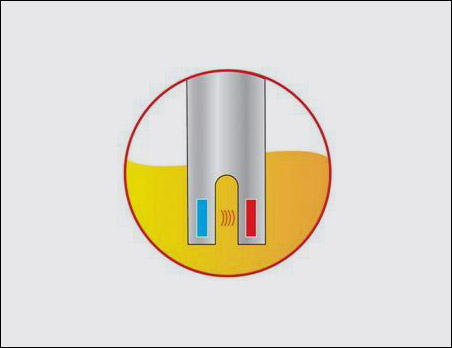
AMETEK Magnetrol explains that its Echotel switches use piezoelectric ceramic crystals encapsulated in epoxy at the transducer tip. The electronics continuously monitor the gap between the transmit and receive crystals and shift the relay or current output when the level changes.
Sound travels about four times faster in water than in air, and far more of its energy crosses from a crystal into a liquid. That large contrast is why a dry gap and a wet gap give such clearly different signals.
How the Transmit and Receive Crystals Work
Most modern units use pulsed electronics rather than a continuous tone. Magnetrol states that pulsed signal technology gives excellent performance in difficult process conditions and strong immunity to electromagnetic noise.
Because the decision is based on signal strength across a fixed gap, the switch does not depend on dielectric constant, conductivity or density in the way a capacitance level switch does. This makes it a good choice for liquids whose properties change from batch to batch.
The Echotel 940/941 catalog quotes a typical response of half a second and repeatability of 2 mm. It also lists a process temperature range of minus 40 to plus 85 °C and pressure up to 2000 psig, or 138 bar, for the shorter threaded transducers.
High and Low Level Alarm Duty
Mounted near the top, it switches when liquid fills the gap.
Mounted low, it switches when the gap runs dry.
Two switches start and stop a pump between two levels.
For safety, the output should go to the alarm state on loss of power or a sensor fault. Most units therefore offer a selectable fail safe mode, where the relay is energised in the normal condition and drops out on alarm or failure.
A low level ultrasonic gap switch on a pump suction protects the pump from running dry, which is especially important for the seals of the machines described in centrifugal vs positive displacement pump. A high level switch closes the inlet valve or trips the feed pump before overfill.
Set the fail safe mode to high level fail safe for overfill duty and low level fail safe for dry run duty. Then test both power loss and wet and dry conditions at commissioning.
Foam, Aeration and Difficult Liquids
Light foam has a lot of air, so it usually reads as dry, which is good for a high level alarm that must ignore froth. Dense, wet foam can couple some energy and may give a false wet signal, as discussed in why foam affects level sensors.
Aeration is a bigger problem, because many fine bubbles scatter the ultrasound and weaken the signal in a truly wet gap. Automation Forum notes that ultrasonic switches should see no aeration in liquids of about 100 cP or more, and that suspended solids should stay below 5 percent.
For sticky or crystallising products, check how the probe will be cleaned, since a coating that bridges the gap will hold the switch in the wet state. Guidance on such fluids appears in level measurement in high viscosity liquids.
A gap switch can be mounted between the walls of a double wall tank. Magnetrol lists interstitial leak detection as one use of its compact Echotel 940/941 models.
Time to Overflow Formula
For a high level alarm, the switch height above normal level must leave enough time for the operator or interlock to act. The available volume between the switch and the overflow follows the cylinder volume method in tank volume from level measurement.
t = V ÷ Q × 3600
D = tank diameter, m
h = height from switch to overflow, m
Q = maximum inflow, m³/h
Example:
D = 2 m, h = 0.3 m, Q = 30 m³/h
V = 0.7854 × 4 × 0.3 = 0.94 m³
t = 0.94248 ÷ 30 × 3600 = 113.1 s
Ultrasonic Gap Switch Response Margin Calculator
Compare this time with the switch response, the logic scan, the valve closing time and the operator response you assume. If the margin is too small, lower the switch or add an automatic trip instead of relying on an alarm alone.
Second Worked Example: Small Day Tank
A diesel day tank of 1.2 m diameter is filled at 12 m³/h, and the high level ultrasonic gap switch sits 0.15 m below the overflow. The margin volume is 0.7854 × 1.44 × 0.15 = 0.17 m³.
The time to overflow is 0.17 ÷ 12 × 3600 = about 51 s. That is enough for an automatic pump trip but tight for a manual response, so the switch should stop the transfer pump directly.
6 Smart Steps to Install an Ultrasonic Gap Switch
For a side mounted switch, a vertical gap lets liquid drain and stops bubbles from collecting in the notch. The same mounting logic is used for the vibrating fork level switch, whose tines are also turned vertical in side entry duty.
Keep the probe tip at least a few centimetres away from the tank wall and nozzles. Splashing from a fill line falling on the gap can cause chattering alarms.
Self Test, Diagnostics and SIL Use
Advanced units such as the Magnetrol Echotel 961 continuously check the sensor and electronics, according to AMETEK. Such a test can detect a broken crystal, a cracked cable or a failed circuit and drive the output to its alarm or fault state.
Magnetrol rates its Echotel 940/941 as suitable for SIL 2 loops, with an FMEDA report available. The meaning of these ratings is covered in what is SIL safety integrity level, and proof testing still remains necessary.
Diagnostics reduce, but do not remove, the need for a real wet and dry proof test. Plan the test interval and coverage as explained in proof test interval and coverage under IEC 61511.
Comparing Point Level Switch Technologies
| Technology | Moving parts | Foam handling | Coating tolerance |
|---|---|---|---|
| Ultrasonic gap | None | Ignores light foam | Moderate |
| Vibrating fork | None | Good | Moderate |
| Float switch | Yes | Good | Poor with sticky liquids |
| Capacitance | None | Can false trip | Good with proper design |
| Conductivity | None | Can false trip | Poor |
Floats are simple and cheap but have hinges and magnets that can stick, as shown in float level switch working. The ultrasonic gap switch avoids moving parts and works with both conductive and non conductive liquids.
- No moving parts and little maintenance.
- No calibration for most liquids.
- Independent of conductivity and dielectric constant.
- Fast response, typically about half a second.
- Self test models suit safety loops.
- Liquids only, not dry bulk solids.
- Heavy aeration weakens the signal.
- Thick coatings can bridge the gap.
- Process temperature is limited on compact models.
Troubleshooting Gap Level Alarms
- Confirm the actual level with a gauge or dip before blaming the switch.
- Check the fail safe mode and the relay wiring at the panel.
- Pull the probe and inspect the gap for coating or crystals.
- Look for gas bubbles or aeration near the switch.
- Verify that inlet streams do not splash onto the tip.
- Read the fault or diagnostic status on self test models.
- Repeat a wet and dry test after any repair.
Chattering alarms often come from waves or splashing, and a small time delay in the electronics or logic helps, following the good practice in alarm management to ISA 18.2. Persistent faults may also come from noise, so check shields and segregation.
Typical Applications
For a full overview of where point switches fit next to continuous transmitters, read basics of level measurement and how to select the right level sensor.
Echotel 940/941 Ultrasonic Level Switch Catalog
Ultrasonic Gap Level Switch Video
Ultrasonic Gap Switch FAQ
A transmit crystal sends ultrasound across a small gap to a receive crystal. Liquid in the gap carries the signal well, while air almost blocks it.
The electronics compare the received signal with a threshold. A strong signal means the tip is wet, and a weak signal means it is dry, so the output changes state.
Yes, the same sensor works for both duties by choosing the mounting height and fail safe mode. A high alarm switches when the gap becomes wet.
A low alarm switches when the gap runs dry, which suits pump dry run protection. Select the fail safe mode so that power loss also gives the alarm state.
Light foam contains mostly air, so the gap usually reads dry and the switch ignores it. This behaviour is helpful for high level alarms in frothy process tanks.
Very dense foam can couple some sound and may look wet. Test the actual product if foam is heavy, or choose another switch technology for that duty.
Fine gas bubbles scatter the ultrasonic energy inside the gap. A wet gap with heavy aeration may then give a weak signal, and the ultrasonic gap switch reads it as dry.
Automation Forum advises avoiding aeration in liquids of about 100 cP or more. Mount the switch away from inlets, agitators and gas sparging points to keep the gap clear.
Most models need no calibration for normal liquids, because they only decide between wet and dry. Magnetrol states this clearly for its Echotel 940/941 ultrasonic gap switch range.
You still need a functional test at commissioning and during proof tests. Raise and lower the level, or dip the probe in liquid, to confirm both states.
Self test models continuously check the crystals, the cable and the electronics. A failure drives the output to an alarm or fault state instead of staying silent.
Diagnostics improve safety but they do not replace a real wet and dry proof test. Plan wet and dry tests at the interval required by the safety study for the loop.
Mount it horizontally with the gap vertical, so liquid drains out and bubbles cannot collect. Keep the ultrasonic gap switch clear of walls, nozzles and splashing inlet streams.
Place the gap exactly at the required alarm level. Also check the response margin so that the interlock has enough time to act before the tank overflows.
Related Articles
- Level Switch Selection Guide
- Vibrating Fork Level Switch Working
- Why Foam Affects Level Sensors
- Capacitance Level Switch Working
- Float Level Switch Working Principle
External References
- Echotel Model 940/941 Ultrasonic Level Switch Catalog, Magnetrol
- Ultrasonic Contact Level Switches, AMETEK Magnetrol
- Level Sensor, Wikipedia
What We Learn Today
- An ultrasonic gap switch passes ultrasound between two crystals, and a liquid filled gap carries the signal while an air filled gap blocks it.
- Light foam usually reads dry, but heavy aeration and thick coatings can weaken or bridge the gap and give false states.
- Self test models check crystals, cable and electronics continuously, and Magnetrol rates its Echotel 940/941 as suitable for SIL 2 loops.