
Table of Contents
ToggleWhy Foam Affects Level Sensors?
Level measurement is used in so many industrial process like chemical plant, food processing unit, wastewater treatment facility, or pharmaceutical industry. Aaccurate level monitoring is very important for safe and efficient operation.
However, one common issue creates serious challenges for many level measurement systems:
Foam.
Foam may look harmless floating on top of a liquid, but for level sensors, it can become a major measurement problem. In many industrial tanks, foam interferes with sensor signals and causes unstable or inaccurate readings.
This is why understanding foam behavior is extremely important when selecting a level measurement technology.
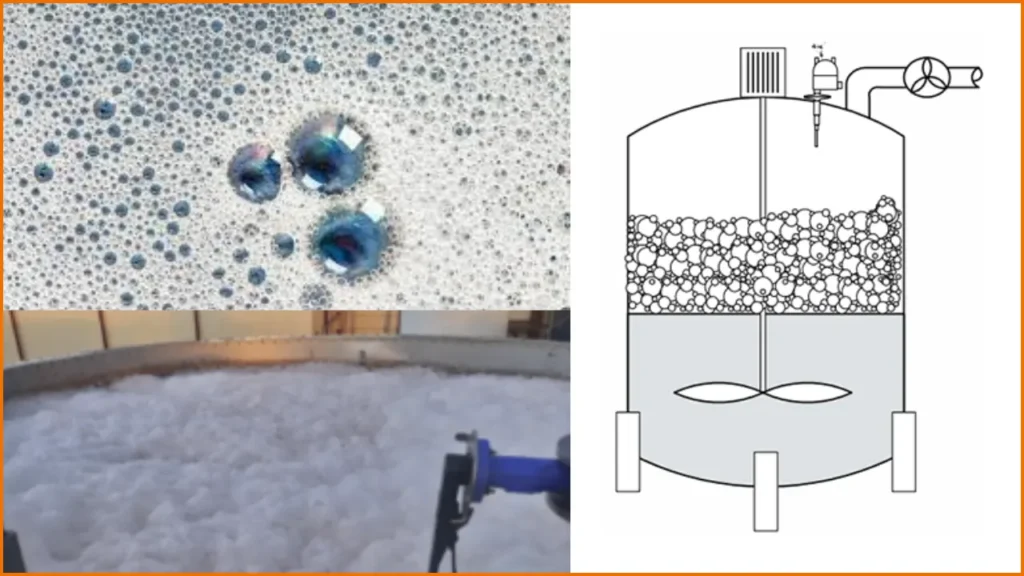
What is Foam?
Foam is formed when gas or air becomes trapped inside a liquid, creating bubbles on the liquid surface. Depending on the process, foam can be light, thick, dry, wet, stable, or continuously moving.
Foam is commonly seen in:
1. Chemical processing tanks
2. Beverage industries
3. Wastewater treatment plants
4. Soap and detergent manufacturing
5. Food processing systems
6. Fermentation tanks
In some applications, foam lasts only for a short time. In others, it remains continuously on the surface of the liquid.
Why Foam Creates Measurement Problems
Most level sensors are designed to detect the actual liquid surface inside a tank. But when foam forms above the liquid, the sensor may mistake the foam layer for the liquid level.
As a result, the instrument may display:
1. Incorrect level readings
2. Fluctuating measurements
3. False alarms
4. Empty tank indication even when liquid is present
The severity of the problem depends on the type of foam, its density, thickness, and the sensor technology being used.
Foam and Ultrasonic Level Sensors
Ultrasonic level sensors are among the most affected technologies in foamy applications.
These sensors work by transmitting sound waves toward the liquid surface and measuring the reflected signal. The problem is that foam absorbs sound energy instead of reflecting it properly.
When this happens, the ultrasonic sensor may:
1. Lose the signal completely
2. Produce unstable readings
3. Detect the foam instead of the liquid
4. Generate false empty tank alarms
Dense foam creates the biggest challenge because the sound wave may never reach the actual liquid surface.
This is one of the most common issues faced in wastewater treatment plants and mixing tanks.
Radar Sensors Perform Better
Radar level sensors use microwave signals instead of sound waves. Because microwaves can penetrate foam better than ultrasonic waves, radar sensors usually perform more reliably in foamy conditions.
However, radar sensors are not completely immune to foam-related problems.
Heavy foam can still:
1. Scatter microwave signals
2. Reduce signal strength
3. Create weak reflections
4. Cause unstable echoes
Wet and sticky foam is especially difficult because moisture absorbs microwave energy more easily.
Even though radar technology performs better, extreme foam conditions can still affect measurement accuracy.
Why Guided Wave Radar is Preferred
In many industries, Guided Wave Radar (GWR) is considered one of the best solutions for foam applications.
Unlike non-contact radar, guided wave radar sends microwave signals directly along a probe into the liquid. This guided signal path reduces signal scattering and improves reliability.
Guided wave radar offers several advantages:
1. Better foam penetration
2. Stable readings
3. Higher accuracy
4. Reliable performance in difficult process conditions
This is why many engineers prefer guided wave radar for tanks where heavy foam formation is expected.
Foam Problems in Other Sensors
Foam does not affect only ultrasonic or radar sensors. Other technologies can also experience problems.
For example, conductive level switches may produce false switching because wet foam can create unwanted conductive paths.
Float-type sensors may also face issues because foam buildup and sticky deposits can restrict float movement.
In some cases, the sensor may respond slowly or become mechanically stuck.
Common Causes of Foam Formation
Foam generation depends heavily on process conditions. Understanding the root cause helps engineers choose the correct measurement technology.
Some common causes include:
1. Agitation and Mixing
Mixers introduce air into the liquid and create bubble formation.
2. Chemical Reactions
Some chemical reactions naturally generate gases and foam.
3. Air Entrainment
Compressed air or turbulent flow can trap air inside the liquid.
4. Detergents and Surfactants
Soap-like chemicals stabilize bubbles and increase foam formation.
5. High-Speed Filling
Rapid filling operations create turbulence and surface disturbance.
Industrial Solutions for Foam Problems
Industries use several methods to improve level measurement reliability in foamy applications.
One common solution is installing a stilling well. A stilling well is a vertical pipe inside the tank that reduces turbulence and minimizes foam interference near the sensor.
Another effective method is optimizing sensor position. Installing the sensor away from mixing zones or turbulence areas can significantly improve performance.
Many plants also try to reduce excessive foam generation by controlling agitation speed, filling rate, or air entrainment.
In difficult applications, selecting the correct sensor technology remains the most important factor.
Why Process Understanding is Important
One of the biggest mistakes in instrumentation is selecting a level sensor based only on tank height or measuring range.
In reality, proper sensor selection depends on several process conditions, including:
1. Foam behavior
2. Temperature
3. Pressure
4. Vapors
5. Tank design
6. Process media properties
Even the best level sensor can fail if it is used in the wrong application.
Experienced instrumentation engineers understand that successful level measurement requires knowledge of both:
1. The instrument
2. The process itself
FAQs About Foam and Level Sensors
1. Why does foam affect level sensors?
Foam interferes with the sensor signal and prevents the instrument from detecting the actual liquid surface accurately. Depending on the sensor type, foam may absorb, scatter, or weaken the signal, causing unstable or incorrect level readings.
2. Which level sensor is most affected by foam?
Ultrasonic level sensors are usually the most affected because foam absorbs sound waves. Thick or dense foam can prevent the ultrasonic signal from reaching the actual liquid surface.
3. Are radar level sensors suitable for foam applications?
Yes, radar level sensors generally perform better in foamy applications because microwaves penetrate foam better than sound waves. However, very dense or wet foam can still affect radar performance.
4. What is the best level sensor for heavy foam applications?
Guided Wave Radar (GWR) is often considered one of the best solutions for heavy foam applications because the signal travels along a probe, reducing signal scattering and improving measurement reliability.
What we learn today?
Foam may seem like a small issue, but it can create major challenges in industrial level measurement systems.
It can absorb signals, create false readings, weaken sensor performance, and cause unstable operation in many industrial applications.
Ultrasonic sensors are usually the most affected, while radar and guided wave radar technologies generally perform better in foamy conditions.
Choosing the right level sensor, understanding process behavior, and optimizing installation methods are essential for reliable measurement.
In instrumentation, accurate measurement is not only about the sensor.
It is about understanding the complete process environment in which the sensor operates.


I hope you like above blog. There is no cost associated in sharing the article in your social media. Thanks for Reading !! Happy Learning