
Centrifugal vs Positive Displacement Pump: Key Differences and Selection Guide
One pump makes fluid move faster and calls the pressure a byproduct. The other traps a fixed slug of fluid and forces it through, whatever the pressure decides to do about it.
Centrifugal and positive displacement pumps solve the same problem, moving fluid, through fundamentally different mechanics. This guide compares their working principles, performance curves, viscosity handling, and gives a clear selection guide for choosing between them.
Centrifugal Pump vs Positive Displacement Pump
A centrifugal pump uses a spinning impeller to accelerate fluid, converting that kinetic energy into pressure as the fluid exits into a volute casing. Because it works by imparting velocity rather than physically trapping fluid, its flow rate varies continuously depending on the system's back pressure, or head.
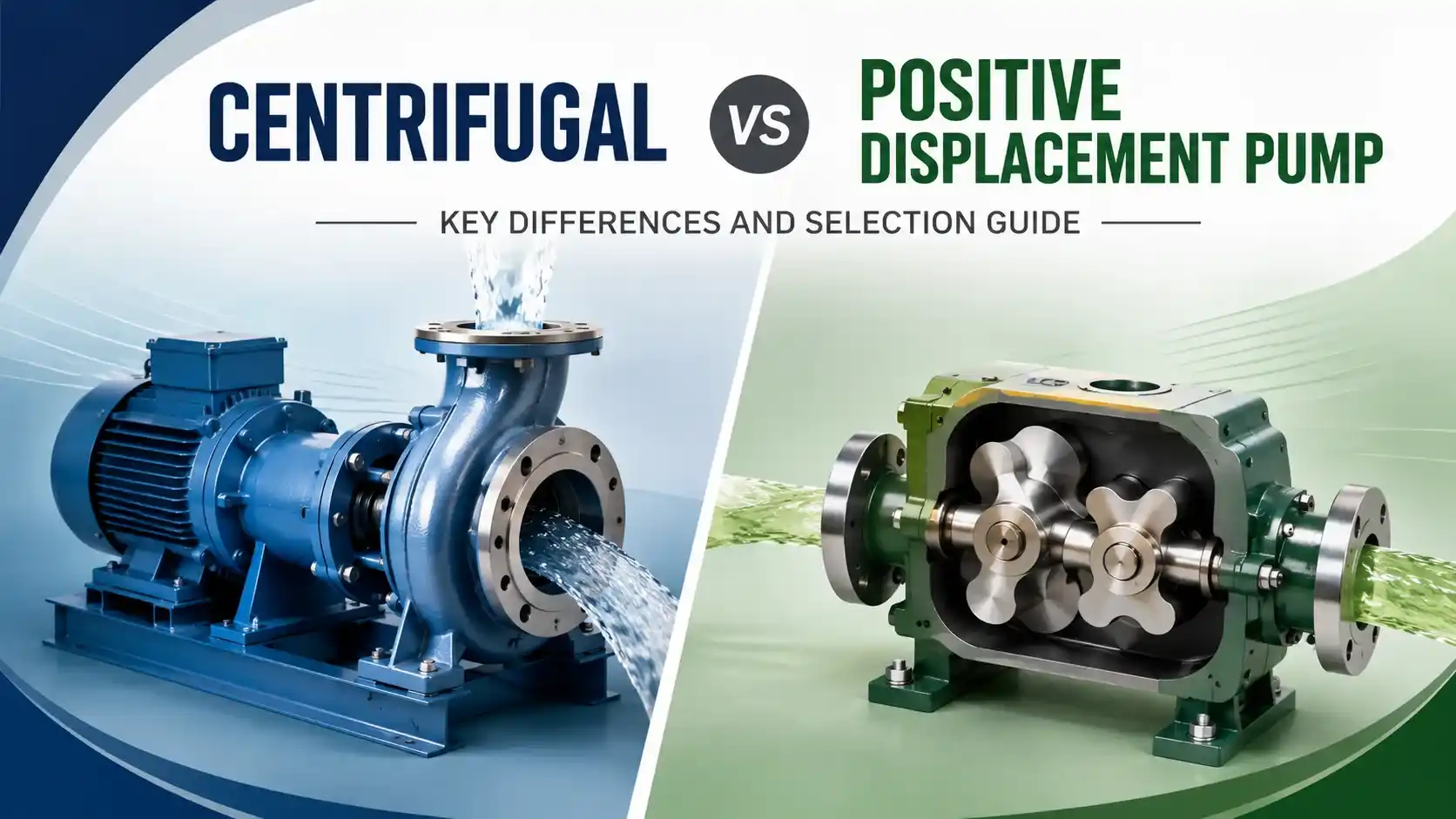
A positive displacement (PD) pump works completely differently. It traps a fixed volume of fluid in a chamber, then physically displaces that volume out through the discharge port, whether by a reciprocating piston, rotating gears, lobes, or a progressive cavity. Because the volume delivered per revolution or stroke is essentially fixed, a PD pump's flow rate stays nearly constant regardless of the discharge pressure, at least up to its mechanical limits.
Real Life Example
Think of a centrifugal pump like a garden hose with your thumb over the end. Press harder to restrict the opening, and the flow slows down even though the water pressure feels higher. A positive displacement pump is more like a hand-cranked syringe: no matter how much resistance is on the other end, one full turn of the crank still pushes out exactly the same fixed amount of fluid, just possibly requiring more effort to do it.
Performance Curve Comparison
Centrifugal pumps trace a curved, downward-sloping line: flow falls as head rises. Positive displacement pumps trace a steep, nearly vertical line: flow stays almost constant across a wide pressure range.
Comparison Table
Applications
Water Supply and HVAC
Centrifugal pumps handle high-flow, low-viscosity water circulation efficiently.
Crude Oil Transfer
Positive displacement pumps handle viscous crude and heavy oils at high pressure.
Chemical Dosing
PD pumps provide the precise, constant metering chemical injection requires.
Food Processing
Many plants pair centrifugal pumps for thin liquids with PD pumps for viscous or shear-sensitive product.
Wastewater Treatment
Both pump types appear across a treatment plant depending on stage and fluid consistency.
Paints, Adhesives, Resins
Positive displacement pumps handle these thick, shear-sensitive fluids without degrading them.
Centrifugal vs Positive Displacement Pump: Video Walkthrough
Frequently Asked Questions
- Hydraulic Institute, Centrifugal vs Positive Displacement Pumps
- What Is Piping, Differences Between a Centrifugal Pump and a Positive Displacement Pump
- Castle Pumps, Positive Displacement vs Centrifugal Pumps Guide
What We Learn Today
- Centrifugal pumps impart velocity through a spinning impeller, with flow rate that falls as pressure rises
- Positive displacement pumps trap and physically displace a fixed volume, keeping flow rate nearly constant regardless of pressure
- Centrifugal pumps suit thin fluids at high flow, PD pumps suit viscous fluids, precise dosing, and high pressure
- Centrifugal pumps should stay within 80-110% of BEP, while PD pumps can run efficiently across their whole curve
- PD pumps require pressure relief protection since blocked discharge can rapidly build dangerous pressure