
Bitumen, polymer melt, heavy crude, molasses, adhesives. Ask a level transmitter to work in liquids like these, and half the usual playbook stops applying.
Ok, let me explain it properly. High viscosity doesn't just slow things down, it actively fools some sensing technologies while barely touching others. Knowing which is which saves you a very expensive mistake at selection stage.
Level measurement in high viscosity liquids is challenging mainly because thick, sticky, or slow-moving fluids coat probes and transducer faces, dampen vibrating and float-based sensors, and settle slowly after disturbance, so technologies that rely on a clean reflective surface or free mechanical movement often struggle where a hydrostatic or properly selected radar approach succeeds.
Level Measurement in High Viscosity Liquids: Why It's a Different Problem
Level measurement in high viscosity liquids behaves nothing like level measurement in water or light hydrocarbons, and the reason comes down to two physical properties working against the sensor at once: high viscosity resists flow and clings to surfaces, while many of these same fluids also carry high density or unusual surface tension. A technology that performs flawlessly in standard level measurement can fail quietly in a tank of heavy bunker fuel or hot asphalt, not because it's broken, but because the assumptions it was designed around no longer hold.
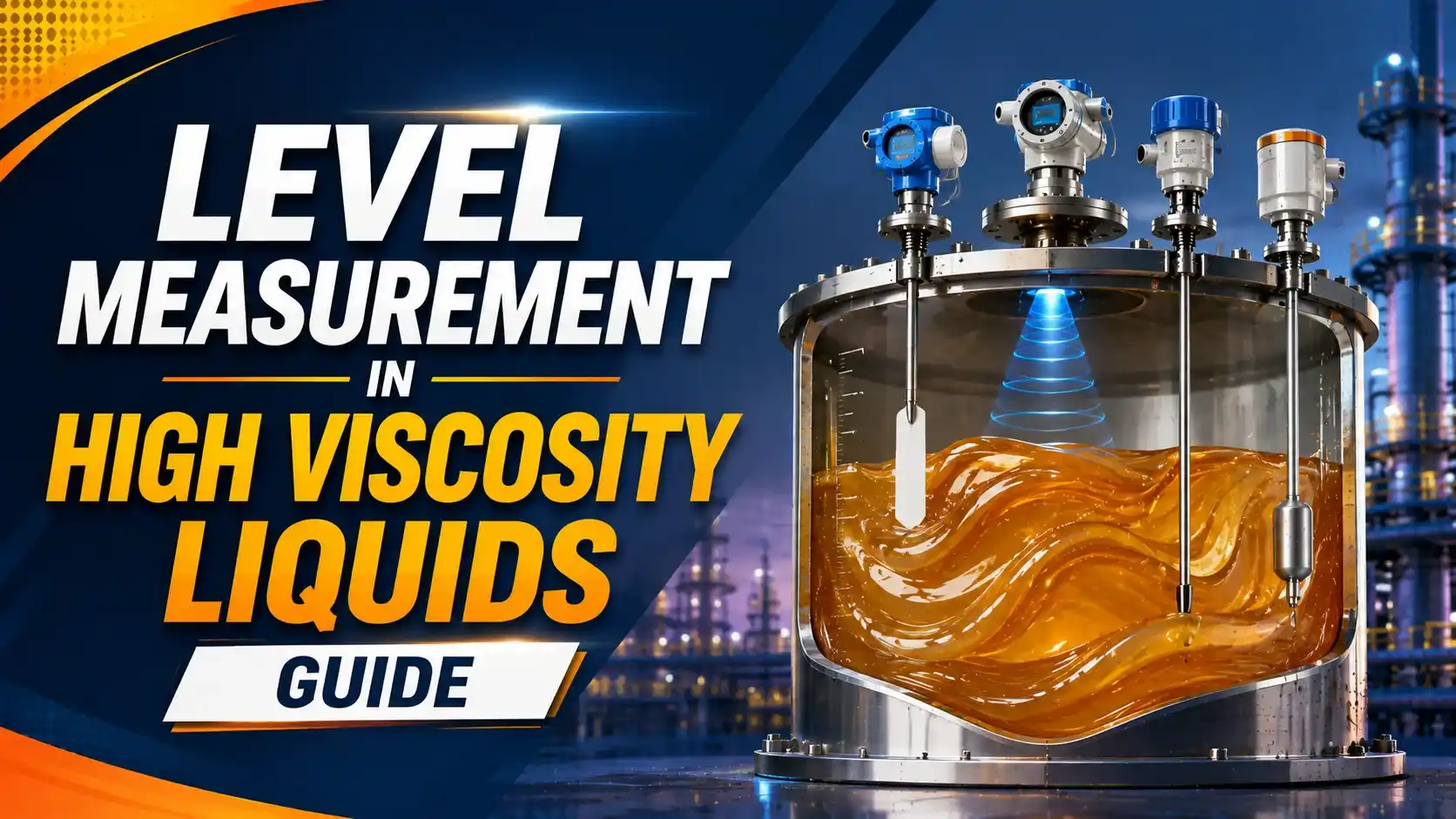
Have you got it so far? Good, because this single idea, that viscosity changes which failure modes matter, is the thread that runs through every technology choice in this guide. A vibrating fork switch that trips instantly in water can stay coated and silent in glycerin. A guided wave radar that reads cleanly in diesel can lose its signal entirely under a film of molten wax.
Six Ways High Viscosity Trips Up Level Sensors
Probe and Transducer Coating
Thick liquid clings to whatever it touches. A guided wave radar probe or an ultrasonic transducer face coated in a viscous film scatters or absorbs the signal before it can return a clean reading.
Slow Settling and Response Lag
After a fill or draw event, a viscous surface takes far longer to settle flat. A fast-updating sensor may report a moving, non-representative surface for minutes rather than seconds.
Float and Displacer Drag
Mechanical floats depend on free movement. High viscosity adds drag against the float body and stiffens any guide wire film, so the float lags the true surface, sometimes badly.
Damped Vibrating Fork Response
Vibrating fork switches detect a change in resonant frequency when submerged. A thick coating left behind after the level drops can keep dampening the fork, causing it to falsely indicate the liquid is still present.
Entrained Air and Foam
Many viscous process liquids trap air bubbles during mixing or pumping far more readily than thin liquids, since the bubbles can't rise and escape quickly. That trapped air scatters non-contact signals and confuses capacitance measurement, a problem covered among the top challenges in liquid level sensing from Icon Process Controls.
Temperature-Dependent Density and Viscosity
Many high viscosity liquids are heated to keep them pumpable, and both their density and their viscosity shift noticeably with temperature. A hydrostatic measurement needs this compensated, or the calculated level drifts even though the pressure reading itself is accurate.
Which Level Technology Actually Works in Viscous Service
This is the part worth reading twice before ordering a transmitter. Not every technology on a typical types of level transmitters list is a fair candidate here, and the ranking below reflects field experience with genuinely thick, sticky process liquids rather than general-purpose suitability.
| Technology | Behavior in High Viscosity Service | Verdict |
|---|---|---|
| Hydrostatic (DP) pressure | Unaffected by coating or opacity, only needs accurate density compensation | Strongly recommended |
| Guided wave radar | Reliable if the probe uses a low-friction coating and is sized to shed film quickly | Good, with the right probe coating |
| Non-contact radar (FMCW) | No probe to foul, but high dielectric coating or foam can still weaken the return signal | Good for clean vapor space applications |
| Capacitance | Buildup on the probe adds a false capacitance reading unless the probe is actively compensated, as detailed in Rika Sensor's review of capacitive accuracy in high-viscosity liquids | Caution, needs coating-immune probe design |
| Ultrasonic (non-contact) | Vapor-space condensation from viscous, often warm, process liquids can attenuate the return echo | Caution, application dependent |
| Vibrating fork switch | Coating left on the fork after level drop can cause false high indication | Caution, best for point detection only |
| Float or displacer | Drag and stiction against viscous liquid slow and distort response | Not recommended for continuous measurement |
Cause 1 in Detail: What Coating Does to a Radar Return Signal
Ok, let's slow down here, because this is the single biggest reason a perfectly good radar transmitter gets blamed for "not working" in viscous service. A guided wave radar, as Endress+Hauser's overview of guided radar level measurement explains, sends a pulse down the probe and times how long it takes to reflect back off the liquid surface. A film of viscous liquid clinging to the probe above the true surface partially reflects and scatters that pulse before it ever reaches the real surface.
This is exactly why probe coating material matters more in viscous service than almost anywhere else. A PTFE-coated or low-surface-energy probe sheds film far faster than a bare stainless probe, and that difference alone can be the deciding factor between a transmitter that works for years and one that needs monthly cleaning.
Try It: Temperature-Compensated Hydrostatic Level Calculator
Many high viscosity liquids are heated to stay pumpable, which changes their density. Enter the DP reading along with the liquid's reference density and thermal expansion behavior to get a properly compensated level, rather than one that quietly drifts as the process temperature changes.
Let Us Take an Example
A heated storage tank holds a heavy fuel oil with a reference density of 950 kg/m³ at 15°C and a thermal expansion coefficient of 0.00065 per °C. The oil is kept at 70°C to stay pumpable, and a DP transmitter at the tank base reads 45 kPa.
ΔT = 70 − 15 = 55°C. Compensated density = 950 × (1 − 0.00065 × 55) = 916.04 kg/m³. Level h = (45 × 1000) ÷ (916.04 × 9.81) = 5.008 m.
Have you got it? Good, because if a technician had used the reference density of 950 kg/m³ without correcting for the process temperature, the calculated level would come out around 4.83 m instead, a difference of roughly 18 centimeters on a real tank. On a custody transfer application, that error alone could represent a meaningful volume discrepancy. This is exactly why temperature compensation isn't an optional refinement for hot, viscous liquids, it's a basic accuracy requirement.
Cause 2 in Detail: Settling Lag After Fill or Draw Events
Here's a subtler one that catches people off guard even after they've picked the right technology. When a viscous liquid is pumped into or out of a tank, the surface doesn't snap flat the way water does. It can remain domed, tilted, or actively moving for several minutes, especially near the fill nozzle or discharge point.
According to APG Sensors' guide to measuring viscous liquid level, allowing settling time before trusting a reading, or averaging the signal over a longer window, is a standard practical fix for exactly this behavior. A transmitter with a fast update rate isn't wrong here, it's just reporting a genuinely unsettled surface, which is a process condition rather than an instrument fault.
A Step-by-Step Approach to Selecting the Right Sensor
Get real viscosity and temperature data
Ask for the actual process viscosity range and operating temperature, not just a general "thick liquid" description, since behavior can vary enormously across that range, a point echoed in VEGA's guide to liquid and fluid level sensing and gauging.
Decide if coating resistance matters
If the liquid is known to cling and build up, prioritize hydrostatic measurement or a coating-resistant probe design over technologies that need a clean reflective surface.
Check for entrained air or foam
Mixing and pumping of viscous liquids often traps air. Confirm whether the application generates persistent foam, since that changes both radar and capacitance performance.
Plan for temperature compensation
If the liquid is heated for pumpability, build density compensation into the calculation from day one rather than discovering the error during a custody transfer audit.
Avoid mechanical, free-movement technologies
Rule out standard floats and displacers for continuous measurement unless the vendor specifically rates them for the viscosity range in question.
Budget for a cleaning or maintenance plan
Even a well-chosen sensor in genuinely sticky service may need periodic probe cleaning. Build that into the maintenance schedule rather than treating it as an unexpected failure.
Good Practices for Viscous Liquid Level Measurement
✓ Do
- Default to hydrostatic pressure measurement when coating or opacity risk is high and density is well characterized
- Specify a low-friction or coating-resistant probe finish for guided wave radar in sticky service
- Allow adequate settling time or apply signal averaging after fill and draw events
- Include temperature-based density compensation for any heated, viscous liquid application
✗ Don't
- Specify a float or displacer for continuous measurement in genuinely thick liquids without vendor confirmation
- Assume a vibrating fork switch is fouling-proof just because it has no moving float
- Ignore entrained air and foam as a possible cause of erratic non-contact readings
- Use a fixed reference density for a heated tank without correcting for actual process temperature
Worth Reading if You Want to Go Deeper
Questions Students and Technicians Often Ask
External References
- How To Measure The Level Of Viscous Liquids, APG Sensors
- How Fluid Viscosity Effects Float Switches and Level Sensors, FluidSwitch
- Liquid Level Sensors: Top 10 Challenges And How To Solve Them, Icon Process Controls
- How Accurate Are Capacitive Level Sensors in High-Viscosity Liquids?, Rika Sensor
- Guided Radar Level Measurement, Endress+Hauser
- Liquid & Fluid Level Sensors & Gauging, VEGA
What we learn today
- Level measurement in high viscosity liquids is difficult mainly because coating, slow settling, and mechanical drag interfere with technologies that need a clean surface or free movement.
- Hydrostatic pressure measurement is generally the most reliable choice, since it is unaffected by coating and only needs accurate temperature-based density compensation.
- A worked example showed a heated fuel oil tank where skipping density compensation understated the level by roughly 18 centimeters compared to the corrected 5.008 m reading.
- Guided wave radar can work well in viscous service when the probe uses a coating-resistant finish that sheds film quickly.
- Floats, displacers, and vibrating fork switches all face specific viscosity-related failure modes and need careful selection or should be avoided for continuous measurement in thick liquids.