
A level switch detects whether the liquid level has reached a specific point and trips a relay output.
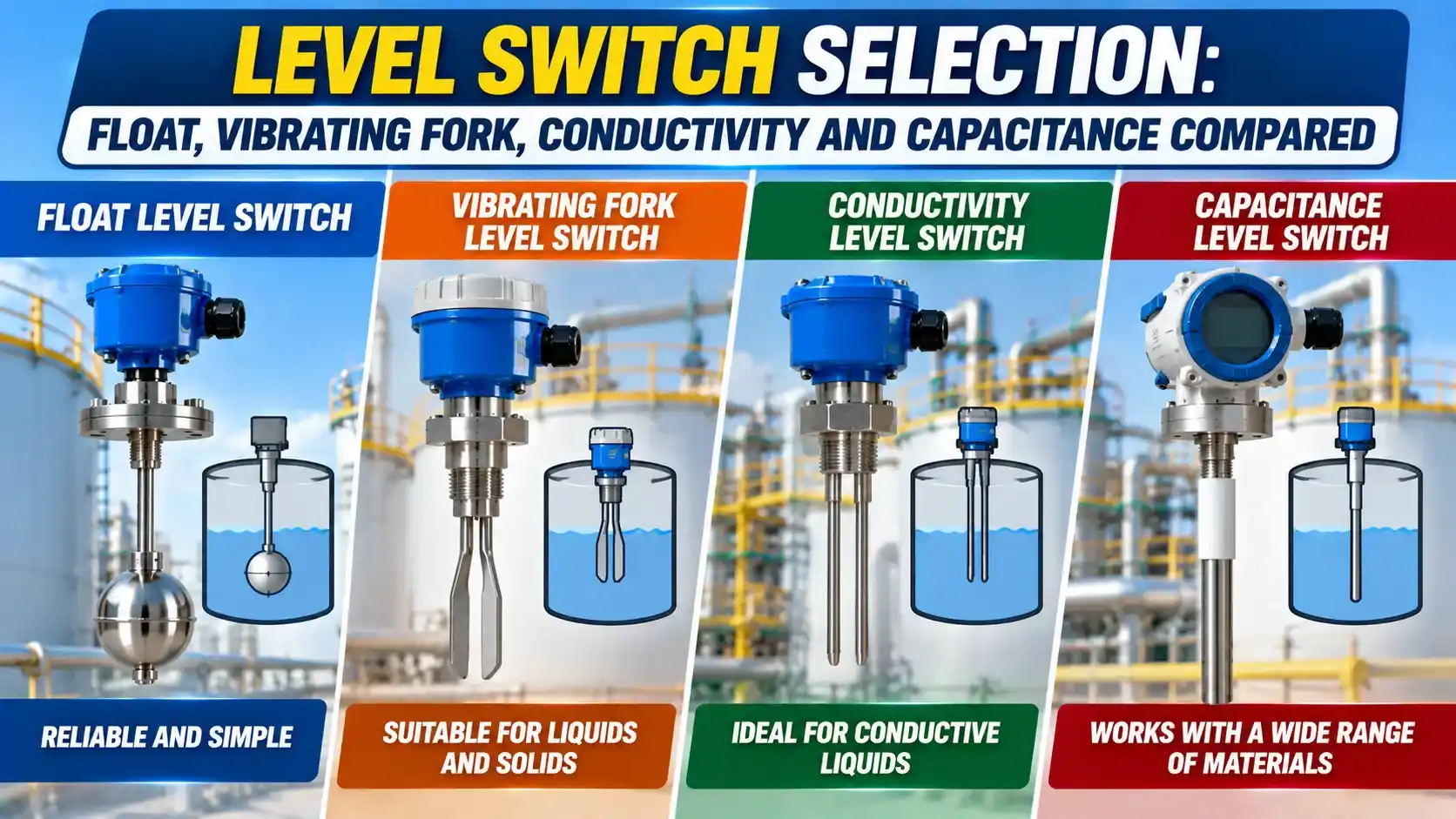
The four most common technologies — float, vibrating fork, conductivity, and capacitance — each suit a different combination of fluid type, temperature, and pressure.
This guide compares all four types and shows which conditions favour each one.
The vibrating fork level switch is the dominant choice for most industrial applications today.
It has no moving parts, works on liquids and many solids, and many models carry SIL 2 certification.
Float and conductivity types remain valid where their simplicity or multi-point capability is the priority.
How a Level Switch Differs from a Level Transmitter
This device answers one question: "has the level reached this point?"
A level transmitter answers a different question: "what is the current level?"
The device is simpler, lower cost, and more reliable for pure on/off detection than a transmitter with a high-alarm setpoint programmed in the DCS.
A level transmitter sends a 4-20 mA signal that the SIS logic solver processes to determine if the level exceeds the trip setpoint. A level switch sends a direct contact that requires no signal processing — it is inherently simpler, and simplicity reduces the probability of dangerous failure.
This is why IEC 61511 allows a simpler proof test approach for direct-contact level switches than for transmitter-based initiating elements in the same SIL 2 or SIL 3 function.
Switch Types Explained
A float level switch uses a buoyant float on a mechanical arm or stem guide. As the liquid level rises, the float rises with it.
When the float reaches the trip point, a magnetic actuator inside the float arm triggers an external reed switch or microswitch.
The float type is the oldest and simplest level switch design.
In its basic form it requires no power on the sensing side — the contact opens or closes purely by buoyancy force, making it inherently fail-safe on power loss.
Best for: Clean or mildly contaminated liquids where direct mechanical contact with the fluid is acceptable. Water, light fuel oils, and chemical storage tanks where simplicity and low cost are priorities.
Limitations: Moving parts (float, arm, hinge) foul in dirty or viscous liquids and can stick in the wrong position.
Float density must match the liquid. A float sized for water sinks in a low-density hydrocarbon. See the float level switch guide for selection details.
A standard stainless steel float designed for water (SG 1.0) may not float at all on a light hydrocarbon with SG 0.6 to 0.7. The float sinks and the switch gives a permanently "wet" (high level) indication regardless of the actual level.
Manufacturers publish float buoyancy tables by liquid SG. Always cross-check the float material and volume against the process liquid SG at the operating temperature before ordering.
Early steam locomotives and industrial boilers used a simple ball float connected to a steam whistle or vent valve. When the boiler water dropped below the float setpoint, the whistle sounded to warn the operator.
Modern float level switches for boiler drum applications still operate on the same buoyancy principle, though now with hermetically sealed reed switch contacts and SIL-rated designs to meet ASME Boiler and Pressure Vessel Code requirements.
A vibrating fork level switch has two tines that vibrate at their natural resonant frequency (typically 85 to 1,200 Hz) in air.
When immersed in liquid, the liquid mass-loads the fork and the frequency drops. The electronics detect this shift and trigger the relay output.
No moving parts are inserted into the process. The piezoelectric drive and sensor elements are inside the probe body, completely isolated from the process fluid by the tine walls.
Best for: The widest application range of any level switch type.
Suitable for liquids (up to about 10,000 cP), light solids and powders, slurries, foam, and interface detection. Works regardless of fluid conductivity or dielectric properties.
SIL rating: Many models carry SIL 1 or SIL 2 certification. Self-monitoring models achieve SIL 2 in a single device without redundancy.
See the vibrating fork guide for proof testing intervals.
Specify self-monitoring models for all SIL-rated applications. Non-self-monitoring forks pass the initial proof test but cannot detect gradual tine corrosion between test intervals.
The self-monitoring feature also confirms that the fork is still vibrating during normal operation — ruling out the failure mode where a fouled or packed fork ceases to vibrate and gives a permanently "wet" indication at any level.
If the liquid has an unexpectedly low density (for example, due to foaming, aeration, or incorrect product in the tank), the frequency shift when immersed is smaller than expected. Some advanced vibrating fork transmitters measure the frequency shift quantitatively and report both level (wet/dry) and an approximate density, identifying aerated or foamed conditions that a simple float switch would misread as a genuine high level.
A conductivity level switch uses bare electrode probes inserted into the vessel.
A low-voltage signal (5 to 24 V, below 1 mA) is applied between the probe tip and a reference. When conductive liquid bridges the gap, the circuit completes and the relay trips.
The probe has no moving parts and no mechanical elements. Detection is purely electrical — the liquid must be electrically conductive to complete the circuit.
Best for: Conductive liquids above approximately 20 to 50 µS/cm: water, aqueous solutions, acids, and caustics.
Multiple probes on a single controller allow multi-point level switching (low-low, low, high, high-high) from a single instrument.
Limitations: Will not work on non-conductive liquids. Probe fouling with insulating coatings opens the circuit even when submerged, giving a false low-level reading.
See the capacitance level measurement guide for the alternative on non-conductive fluids.
Electropolishing removes the surface roughness that provides nucleation sites for scale and crystalline deposits. On a smooth electropolished surface, deposits are less adhesive and more easily removed during normal CIP cycles.
For highly corrosive acids (hydrofluoric, hydrochloric, concentrated sulphuric), specify tantalum or PTFE-insulated Hastelloy probes. Standard 316 SS will pit and fail within months on these services.
A typical boiler feedwater tank uses four probes: low-low (pump stop), low (pump start), high (fill valve close), high-high (alarm and overflow prevention).
The controller monitors all four probes simultaneously and drives four separate relay outputs. This multi-point approach is far less expensive than installing four separate level switches, which is why conductivity probes remain popular for multi-point applications in water treatment, boiler houses, and chemical storage.
A capacitance level switch uses an insulated probe as one plate of a capacitor. When liquid or solid covers the probe, the dielectric constant between probe and reference changes, increasing capacitance.
The electronics detect this change and trip the relay when capacitance crosses the setpoint.
A capacitance level switch works on both conductive and non-conductive liquids, and on granular solids and powders — making it more versatile than a conductivity type.
Best for: Non-conductive liquids, bulk solids and powders, highly viscous fluids, and applications requiring a fully insulated probe.
See the capacitance level switch guide for probe insulation selection.
Limitations: Conductive deposits on the probe cause false high-level readings. Varying fluid dielectric constant (composition or temperature changes) can shift the trip point.
Requires calibration for each specific fluid and periodic recalibration if composition changes significantly.
A standard capacitance probe needs a conductive vessel wall as the reference plate. Without it, the baseline capacitance is undefined and the switch is unstable.
A guarded probe design uses a concentric outer electrode on the probe itself as the reference, making the device independent of vessel wall conductivity. This is the correct type for GRP vessels, plastic tanks, and non-metallic containers.
Bulk solids have much lower dielectric constants than liquids (grain: about 3 to 5; water: about 80). The larger probe area compensates for the weaker capacitance signal from low-dielectric materials.
For very low dielectric solids (polyethylene pellets, PTFE powder, glass beads), the probe length may need to be 2 to 3 metres to produce enough capacitance change to trip the relay reliably.
Level Switch Types: Full Comparison
| Parameter | Float | Vibrating Fork | Conductivity | Capacitance |
|---|---|---|---|---|
| Working principle | Buoyancy: float rises with liquid level, actuates a microswitch or reed switch | Resonance: liquid mass-loads the fork, causing a frequency shift detected electronically | Electrical circuit: conductive liquid bridges probe to reference, completing a low-voltage circuit | Capacitance change: liquid or solid changes dielectric between probe and reference electrode |
| Moving parts in process | Yes: float, arm, pivot | No (piezo elements inside the probe body) | No | No |
| Fluid conductivity required | No | No | Yes: minimum 20 to 50 µS/cm | No (but higher dielectric constant improves sensitivity) |
| Non-conductive liquids (hydrocarbons, solvents) | Good | Good | Not suitable | Good |
| Bulk solids and powders | Not suitable | Good (light powders and granules) | Not suitable | Excellent (with long rod probe) |
| Viscous liquids (above 1,000 cP) | Poor: float sticks | Good (up to ~10,000 cP typical; check manufacturer data) | Poor: probe coats with viscous film | Good for viscous liquids; check for probe coating with very sticky materials |
| Dirty or slurry service | Poor: float fouls and mechanical parts stick | Good: no moving parts, fork profile is self-draining | Poor: insulating coatings cause false low readings | Moderate: conductive coating causes false high readings; use coating-resistant models |
| Multi-point detection (several levels) | One switch per level point | One switch per level point | Multiple probes on one controller (low cost per additional point) | One switch per level point (or continuous transmitter version) |
| SIL rating | Some models SIL 1 | SIL 1 to SIL 2 (self-monitoring models); some SIL 3 rated | Generally not SIL rated without redundancy | SIL 1 to SIL 2 (model-dependent) |
| Relative cost | Lowest | Medium | Lowest (probe only; controller shared between probes) | Medium |
| Best for | Clean liquids, water, fuel oil, simple applications, low cost | Most process liquids, SIL-rated safety functions, viscous fluids, foam, interface | Multi-point water, boiler feedwater, aqueous process solutions, acids and caustic | Non-conductive liquids, bulk solids, powders, high-temperature or high-pressure applications |
switch selection tool
Watch: Level Switch Types Explained (2025 Guide)
FAQ: Selection Questions
External References
- Point Level Detection: Vibrating Fork, Capacitance and Float Types | VEGA (2025)
- Level Switch Selection Guide | Emerson Rosemount (2025)
What We Learn Today
- Vibrating fork: no moving parts, works on liquids and solids, SIL 1 to SIL 2 rated. The best all-round choice for most process applications. Float: simplest and cheapest for clean conductive liquids, but moving parts foul in dirty or viscous service.
- Conductivity: lowest cost for multi-point detection in conductive liquids. One controller drives multiple probes. Not suitable for hydrocarbons or non-conductive fluids.
- Capacitance: the only switch type that works reliably on bulk solids and powders. Also suitable for non-conductive liquids where a vibrating fork cannot be used.