A firewall rule or patch that is routine in an office network can stop a compressor or trip a boiler in a plant. This guide compares how plant networks and business networks are protected, why the priorities differ and how both teams can work together safely.
OT vs IT security differs in priorities, patching, lifecycle, protocols and safety impact. This guide gives a comparison table, the CIA vs AIC logic, IEC 62443 vs ISO 27001, convergence risks and a downtime cost calculator.
How Is OT vs IT Security Different?
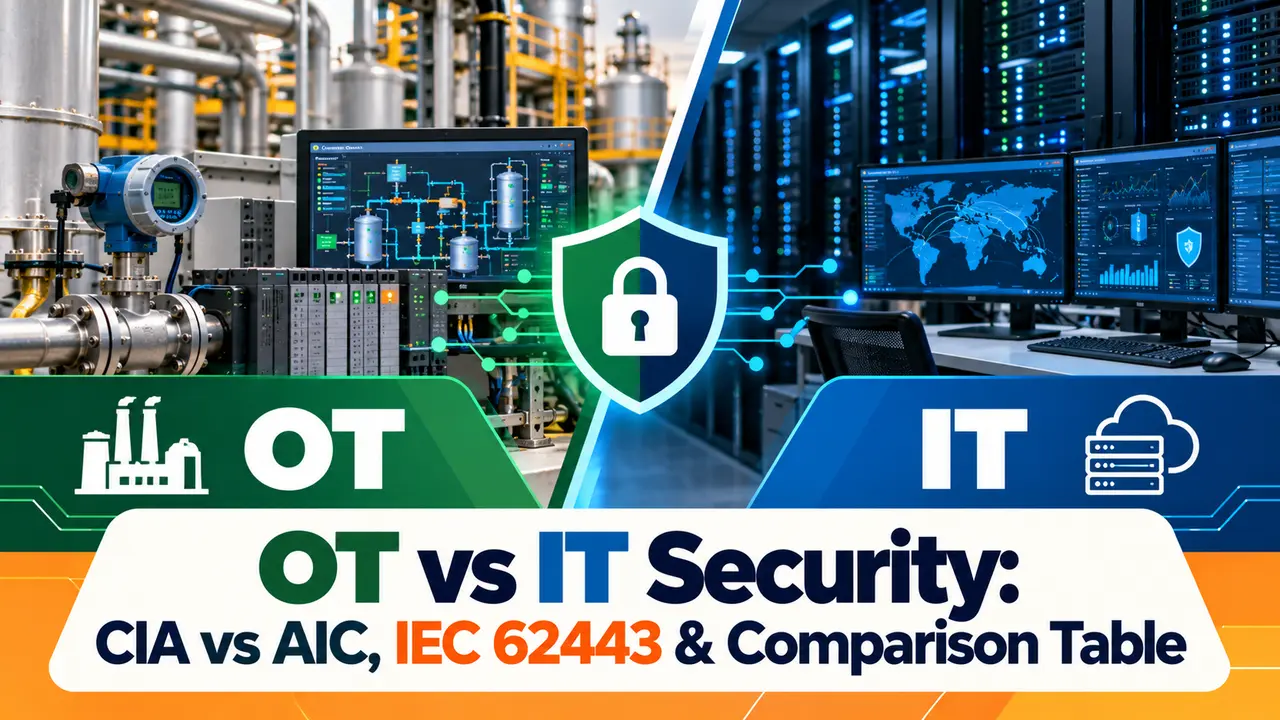
OT vs IT security is the difference between protecting systems that control physical processes, such as a DCS, PLC or SCADA, and protecting business systems that store and move data. IT security protects information first, while OT security protects people, equipment and continuous production first.
| Point | IT security | OT security |
|---|---|---|
| Main asset | Data, email, ERP, servers | PLC, DCS, SIS, HMI, field devices |
| Priority order | Confidentiality, Integrity, Availability | Availability, Integrity, Confidentiality, with safety above all |
| Impact of failure | Data loss, fines, downtime | Injury, fire, spill, plant trip, lost batch |
| Typical lifetime | 3 to 5 years (NIST) | 10 to 15 years and often longer (NIST) |
| Patching | Monthly, often automatic | Only after vendor approval, in a planned shutdown |
| Reboot | Usually acceptable | Usually not acceptable while running |
| Protocols | HTTP, SMB, TLS based | Modbus, Profibus, DNP3, often without authentication |
| Response time | Delay is tolerable | Deterministic, real time |
| Main standard | ISO 27001, NIST CSF | IEC 62443, NIST SP 800 82 |
Industrial Cyber says that NIST SP 800 82 Revision 3 widened its scope from industrial control systems to all OT and added an OT overlay of NIST SP 800 53 controls. It also points to ISA 62443 2 1 for building an OT security programme.
CIA vs AIC Triad in OT and IT
SANS explains that IT follows the CIA order of confidentiality, integrity and availability, while OT reverses it to AIC because keeping the process running safely comes first. In a refinery, a leaked drawing is serious, but a frozen controller during a furnace light off is far worse.
NIST SP 800 82 Revision 3 says OT objectives usually put integrity and availability ahead of confidentiality, with safety as an overarching priority. That is why any control that slows a BPCS or SIS response is rejected, however good it looks on paper.
NIST warns that a common IT fix, simply rebooting a component, is usually not acceptable for OT. Outages in a plant are often planned days or weeks in advance.
Why OT Patching Is Slower Than IT Patching
In OT vs IT security, patching shows the gap most clearly. An office laptop can take a Windows update tonight, but an engineering station must wait for the DCS vendor to qualify the patch, as our guide on OT patch management explains.
NIST calls unpatched software one of the greatest vulnerabilities to a system, yet it admits that OT updates cannot always be applied on time. Many OT hosts also run old operating systems that the vendor no longer supports.
When a patch cannot be installed for months, add compensating controls such as tighter firewall rules, disabled USB ports and application allowlisting. Write the decision down so the auditor sees it was a risk choice, not neglect.
Lifecycle, Protocols and Availability Differences
NIST puts IT component life at three to five years, while deployed OT technology often lasts 10 to 15 years and sometimes longer. A controller bought in 2010 may still run a cracker unit in India today, so planning for DCS migration and obsolescence is part of security.
SANS points out that Modbus, BACnet and Profibus were designed without built in encryption or authentication. Any device that can reach port 502 can send a write command, which is why our note on the Modbus protocol stresses network separation.
Simple master and slave polling with no login or encryption in the classic form.
Fieldbus and industrial Ethernet with tight timing; diagnostics tools differ from IT tools.
Telemetry protocols for SCADA over wide areas; secure versions exist but are not always enabled.
Modern protocol with built in certificates, signing and encryption when configured.
NIST also notes that OT service support is sometimes available from only a single vendor. An IT team cannot simply swap a firewall or antivirus product on a controller network without that vendor agreeing.
Downtime Cost Formula With Solved Example
Availability targets explain why OT vs IT security choices differ. Convert the availability percentage into hours of downtime per year and then into lost production to see what one careless reboot can cost.
Availability = 99.9 %
Downtime = 0.1 ÷ 100 × 8760 = 8.76 h
Downtime = 8.76 × 60 = 525.6 min
Production loss = ₹5 lakh per hour
Annual loss = 8.76 × 5 = ₹43.80 lakh
At 99.99 % the allowed downtime falls to about 53 minutes a year. One unplanned controller reboot can use up that budget, so OT teams resist IT style quick fixes.
IEC 62443 vs ISO 27001 for Plant Networks
IEC 62443 is the series written for industrial automation and control systems, while ISO 27001 is a management system standard for information security across a whole company. Our article on IEC 62443 zones and conduits shows how the plant network is split into trusted groups.
| Point | ISO 27001 | IEC 62443 |
|---|---|---|
| Scope | Information security management for the organisation | Security of automation and control systems |
| Main idea | Risk based ISMS with Annex A controls | Zones, conduits and target security levels |
| Levels | No technical levels | Security levels SL 1 to SL 4 |
| Audience | CISO, IT, management | Asset owner, integrator, product supplier |
| Product rules | None for devices | 62443 4 1 secure development, 62443 4 2 components |
| System rules | General controls | 62443 3 3 system requirements |
| Certification | Company ISMS | Products, sites and processes |
Most Indian plants need both: ISO 27001 for the corporate network and IEC 62443 below the industrial DMZ. A combined policy should reference both, so one audit trail covers the whole site.
Acronis notes that ISA 95 places the formal boundary between IT and OT between Levels 3 and 4. The industrial DMZ is often called Level 3.5, but that is industry shorthand rather than an ISA 95 level.
IT OT Convergence Risks
IT OT convergence links historians, MES and cloud dashboards to the control network, which brings real benefits and real exposure. The Purdue model helps decide which level may talk to which, so an office threat cannot walk straight down to a PLC.
For the most critical links, a data diode allows data out but nothing back in. Where full separation is not possible, our guide on air gapped vs segmented networks explains the middle ground.
Never run an active vulnerability scanner on a live control network without the vendor and operations agreeing. Acronis notes that NIST warns such scans can destabilise devices, so start with passive monitoring.
OT vs IT Security Field Tips and Mistakes
Most OT vs IT security problems in plants come from applying IT habits without checking the process impact. Use this table when an IT policy lands on the control network.
| IT habit | OT problem | Better OT practice |
|---|---|---|
| Auto patch every month | Unqualified patch can crash HMI or controller | Vendor approved patch in planned window |
| Account lockout after 3 tries | Operator locked out during an upset | Lockout off on HMIs, monitor failed logins instead |
| Full antivirus scan at noon | CPU load slows HMI updates | Vendor approved scan schedule or allowlisting |
| Active network scan | PLC or old NIC hangs | Passive asset discovery |
| Password change every 60 days | Shared panel logins break | Role based accounts and logged access |
| Cloud backup only | No restore when WAN is down | Local offline backups of controllers and images |
Keep a current OT asset inventory and a tested ICS incident response plan, because you cannot defend a device you do not know about. The CERT In directions of 2022 also ask Indian organisations to report cyber incidents within 6 hours.
Where IT Methods Help and Where They Hurt
- Asset inventory and configuration baselines.
- Network segmentation with firewalls and a DMZ.
- Multi factor authentication for remote access.
- Central logging and incident response planning.
- Automatic patching and forced reboots.
- Active scanning of controllers and old devices.
- Account lockout on shared operator HMIs.
- Heavy endpoint agents on low resource hosts.
The right answer to OT vs IT security is not to choose one side but to adapt IT methods to plant rules. Our SCADA security checklist and the note on zero trust for OT networks show how to do that step by step.
- OT asset register with firmware and owner for every device
- Zones and conduits defined, with a DMZ between Levels 3 and 4
- Remote access only through a logged jump host with MFA
- Patch decisions recorded with vendor approval or compensating controls
- USB and removable media policy enforced on HMIs and EWS
- Offline backups of controllers, HMIs and historian tested
- Joint IT and OT incident response drill held every year
NIST SP 800 82 Guide to OT Security PDF
Video on IT and OT Security Differences
OT vs IT Security FAQ
IT security protects data, users and business systems, with confidentiality usually ranked first. OT security protects the control systems that run physical processes, where availability and safety rank first.
This changes how patches, scans and passwords are handled. An action that is harmless on an office server can trip a running unit in a plant.
A control system that stops or slows down can lose control of pressure, temperature or flow within seconds. That can damage equipment, harm people or release material to the environment.
Restarting a process unit can also take hours or days. Because of this, OT teams treat any security action that risks downtime as a safety question first.
CIA stands for confidentiality, integrity and availability, which is the usual priority order for office systems. Many OT guides reverse the order to AIC, putting availability first for every running plant.
NIST also places safety above all three for OT systems. Integrity stays high because a changed setpoint or false reading is just as dangerous as a stopped controller.
No, the two standards have different scopes even though they work well together. ISO 27001 sets up an information security management system for the whole organisation.
IEC 62443 covers automation and control systems with zones, conduits and security levels from SL 1 to SL 4. Many plants use ISO 27001 for the office and IEC 62443 for the control network.
Some can, such as firewalls, central logging and multi factor authentication for remote vendor access. Others, like active scanners and heavy endpoint agents, can disturb older controllers and HMIs.
Always check the vendor compatibility lists and test every tool on a spare system first. Passive monitoring tools that understand industrial protocols are usually the safer starting point.
Patches for DCS, SCADA and HMI hosts must be qualified by the control system vendor before use. Installing them often needs a reboot, which may only be possible during a planned shutdown.
Some older systems run operating systems that no longer get updates at all. In these cases, plants rely on segmentation, allowlisting and monitoring as compensating controls.
IT OT convergence means connecting plant control systems with business systems for data sharing, reporting and remote support. It brings better visibility but also opens new paths for attackers.
Good designs use a DMZ, separate domains and controlled remote access between the two worlds. OT vs IT security teams should agree on these rules together before any new link goes live.
Related Articles
- Purdue Model for ICS Cybersecurity
- IEC 62443 Zones and Conduits
- Industrial DMZ Between IT and OT
- OT Patch Management for ICS
- Data Diode for OT Network Security
External References
- NIST SP 800 82 Rev 3, Guide to Operational Technology Security, NIST
- Guide to OT Security Best Practices, SANS Institute
- Operational Technology, Wikipedia
What We Learn Today
- OT vs IT security starts with priorities: IT ranks confidentiality first, while OT ranks availability and integrity first and treats safety as the overriding goal.
- OT assets often run 10 to 15 years or more, so patches need vendor approval, planned outages and compensating controls when updates are not possible.
- IEC 62443 secures control systems with zones, conduits and security levels, while ISO 27001 manages information security for the whole organisation.