5 Key Automation Terms Every Engineer Should Know: PLC, PAC, RTU, DCS, and SCADA

Share:
Industrial Automation

5 Key Automation Terms Every Engineer Should Know: PLC, PAC, RTU, DCS, and SCADA

Five acronyms, one control hierarchy. Here is what each one actually does, and how they fit together to run a real plant.

Automation PLC SCADA 10 Min Read

PLC, PAC, RTU, DCS, and SCADA are the five terms every automation engineer runs into constantly, and they are often used loosely or interchangeably. This guide breaks down what each one actually is, how they differ, and how they work together in a real industrial control system.

Why Automation Terminology Gets Confusing

Modern control systems are the combined effort of several different components, each with its own job, working together to provide seamless control for a plant. The mix of hardware in any given facility changes over time, but five terms keep showing up everywhere: PLC, PAC, RTU, DCS, and SCADA. Engineers often use these words loosely, and the lines between them blur further every year as vendors combine features once split across separate boxes. That makes a clear, working definition of each one worth having, even if the formal boundaries keep shifting.

💡 Quick Summary: A PLC controls equipment at the machine level. A PAC is a more powerful PLC with added processing and communication capability. An RTU is a remote control unit built for isolated field sites. A DCS is a plant-wide control architecture. SCADA is the supervisory layer that lets operators watch and manage it all from a control room.
Advertisement
Advertisement

Where Each System Sits in the Control Hierarchy

Before looking at each term individually, it helps to see where it sits relative to the others. Field devices and machine-level control live at the bottom, supervisory and plant-wide systems sit at the top.

SCADASupervisory layer, control room, historian, operator screens
DCSPlant-wide, integrated control across many processes at once
PACAdvanced controller, multi-processor, high I/O and communication
PLCMachine-level logic controller, the industry workhorse
RTURemote field unit controlling isolated sensors, valves, actuators

In practice, an RTU or PLC sits closest to the actual equipment. A DCS coordinates many such units across an entire plant. SCADA then sits above everything, giving operators one screen to watch and command the whole system, whether the underlying controllers are PLCs, RTUs, or a DCS.

PLC, PAC, RTU, DCS, and SCADA Explained

1

PLC (Programmable Logic Controller)

The industrial-grade computer that acts as the "brain" of a machine or process, executing control functions down at the equipment level. PLCs were originally built to replace relay banks, since they can be reprogrammed instead of physically rewired every time the control logic changes.
Programming: Most PLCs use ladder logic, a style deliberately designed to resemble the relay drawings it replaced.
Limitation: By strict definition, a PLC performs logical bit manipulation. It was never built for heavy communication or data sharing with other networks, which is exactly the gap the PAC filled.
2

PAC (Programmable Automation Controller)

An "advanced" PLC with more memory, more processing power, and native support for tasks like PID control, SCADA communication, and data logging that used to sit beyond a basic PLC's scope.
Why it exists: PACs often run multiple processor chips and a high-bandwidth backplane, giving them fast data acquisition for motion control and other demanding applications.
In practice: Most controllers sold today are technically PACs, but engineers still call them PLCs out of habit, since they perform the same core logic control job.
3

RTU (Remote Terminal Unit)

A control device located separately from the main control system, usually monitoring or controlling individual sub-units of equipment such as sensors, valves, fans, and actuators. RTUs are commonly part of a larger DCS or SCADA system.
Communication: Modern RTUs mostly use Ethernet or similar protocols to relay data back to the main system. Modbus RTU, one of the most widely used industrial protocols, was designed specifically to interface with these units.
In short: An RTU behaves like a basic PLC dedicated to one isolated I/O device or network, forming part of a larger control system.
4

DCS (Distributed Control System)

A higher-level system used to control and monitor multiple processes at once, usually plant-wide, with redundancy built in to reduce downtime risk if part of the system fails.
Not a single product: Unlike a PLC or RTU, a DCS is not something you simply buy off a shelf. It is an entire plant-level set of products, from field-level I/O through controllers to production, monitoring, and scheduling software.
Vendor consistency: Most DCS installations use like-branded components throughout so everything communicates easily. Retrofitting legacy equipment into a DCS is possible, but usually far more complicated than designing one from the ground up.
5

SCADA (Supervisory Control and Data Acquisition)
A monitoring and control system used across many manufacturing processes to increase the efficiency of hardware and software at the plant, or even global, level.
HMI: SCADA systems typically include a Human Machine Interface, which helps operators in a control room see equipment status and make changes when necessary.
How it works: SCADA monitors many different systems within a plant and relays that information to a central location, either handled automatically in the SCADA programming or displayed for an operator to act on.
📌 Engineering Tip: Don't get stuck memorizing formal definitions, since the boundaries between these systems keep shifting as technology advances. Focus on understanding the equipment that actually runs your plant, and stay open to how new architectures, like the industrial PC (IPC), continue to reshape this space.
Advertisement
Advertisement
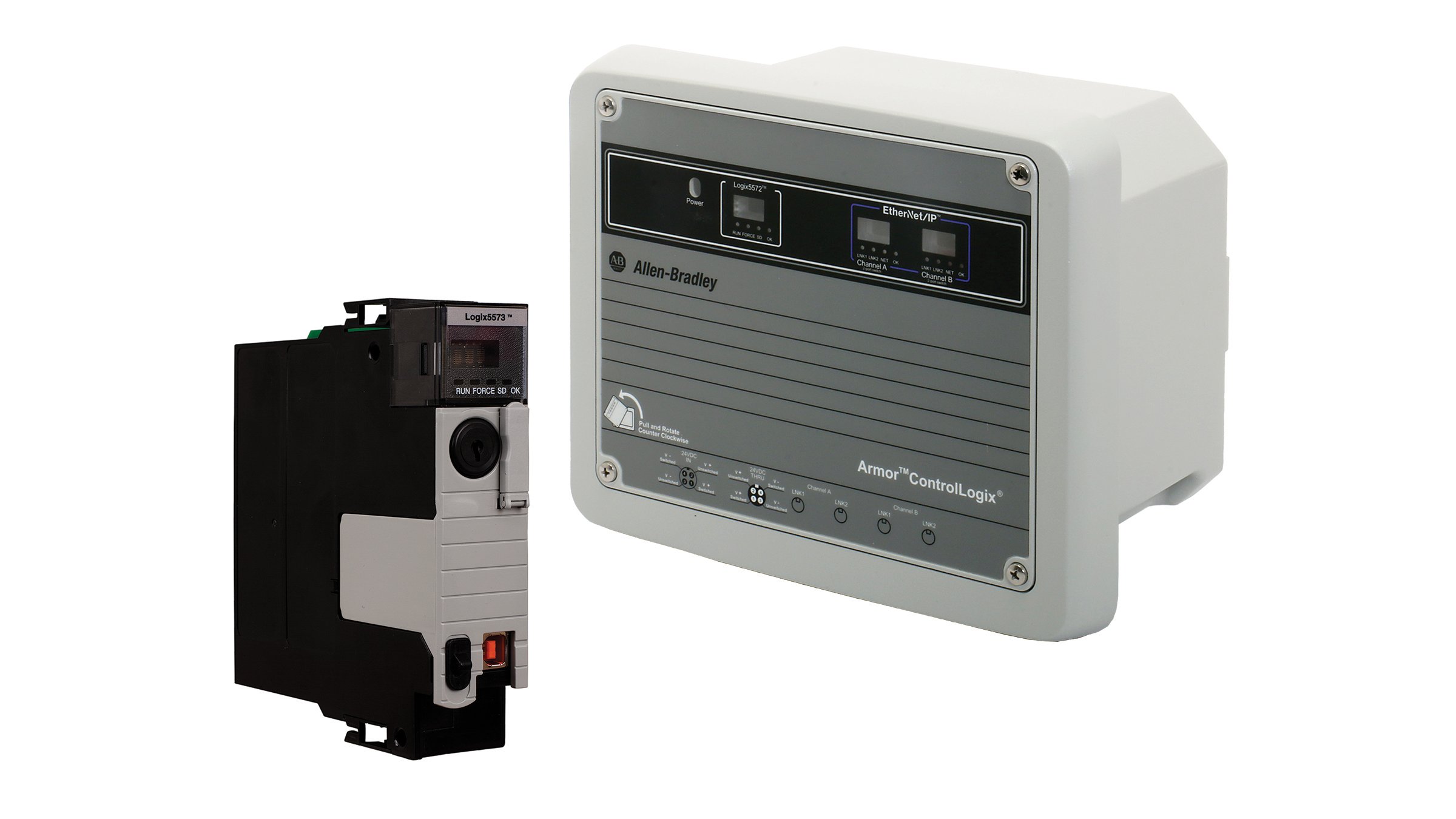
Industrial PLC controller module used for machine-level automation control
Image credit: Rockwell Automation

Comparison of PLC, PAC, RTU, DCS, and SCADA

System
Scope
Purchased As
Typical Role
PLC
Single machine or process
Standalone hardware
Machine-level logic control
PAC
Machine to plant-level
Standalone hardware
Advanced control, PID, motion, communication
RTU
Remote, isolated field site
Standalone hardware
Remote I/O and basic logic
DCS
Entire plant
Complete system, not a single product
Plant-wide integrated control
SCADA
Plant or multi-site
Software and HMI layer
Supervisory monitoring and control

How These Systems Work Together

In a real plant, these five terms rarely stand alone. A typical architecture might use PLCs or PACs to control individual machines, RTUs to manage remote or isolated equipment such as pipeline valves, a DCS to coordinate continuous processes across the whole facility, and SCADA as the single supervisory layer tying it all together for the operators in the control room.

🏭

Discrete Manufacturing

PLCs and PACs run individual machines, conveyors, and packaging lines.

🛢️

Oil and Gas Pipelines

RTUs monitor remote valves and compressor stations, reporting back to a central SCADA.

🧪

Chemical and Refining

A DCS coordinates continuous, plant-wide process control with built-in redundancy.

💧

Water and Wastewater

SCADA aggregates data from pump stations and treatment plants spread across a city.

Power Generation

DCS platforms manage boilers and turbines where reliability and redundancy are critical.

🤖

Robotics and Motion Control

PACs handle multi-axis motion tasks that a basic PLC was never built for.

Common Confusions to Avoid

✅ Keep This Straight

  • A PAC is still commonly called a "PLC" in everyday conversation, and that's fine
  • SCADA supervises, it does not replace the underlying PLC, RTU, or DCS controllers
  • A DCS is a complete system, not a single hardware product you can buy off a shelf
  • An RTU is essentially a ruggedized, remote-focused PLC for isolated I/O

❌ Avoid This

  • Assuming SCADA can directly control field equipment without a PLC or RTU underneath it
  • Treating "DCS" and "PLC" as interchangeable products with the same purchase process
  • Ignoring that most modern "PLCs" on the market are technically PACs
  • Forgetting that formal definitions here shift as technology, like the IPC, keeps evolving

PLC vs PAC vs RTU vs DCS vs SCADA: Video Walkthrough

Advertisement
Advertisement

Frequently Asked Questions About PLC, PAC, RTU, DCS, and SCADA

What is the main difference between a PLC and a PAC?
A PLC is a simpler, machine-level logic controller, while a PAC offers significantly more memory, processing power, and communication capability, often using multiple processors for tasks like motion control and PID.
Is an RTU the same thing as a PLC?
Not exactly. An RTU is similar to a basic PLC but is specifically built to control or monitor isolated field equipment remotely, and usually forms part of a larger DCS or SCADA system.
Can I buy a DCS the way I buy a PLC?
No. A DCS is not a single product. It is an entire plant-level set of hardware and software, from field I/O through controllers to production and monitoring software, usually from one vendor family.
Does SCADA control equipment directly?
SCADA is a supervisory layer. It monitors and can send commands, but the actual real-time control logic runs on the underlying PLCs, RTUs, or DCS controllers, not inside SCADA itself.
Why do people still call PACs "PLCs"?
Because PACs still accomplish the same core logic control tasks engineers associate with the term PLC, the industry has largely kept using the familiar name even as the underlying hardware became more advanced.
External References
Advertisement
Advertisement

What We Learn Today

  • PLC, PAC, RTU, DCS, and SCADA each occupy a different layer of the industrial control hierarchy
  • A PLC handles machine-level logic, a PAC adds processing power and communication, an RTU manages remote isolated I/O
  • A DCS is a complete plant-wide system, not a single purchasable product like a PLC
  • SCADA supervises and displays, but the real-time control logic still lives in the PLCs, RTUs, or DCS underneath it
  • Formal definitions keep shifting as technology evolves, so understanding your own plant's equipment matters more than memorizing labels
"I hope you like above blog. There is no cost associated in sharing the article in your social media. Thanks for Reading !! Happy Learning"

Leave a Reply

Your email address will not be published. Required fields are marked *