A DCS that passed its factory test can still fail on site because of one swapped pair or a wrong range. This guide follows the real order of site work, with standards, a checklist and a loop check time calculator for planning.
DCS commissioning turns a tested control system into a running plant, one verified loop at a time. We walk through each stage with IEC and ISA references, a checklist, documents and a planning calculator.
What Is DCS Commissioning?
DCS commissioning is the site process of proving that a distributed control system, its field wiring and its instruments work together exactly as designed, before and during plant start up. It runs from power up and network checks through IO and loop checks to cold and hot commissioning, and ends with the site acceptance test and handover.
- Starts after FAT, installation and mechanical completion
- Order: power up, network, IO, loop checks, cold then hot commissioning
- IEC 62382 covers the loop check up to the start of cold commissioning
- IEC 62381 covers FAT, SAT and SIT
- Every open item goes on a punch list with an owner and a closing date
A DCS has engineering stations, operator stations and controllers, as explained in DCS components ES, OS and AS. DCS commissioning tests all three on site along with every cable and field device connected to them.
DCS Commissioning Steps in Order
The order matters, because each stage relies on the one before it. Skipping ahead to hot commissioning with untested loops is the most common cause of delays and trips at start up.
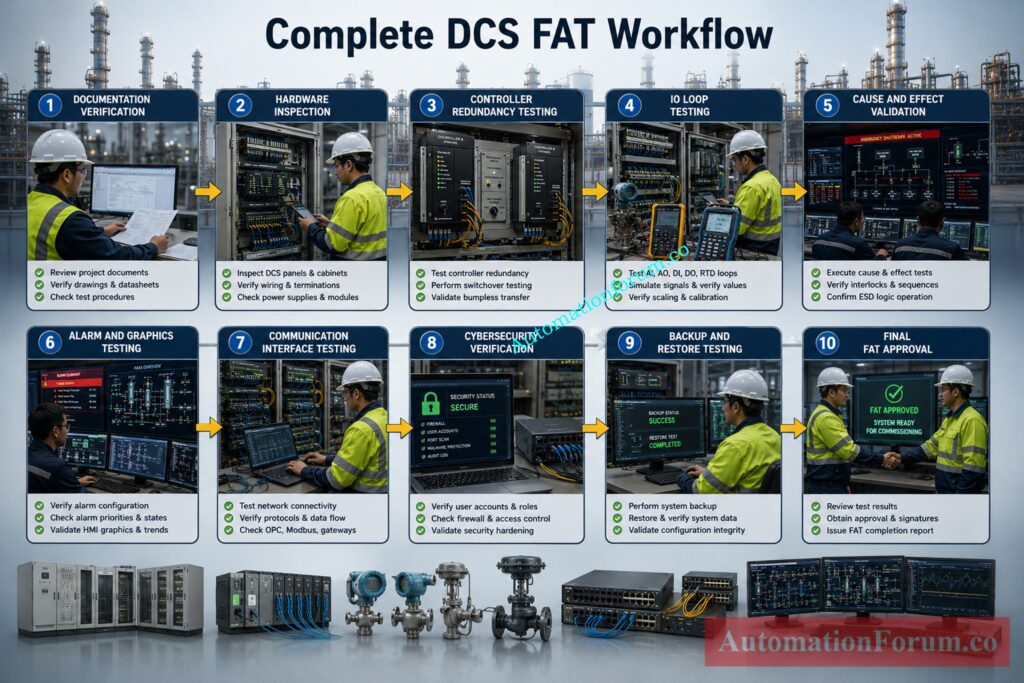
Automation Forum explains that FAT uses simulated signals on a factory assembled system, while SAT uses real field signals with full integration. Read factory acceptance test for DCS for the factory side of this story.
Pre Commissioning and Power Up
Pre commissioning is done with power off and covers everything that can be checked by eye, by meter or by megger. It is the cheapest stage of DCS commissioning to find mistakes.
- Cabinets installed, labelled and free of debris and swarf
- Earthing to the instrument and safety earth bars checked
- Insulation resistance of field cables tested before termination
- Terminations checked against the loop drawing and IO list
- Power supply rating, fuses and redundant feeds confirmed
- Panel cooling and cabinet lighting working
Use the method in insulation resistance test with a megger on field cables, but always disconnect them from the IO cards first. The earthing layout should follow earthing aspects in process plants.
Keep a signed copy of the database version used in FAT. If the site version differs, every change since FAT must be listed and tested again during DCS commissioning.
Network and Controller Checks
Before any loop is tested, the control network must be stable. Check every switch port, IP address and redundancy path, using the designs shown in DCS network redundancy.
Redundancy tests are covered in more depth in DCS controller redundancy types. Record each result, because the SAT will ask for the same evidence again.
IEC 62382 Edition 3.0 was published in 2024 and defines what to test in a loop check, not how to test it. Its scope runs from the end of loop construction to the start of cold commissioning.
IO Checks and Loop Checks
A loop check proves the full path from field device through marshalling, IO card and database to the operator screen. The ISA 105 series adopts IEC 62382 as the standard for electrical and instrumentation loop checks.
For analog inputs, inject or simulate 0, 25, 50, 75 and 100 percent and compare the DCS reading with the expected value. The full field method is in instrument loop checking procedure and pressure transmitter loop check.
Inject signal and check range, units, alarms and bad PV handling.
Drive 0 to 100 % and check valve stroke and feedback.
Operate the switch and check state and alarm on screen.
Force output and confirm the motor or solenoid responds.
- Emerson reports about 5 minutes per device with Smart Commissioning
- One technician can test many devices from a workstation
- Reports show expected and actual values at each step
- Works only for HART devices on supported IO
- Does not replace a visual check of tags and valve stroke
- Field wiring errors before the IO card still need manual tests
Emerson states that traditional methods take a couple of hours per device and that one site commissioned 395 devices in 4 days, about 100 per day against a typical 20. The protocol behind this is explained in how HART protocol works.
Cold Commissioning vs Hot Commissioning
| Point | Cold commissioning | Hot commissioning |
|---|---|---|
| Process fluid | None, or water only | Real process at design conditions |
| Main tests | Interlocks, sequences, valve strokes, motor bumps | Loop tuning, alarms, start up sequences |
| Risk level | Low, no hazardous fluid | High, needs permits and operations staff |
| Who leads | Commissioning team | Operations with commissioning support |
| Typical result | All logic proven against cause and effect | Plant running at rated load |
Cold commissioning proves every interlock against the cause and effect matrix. Hot commissioning then tunes the loops using the methods in how to tune a PID controller.
What Is the Difference Between FAT and SAT?
IEC 62381 defines requirements and checklists for the factory acceptance test, factory integration test, site acceptance test and site integration test. In short, FAT proves the system at the vendor and SAT proves it on site with real signals.
| Test | Where | Signals | Purpose |
|---|---|---|---|
| FAT | Vendor works | Simulated | Prove hardware and software before shipping |
| FIT | Vendor works | Simulated, with third party systems | Prove interfaces between packages |
| SAT | Plant site | Real field signals | Prove the installed system |
| SIT | Plant site | Real, with all packages | Prove the whole plant works together |
DCS Commissioning Loop Check Time Calculator
Planners often need a quick estimate of loop check effort. The formula below uses your own minutes per loop, which you should take from past jobs on the same plant type.
Days = total hours ÷ (teams × hours per day)
Take 400 analog loops at 30 minutes each, 600 digital loops at 15 minutes each, and 3 teams working 8 hours a day.
Hours = 21000 ÷ 60 = 350.0 hours
Days = 350 ÷ (3 × 8) = 14.6 days
Add time for punch list rework and waiting for permits, since loop checks rarely run without breaks. The IO counts come straight from the instrument IO list.
Punch List and Handover Documents
A punch list records every defect found during DCS commissioning with a category, an owner and a target date. Category A items stop start up, while lower categories can be closed after handover by agreement.
The handover pack should include the as built loop drawings in the format of ISA 5.4 loop diagrams, signed loop check sheets and calibration certificates as described in as found and as left calibration.
- Signed DCS commissioning loop check sheets
- As built loop drawings and IO list
- Final database backup with version number
- Network drawing with IP addresses
- Closed punch list with signatures
- SAT report and controller switchover records
Take a full backup of the database at the end of each day during DCS commissioning. Many sites have lost a week of changes to a single disk failure.
Common DCS Commissioning Problems
Most site problems repeat from plant to plant. The table lists the ones every DCS commissioning team should expect.
| Problem | Likely cause | Fix |
|---|---|---|
| Wrong value on screen | Range or units differ from datasheet | Correct database range and retest five points |
| Signal on wrong tag | Swapped pair in junction box or marshalling | Trace with loop drawing and correct terminals |
| Bad PV on healthy loop | Open circuit or blown fuse | Check fuse, terminals and loop current |
| Valve moves the wrong way | Fail action or output reversal set wrong | Check positioner action and DCS output direction |
| Network alarms | Duplicate IP or loose patch cord | Check IP list and switch port status |
Wiring faults often sit in the marshalling area, which is explained in marshalling cabinet DCS wiring. Bad signals are handled as shown in DCS bad PV signal handling.
Emerson reports that a lab test commissioned 60 devices on two CIOCs in 30 minutes with one person. Its default automated loop test uses five points at 0, 25, 50, 75 and 100 percent.
Operators can practise start up on a simulator before hot commissioning, as covered in operator training simulator for DCS.
DCS Commissioning FAQ
DCS commissioning starts with pre commissioning checks, then power up, network checks and IO checks. Loop checks follow, then cold commissioning and hot commissioning with process.
The work ends with the site acceptance test and handover of documents. Each stage of DCS commissioning must be complete before the next one starts, or problems appear at start up.
Cold commissioning tests logic, interlocks and equipment without process fluid, or with water only. It proves sequences, motor directions and valve strokes while the risk to people is low.
Hot commissioning introduces the real process at operating conditions. Loops are tuned, alarms are checked and operations staff take over control of the plant from the DCS commissioning team.
A loop check proves the full signal path from the field device to the operator screen. It covers wiring, marshalling, the IO card, the database range and the alarms.
For analog loops, technicians test several points across the range, often 0, 25, 50, 75 and 100 percent. IEC 62382 defines what such a loop check should cover.
SAT stands for site acceptance test, and it proves the installed system on site with real field signals. The client usually witnesses it before taking over the system.
IEC 62381 gives requirements and checklists for SAT along with FAT and site integration tests. The SAT report becomes a key part of the handover pack for the plant.
The team needs the IO list, loop drawings, cause and effect matrix, network drawing and approved test procedures. The FAT report and database version are also required.
At handover, signed loop sheets, the closed punch list and a final backup are added. These records help maintenance staff trace every change in the years after start up.
Related Articles
- Factory Acceptance Test for DCS, FAT and SAT
- Cold Loop and Hot Loop Testing
- Instrument Loop Checking Procedure
- Distributed Control System DCS
- PLC Simulation Software and Virtual Commissioning
External References
- Emerson DeltaV Smart Commissioning White Paper
- ISA 105 Standards for Commissioning, Loop Checks, FAT and SAT
- Wikipedia: Distributed control system
What We Learn Today
- DCS commissioning runs in a fixed order, from pre commissioning and power up through network, IO and loop checks to cold and hot commissioning.
- IEC 62382 covers loop checks up to cold commissioning, and IEC 62381 covers FAT, SAT and SIT, both adopted in the ISA 105 series.
- A punch list with owners and dates, daily backups and signed loop sheets make the SAT and handover smooth and keep the plant traceable.