Drop a small stainless probe on a cable into a sump or borewell, and the weight of the water above it tells you the level. The idea is simple, but the cable vent, surge protection and density settings decide whether it works for years.
A submersible level transmitter hangs below the liquid surface and converts hydrostatic pressure into a 4 to 20 mA level signal. Good venting, cable support and surge protection keep it accurate in sumps, borewells and wet wells.
What Is a Submersible Level Transmitter?
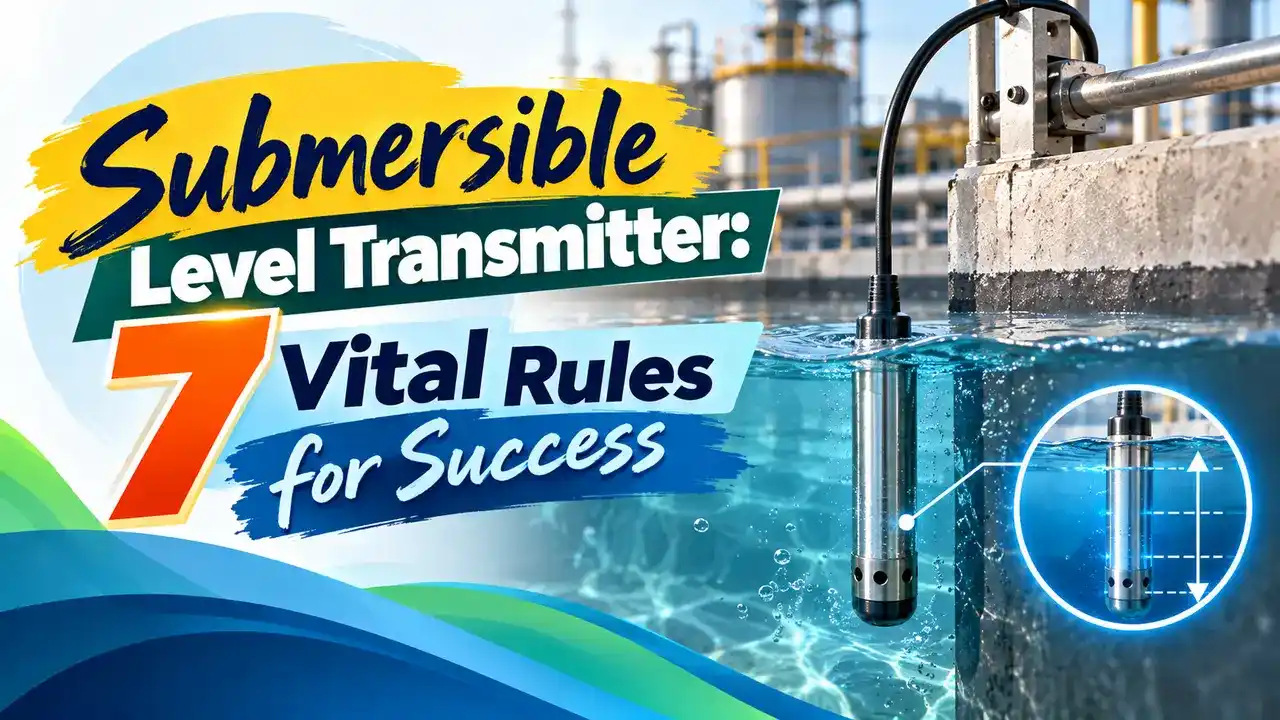
A submersible level transmitter is a sealed pressure sensor that is lowered on its own cable to the bottom of a tank, sump or well, where it measures the hydrostatic pressure of the liquid above it and sends a level signal to the control system. It is the simplest form of hydrostatic level measurement, with no process connection or mounting nozzle needed.
The probe body is usually stainless steel, titanium or a plastic such as PTFE, with a flush or caged diaphragm at the tip. Most units are two wire transmitters with a 4 to 20 mA output, and some add HART, Modbus or a built in temperature sensor.
DwyerOmega points out that the reading depends only on liquid height and density, not on the shape of the container. That makes the probe equally useful in a narrow borewell, a round tank or an irregular pit.
Hydrostatic Principle and Density Effect
The pressure at the probe equals density times gravity times liquid height, P = ρgh, as DwyerOmega explains. The transmitter is ranged in metres of water, so any liquid that is heavier or lighter than water changes the level it reports, a point covered in what is hydrostatic level measurement.
Liquid level above probe = Head ÷ SG
Level from tank bottom = Level above probe + Probe offset
Pressure in mbar = Head × 98.0665
Example:
Range 0 to 10 m water, I = 12 mA, SG = 1.05, offset 0.3 m
Head = (12 minus 4) ÷ 16 × 10 = 5.00 m water
Level above probe = 5.00 ÷ 1.05 = 4.76 m
Level from bottom = 4.76 + 0.3 = 5.06 m
Pressure = 5.00 × 98.0665 = 490.33 mbar
If the system ignores density, a sludge or brine with SG 1.05 reads about 5 percent high. Enter the real specific gravity in the transmitter or the DCS scaling, and recheck it when the process changes.
Submersible Level Transmitter Level Calculator
DwyerOmega notes that many submersible units reach an accuracy of ±0.1 to ±0.25 percent of full scale. On a 10 m range that is only 10 to 25 mm of water.
Why a Submersible Level Transmitter Needs a Vented Cable
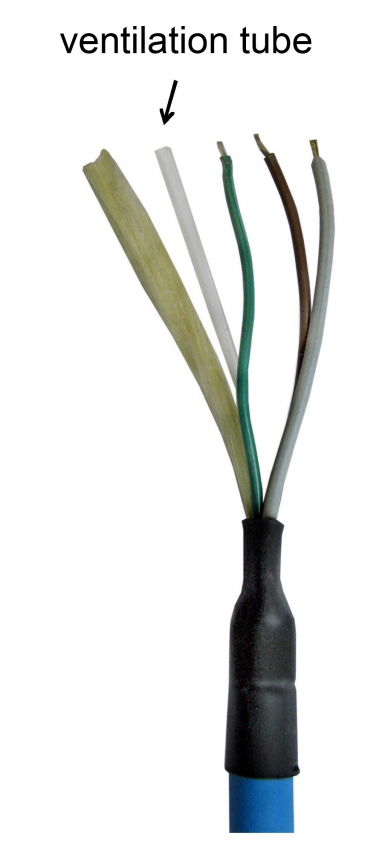
A gauge sensor must compare the liquid pressure with the air pressure above the surface. DwyerOmega explains that a vent tube built into the cable lets the sensor equalise with the atmosphere, so barometric changes cancel and only the liquid head is reported, as discussed in absolute vs gauge pressure.
WIKA warns that the same tube is also a path for moisture. Splash water, rain and condensation can enter the open cable end, and capillary action can draw it down to the sensor electronics.
WIKA recommends an air permeable but water impermeable filter element at the end of the vent tube and a waterproof junction box, for example IP65, where the cable is terminated. The company adds that complete protection over the full lifetime is never guaranteed, because diffusion and capillary effects cannot be stopped entirely.
APG offers a desiccant cartridge as an alternative for its PT 503 series. The crystals change from blue to pink as they absorb moisture, and the cartridge must be replaced once all of them have saturated.
Never cut or shorten a vented cable in the field unless the maker allows it. A cut that crushes or blocks the vent tube turns the probe into a sealed sensor that drifts with the weather.
Types of Submersible Probes
Diaphragm protected by a stainless cage or nose cap.
Smooth face with no cavity where solids can pack.
Small diameter body to pass through narrow casings.
Internal surge protection on the signal lines.
DwyerOmega lists one model with dual surge arrester protection and a mini model only 0.63 inch in diameter, showing how probes are tailored to the job. Compare these with other options in types of level transmitters before you choose.
Sumps, Borewells and Wet Wells
In a wet well, the submersible level transmitter usually feeds a pump controller that starts and stops pumps at set levels, often backed by float switches for high level alarms. Pump choice and cycling are covered in centrifugal vs positive displacement pump.
In borewells the probe is lowered below the lowest expected pumping level, and the cable is clamped at the well head. An ultrasonic sensor cannot see down a narrow casing, which is why ultrasonic level transmitters are rarely used there.
APG advises that its probe can rest on the bottom, but where sediment is present it should hang just above the sediment layer. Buried diaphragms read wrongly and are hard to clean.
Lightning and Surge Protection
Outdoor wells, ponds and reservoirs put a long metal cable into wet ground, which is an easy path for induced lightning surges. A surge protection device at the panel end, and ideally one built into the probe, protects both the sensor and the analog input card, as described in surge protector types and working.
Bond the surge protector earth to the same reference as the instrument earth, keeping the bonding lead short and straight. For exposed sites, follow the wider guidance in lightning protection system design.
Cable Sizing and Loop Voltage
The loop must deliver enough voltage at the probe even at 20 mA, after drops in the cable, the input resistor and any surge protector. Check this with the method in HART loop voltage budget calculator.
APG lists a supply range of 9 to 30 V DC for the 4 to 20 mA version of its PT 503 submersible level transmitter. That minimum of 9 V must be available at the probe terminals at the full loop current.
Second Worked Example: 150 m Borewell Cable
A borewell probe sits 150 m of cable away from a 24 V DC supply with a 250 Ω input resistor. With 0.5 mm² copper at about 39 Ω per km, the loop of 300 m adds about 11.7 Ω.
At 20 mA, the resistor drops 5 V and the cable about 0.23 V, so the probe still sees 24 minus 5.23 = 18.77 V. That is well above the 9 V minimum, leaving margin for a surge protector and supply tolerance.
7 Vital Installation Rules
APG warns that touching the diaphragm can permanently shift the output, so handle the probe by its body only. Choose the right cable gland for the junction box so that rain cannot follow the cable inside.
Mark the cable at the installed depth with tape before lowering the probe. After cleaning or pump work, you can reinstall it at exactly the same height and keep the level reference intact.
Commissioning a Submersible Level Transmitter
- Confirm the range, SG and probe offset in the DCS scaling.
- Check zero with the probe in air at the installed height.
- Compare the reading with a dip tape at two or more levels.
- Inspect the vent filter or desiccant colour.
- Measure loop voltage at the probe terminals at 20 mA.
- Check the surge protector and earth bonding.
- Look for drift that follows weather, a sign of a blocked vent.
A five point check against a dip tape or a calibrated reference column confirms linearity, as shown in level transmitter 5 point calibration. Noisy or unstable readings on long cables point to shielding problems, explained in shielded cable and twisted pair.
If level is used to calculate stored volume, apply the tank geometry afterwards, using tank volume from level measurement. The submersible level transmitter itself only knows height of liquid above its diaphragm.
- No tank nozzle or mounting hardware needed.
- Works in narrow wells and irregular pits.
- Unaffected by foam, vapour or surface turbulence.
- Low cost and easy to replace.
- Reading changes with liquid density.
- Vented cable needs moisture protection.
- Diaphragm can foul in sludge.
- Exposed to lightning on outdoor cables.
Choosing Between a Probe and Other Level Sensors
A submersible level transmitter suits open sumps, wells and vented tanks where a sensor can hang inside the liquid. For closed pressurised vessels, a DP transmitter or radar is a better choice, and the trade offs are covered in how to select the right level sensor.
APG PT 503 Installation Guide
Installing Submersible Level Sensors on Video
Submersible Level Transmitter FAQ
It hangs below the liquid surface and measures the hydrostatic pressure of the liquid above its diaphragm. That pressure equals density times gravity times height.
The transmitter converts the pressure into a 4 to 20 mA or digital level signal. The shape of the tank or well has no effect on the reading, only height and density matter.
The vent tube lets the sensor compare liquid pressure with the air pressure above the surface. Barometric changes then cancel out of the submersible level transmitter reading.
Without the vent, the probe would drift up and down as the weather and air pressure change. The open vent end must be protected by a filter element or a desiccant cartridge.
Fit an air permeable, water impermeable filter element or a desiccant cartridge at the cable end. Terminate the cable inside a sealed junction box such as an IP65 enclosure.
Replace desiccant once all the crystals have changed from blue to pink. WIKA notes that complete protection over the full lifetime of the probe can never be guaranteed.
The probe measures pressure, so a heavier liquid gives more pressure for the same height. A liquid with SG 1.05 reads about 5 percent high if the system assumes water.
Enter the correct specific gravity in the transmitter or the DCS scaling. Recheck it whenever the liquid, its temperature or its solids content changes noticeably.
Hang it free just above any sludge layer and away from the pump suction. A perforated stilling pipe stops it from swinging in turbulent or fast moving water.
Note the probe height above the floor and add it as an offset. Mark the cable so the submersible level transmitter can be reinstalled at the same depth later.
Outdoor wells, ponds and long cable runs are exposed to induced lightning surges. A surge protector at the panel, and ideally inside the probe, protects both ends of the loop.
Bond the protector to the instrument earth with a short and straight lead. Check the protector and the probe reading after every major storm in the area.
The probe needs its minimum voltage at its own terminals even at the full loop current. APG lists 9 to 30 V DC for its 4 to 20 mA version.
Subtract the drops across the input resistor, cable and surge protector from the supply. A 24 V supply usually leaves good margin on cables of a few hundred metres length.
Related Articles
- Hydrostatic Level Measurement
- What Is Hydrostatic Level Measurement
- Types of Level Transmitters
- Level Transmitter 5 Point Calibration
- Surge Protector Types and Working
External References
- PT 503 Series Installation Guide, APG
- Submersible Level Transmitters, DwyerOmega
- Level Sensor, Wikipedia
What We Learn Today
- A submersible level transmitter hangs in the liquid and converts hydrostatic pressure, P = ρgh, into a level signal that ignores tank shape.
- The vented cable cancels barometric pressure, so protect its open end with a filter element or desiccant and terminate it in a sealed box.
- Set the correct specific gravity and probe offset, add surge protection outdoors and check loop voltage at the probe at 20 mA.