A Bourdon tube barely moves at a few millibar, so draft lines, burner trains and biogas holders need a far more sensitive element. Two thin corrugated discs welded into a capsule turn those tiny pressures into a clear pointer movement.
Low gas pressures in millibar are too small for a Bourdon tube to read well. The capsule element, built from two corrugated discs, gives a sensitive and robust dial gauge for draft, burner and biogas service.

What Is a Capsule Pressure Gauge?
A capsule pressure gauge is a mechanical dial gauge whose sensing element is a capsule made of two circular corrugated diaphragms joined at their edges. It is built to measure very low gauge pressures and vacuum of gases in the millibar range, where a Bourdon tube pressure gauge is too stiff to respond.
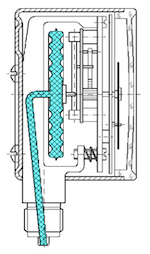
Pressure enters the inside of the capsule through the socket and makes the two discs move apart. A small link transfers this lift to a geared movement, which turns the pointer over the dial, the same basic chain you meet in basics of pressure measurement.
WIKA explains that the two corrugated discs are made of brass or stainless steel and fused into one capsule. A larger disc area gives more force and better sensitivity to very small pressure changes.
How the Capsule Element Converts Pressure to Movement
Because both discs move, the total lift is roughly double that of a single diaphragm of the same size. The corrugations act like a spring with a nearly linear force and travel relation, so the dial scale stays evenly spaced.
Under vacuum, the capsule contracts instead of expanding. WIKA notes that capsule gauges show vacuum with a clockwise pointer movement, while a Bourdon gauge moves the other way, which is why the dial is marked vacuum to avoid confusion, a point also covered in how to calculate vacuum pressure.
WIKA lists a lowest capsule range of just 1 inch of water column, about 2.5 mbar. That is roughly the pressure of a 25 mm column of water.
Capsule, Diaphragm or Bourdon: Which Element?
WIKA states that Bourdon tube gauges typically cannot go below about 10 psi, or 690 mbar. Below that, the choice is between a capsule element for dry gases and a diaphragm element for liquids or dirty media.
| Feature | Capsule | Diaphragm | Bourdon Tube |
|---|---|---|---|
| Typical range | A few mbar to about 600 mbar | About 10 mbar to 40 bar | About 0.6 bar to 1000 bar and more |
| Media | Dry, clean gases only | Liquids, gases, viscous media | Liquids and gases |
| Overload | Low unless protected | Good, with a support | Moderate |
| Main standard | EN 837 3 | EN 837 3 | EN 837 1 |
For corrosive, viscous or crystallising fluids, a diaphragm seal or a flat diaphragm gauge is the right path. The capsule pressure gauge is the specialist for clean air, flue gas and fuel gas at very low pressure.
Why a Capsule Gauge Is for Dry Gas Only
WIKA warns that capsule gauges are meant for dry gaseous media only. If liquid enters, it stays inside the capsule, adds a hydrostatic load of its own and gives a false reading.
The effect is large because the measured pressures are so small. A few millimetres of trapped water already equals a few tenths of a millibar, enough to shift a 0 to 25 mbar gauge by a visible amount.
On a flue gas or biogas line, mount the gauge above the tapping with a rising impulse line. Condensate then drains back to the process instead of collecting inside the capsule.
Types of Capsule Pressure Gauge
Brass or bronze capsule with a steel or brass case.
316 capsule and connection in a stainless case.
Capsule mounted at right angles with a stop that resists overload.
Built in valve protects the capsule from over or under pressure.
The bene inox 7326 data sheet is a good example of the stainless type. It offers spans from 0 to 40 mbar up to 0 to 400 mbar on a 100 mm dial, class 1.6, with an AISI 316 capsule and an IP65 case.
WIKA adds that its perpendicular capsule model 632.51 has a standard overpressure rating of 50 times full scale. Other designs can offer increased safety of up to 10 times full scale using an integrated relief valve, depending on range.
EN 837 3 Accuracy Class and Permissible Error
EN 837 3 covers diaphragm and capsule pressure gauges, including their dimensions, ranges, accuracy classes and tests. The class number is the permissible error as a percentage of span, exactly as explained in pressure gauge accuracy classes.
Error in mmWC = error in mbar × 10.197
Position on scale = (Reading minus Range low) ÷ Span × 100
Example:
Range 0 to 40 mbar, class 1.6, reading 20 mbar
Error = 1.6 ÷ 100 × 40 = 0.64 mbar
0.64 × 10.197 = 6.53 mmWC
Position = 20 ÷ 40 × 100 = 50.0 percent
So a class 1.6 capsule pressure gauge with a 0 to 40 mbar range may be off by up to 0.64 mbar at any point on the scale. That is fine for draft indication but not for a fiscal or safety measurement.
Capsule Gauge Error and Scale Position Calculator
Second Worked Example: Biogas Holder at 25 mbar
A biogas holder normally runs at 25 mbar, and the designer first picks a 0 to 100 mbar class 1.6 gauge. The reading then sits at only 25 percent of span and the permissible error is 1.6 mbar.
Switching to a 0 to 40 mbar range puts the reading at 62.5 percent of span and cuts the error to 0.64 mbar. STASTO gives the same advice, recommending that the operating pressure sit in the middle third of the scale.
7 Simple Steps to Select a Capsule Pressure Gauge
These steps complement the general pressure gauge selection factors. Always write the range in mbar on the data sheet, since a range given in bar invites a Bourdon tube offer by mistake.
Overload Protection and Installation Tips
A capsule pressure gauge is easily damaged by an overpressure far above its scale, which permanently stretches the discs and shifts the zero. Isolate the gauge during line purging or blower start, and see pressure gauge over range protection for practical devices.
Fit a gauge isolation valve so the instrument can be removed without a shutdown. Avoid long liquid filled impulse lines and follow the general advice in pressure gauge installation mistakes.
The bene inox data sheet limits the 7326 to process temperatures of minus 25 to plus 65 °C. For hotter gases it recommends cooling accessories such as a siphon or a cooling element between the line and the gauge.
External zero adjustment is a standard feature on WIKA capsule gauges. It lets a technician correct small zero shifts in the field without opening the case.
Calibrating a Capsule Pressure Gauge
Low pressure gauges are calibrated against a reference that resolves fractions of a millibar, such as a precision digital manometer, an inclined water manometer or a low range multifunction calibrator with a hand pump. A dead weight tester is generally used for much higher ranges.
- Mount the gauge in its normal working position before testing.
- Vent to atmosphere and check zero, using the external adjuster if fitted.
- Apply at least five points rising and falling across the span.
- Tap the case gently and record any change in reading.
- Compare each error with the EN 837 3 class limit.
- Check hysteresis between rising and falling points.
- Record as found and as left values with the reference details.
Use a fine adjustment volume controller, because a hand pump can overshoot a 25 mbar range in a single stroke. The calibration uncertainty must stay well below the gauge class, as described in measurement uncertainty in calibration.
Always calibrate in the mounting position used on site, vertical dial or horizontal. At such low ranges, the weight of the capsule and linkage alone can shift the reading.
- Reads pressures down to a few millibar.
- Handles both low positive pressure and vacuum.
- No power supply or wiring needed.
- Robust, simple and low cost for draft and gas lines.
- Suitable for dry, clean gases only.
- Low overload capacity without protection.
- Liquid or condensate causes false readings.
- Mechanical, so no remote signal without a transmitter.
Where Capsule Gauges Are Used
Burner trains are often supervised by a burner management system, so the capsule gauge serves as local indication while switches and transmitters handle trips. For remote readings in the same ranges, a low pressure transmitter or a differential pressure gauge may be a better fit.
Capsule Gauge Data Sheet
Capsule Gauge Working Explained on Video
Capsule Pressure Gauge FAQ
It measures very low gauge pressure and vacuum of dry gases, usually measured in millibar. Typical uses are furnace draft, burner gas trains, biogas holders and air ducts.
A Bourdon tube is too stiff for such small pressures. The two corrugated discs of the capsule give much more movement for the same small pressure change.
Pressure enters the capsule and pushes its two welded corrugated discs apart. A link carries this small lift to a geared movement that turns the pointer over the dial.
Under vacuum, the capsule contracts instead and the pointer moves the other way. The corrugations keep the movement close to linear across the whole scale of the dial.
Liquid that enters the capsule cannot drain out and adds its own hydrostatic load. WIKA notes that this gives a false reading on such sensitive ranges.
For liquids at very low pressure, use a diaphragm gauge or a transmitter instead. Mount gas service gauges above the tapping so that any condensate drains back to the process line.
WIKA lists a lowest capsule range of 1 inch of water column, about 2.5 mbar. Typical industrial spans run from about 10 mbar up to a few hundred millibar.
The bene inox 7326, for example, covers 0 to 40 mbar up to 0 to 400 mbar. Choose a span that places normal pressure in the middle third.
EN 837 3 covers diaphragm and capsule pressure gauges, including ranges, accuracy classes and testing. Bourdon tube gauges fall under EN 837 1 instead.
The class number is the permissible error as a percentage of span. A class 1.6 capsule pressure gauge on a 0 to 40 mbar range may read up to 0.64 mbar off.
Choose a model with an integrated relief valve or a perpendicular capsule design when surges are possible. WIKA rates one perpendicular model at 50 times full scale.
Also isolate the gauge during purging and blower starts. A gauge that has been overloaded usually shows a permanent zero shift and needs checking before it returns to service.
Compare it with a low pressure reference such as a precision digital manometer or an inclined water manometer. Test at least five points rising and falling.
Calibrate in the same mounting position used on site and tap the case lightly at each point. Record as found and as left errors against the EN 837 3 class limit.
Related Articles
- Bourdon Tube Pressure Gauges
- Pressure Gauge Accuracy Classes
- Pressure Gauge Selection, 7 Factors
- What Is a Diaphragm Seal
- Vacuum Measurement Sensor Types
External References
- Stainless Steel Capsule Pressure Gauge 7326 Data Sheet, bene inox
- Low Pressure Gauges for Very Low and Vacuum Measurements, WIKA
- Pressure Measurement, Wikipedia
What We Learn Today
- A capsule pressure gauge uses two welded corrugated discs to read dry gas pressure and vacuum down to a few millibar, far below Bourdon tube limits.
- Liquid trapped in the capsule adds its own head and gives false readings, so use diaphragm gauges for liquids and mount gas gauges above the tapping.
- Under EN 837 3, permissible error equals class times span, so a class 1.6 gauge on 0 to 40 mbar may read 0.64 mbar off.