
A few grams of brass and rubber decide whether water, dust or gas stays out of a panel and whether a cable fault stays safely earthed.
Every cable that enters an enclosure needs a fitting that seals, grips and, for armoured cable, earths the armour. Choosing the wrong one leads to water ingress, pulled cables and failed hazardous area inspections.
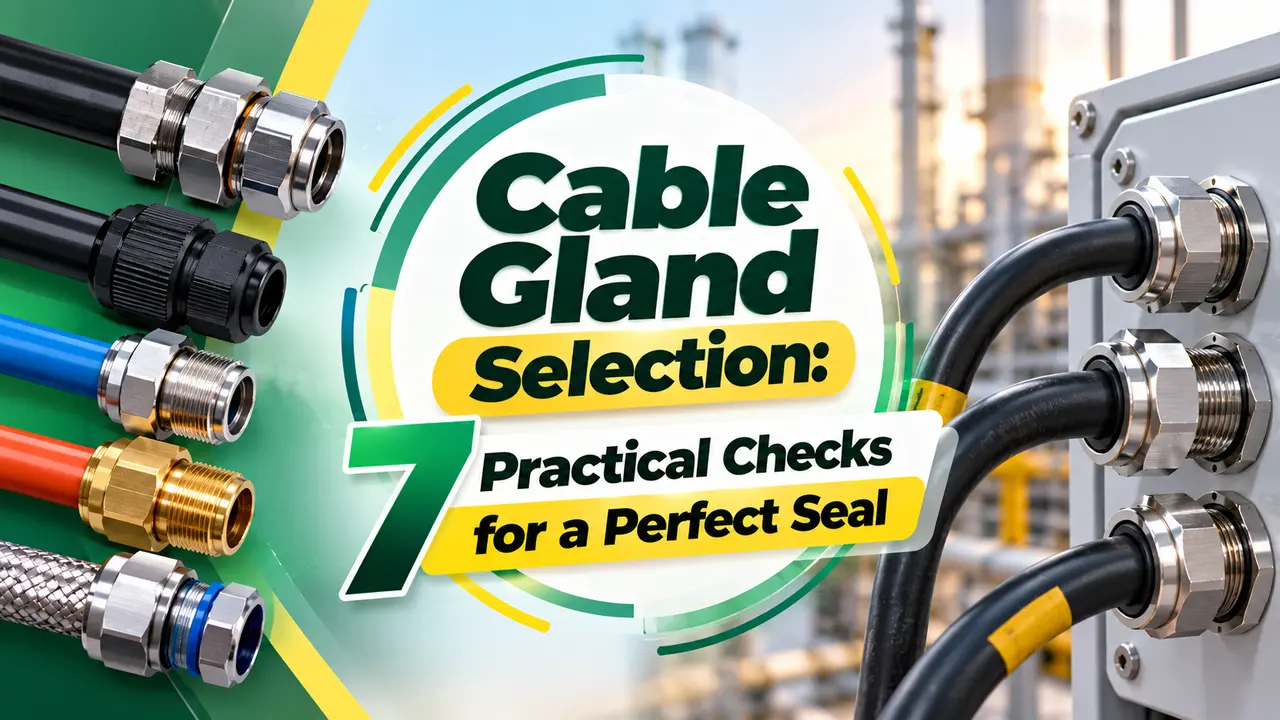
What Is a Cable Gland?
A cable gland is a mechanical fitting that attaches a cable to an enclosure while sealing the entry, holding the cable firmly and, where armour is present, providing earth continuity. It keeps the IP rating of the enclosure intact.
The main parts are the entry body with its thread, a seal or seals, an armour clamping cone and ring, and a back nut that compresses everything together. A locknut and washer fix it to the gland plate.
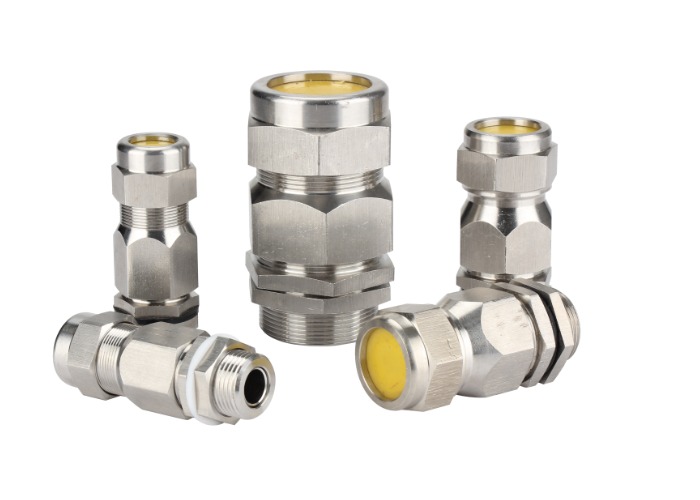
Metal Cable Gland explains that armoured designs seal twice, once on the inner bedding and once on the outer sheath. IP68 is the highest waterproof level they commonly reach.
In hazardous areas the fitting becomes part of the explosion protection concept, so it must carry the right Ex certificate. Our hazardous area classification guide explains zones.
Common Gland Types
Unarmoured cable, single seal on the sheath.
Armour clamp without an environmental seal.
Armour clamp with an outer sheath seal.
Double seal on inner and outer sheaths.
Ex d barrier types add a setting compound around each core to stop flame and gas passing along the cable. They are required for some explosion proof enclosures and gas groups.
Nylon or polyamide fittings suit light duty unarmoured cable and resist corrosion. Metal bodies are used where earthing and mechanical strength matter.
7 Practical Cable Gland Selection Checks
CMP Products lists the same starting points, beginning with cable type, overall diameter and armour details. It also stresses using the maker accessories to keep sealing and short circuit ratings valid.
Offshore and coastal sites favour 316 stainless steel or nickel plated brass. Match the certification to the gas group and temperature class.
Installation Steps That Prevent Failures
An earth tag under the entry links the armour to the panel earth, as described in plant earthing. Loose armour clamping is a common inspection finding.
Do not overtighten plastic fittings, since cracked bodies lose their IP rating. Use sealing washers on threaded entries in wet areas.
Thread and Size Reference
| Size | Thread | Typical Outer Seal Range |
|---|---|---|
| 20S | M20 | 6.1 to 11.7 mm |
| 20 | M20 | 6.5 to 14 mm |
| 25 | M25 | 11.1 to 20 mm |
| 32 | M32 | 17 to 26 mm |
| 40 | M40 | 22 to 32.2 mm |
| 50S | M50 | 29.5 to 38.2 mm |
| 50 | M50 | 35.6 to 44.1 mm |
| 63S | M63 | 40.1 to 50 mm |
| 63 | M63 | 47.2 to 56 mm |
Ranges vary by maker and series, so always confirm with the catalogue. The gland plate hole is usually the thread size plus about 0.5 mm.
Cable diameter follows the conductor size chosen in cable sizing and ampacity. Instrument cables follow the colour rules in cable colour codes.
Gland Size Finder
Choose the size where the diameter sits near the middle of the range for the best grip. Check the armour range separately for armoured cable.
- Measure the real cable diameter.
- Use certified parts in Ex areas.
- Fit earth tags on armoured cable.
- Torque to the maker value.
- Wrong seal range, leading to leaks.
- Mixing parts from different makers.
- Missing shroud in corrosive areas.
- Unused entries left open.
CMP IEC Catalogue PDF
Gland Types Video
Cable Gland FAQ
Related Articles
- IP Rating Explained
- Hazardous Area Classification
- ATEX vs IECEx
- Cable Tray Fill Calculation
- Field Instrument to Cabinet Wiring
External References
- IEC Short Form Catalogue, CMP Products
- Selecting the Right Gland and Accessory, CMP Products
- Cable Gland, Wikipedia
What We Learn Today
- A good cable gland seals, grips and earths the cable.
- Select by cable type, diameter, environment, area class and thread.
- Install with correct torque, earth tags and certified parts.