
What is Hydrostatic Level Measurement? Working Principle, Formula, and Applications
Why the pressure at the bottom of a tank tells you exactly how full it is, and how one simple formula turns that pressure into a level reading.
Hydrostatic level measurement determines the liquid level by measuring the pressure created by the liquid column above the sensor. Learn its working principle, formula, advantages, disadvantages, and industrial applications.
What is Hydrostatic Level Measurement?
Imagine filling a water bottle from the tap. As the bottle fills, the water at the bottom experiences increasing pressure because more liquid presses down from above. Keep adding water, and the pressure at the bottom keeps rising. That simple observation is the entire basis of hydrostatic level measurement.
Hydrostatic level measurement is one of the most widely used methods for measuring liquid level in tanks, reservoirs, wells, and industrial vessels. Instead of measuring the liquid surface directly, it measures the hydrostatic pressure generated by the liquid column. Since that pressure is directly proportional to liquid height, it converts cleanly into a level reading. The technique is simple, reliable, and cost effective, which is why it shows up across water treatment, chemical processing, oil and gas, food and beverage, pharmaceuticals, and power generation.

Real Life Example
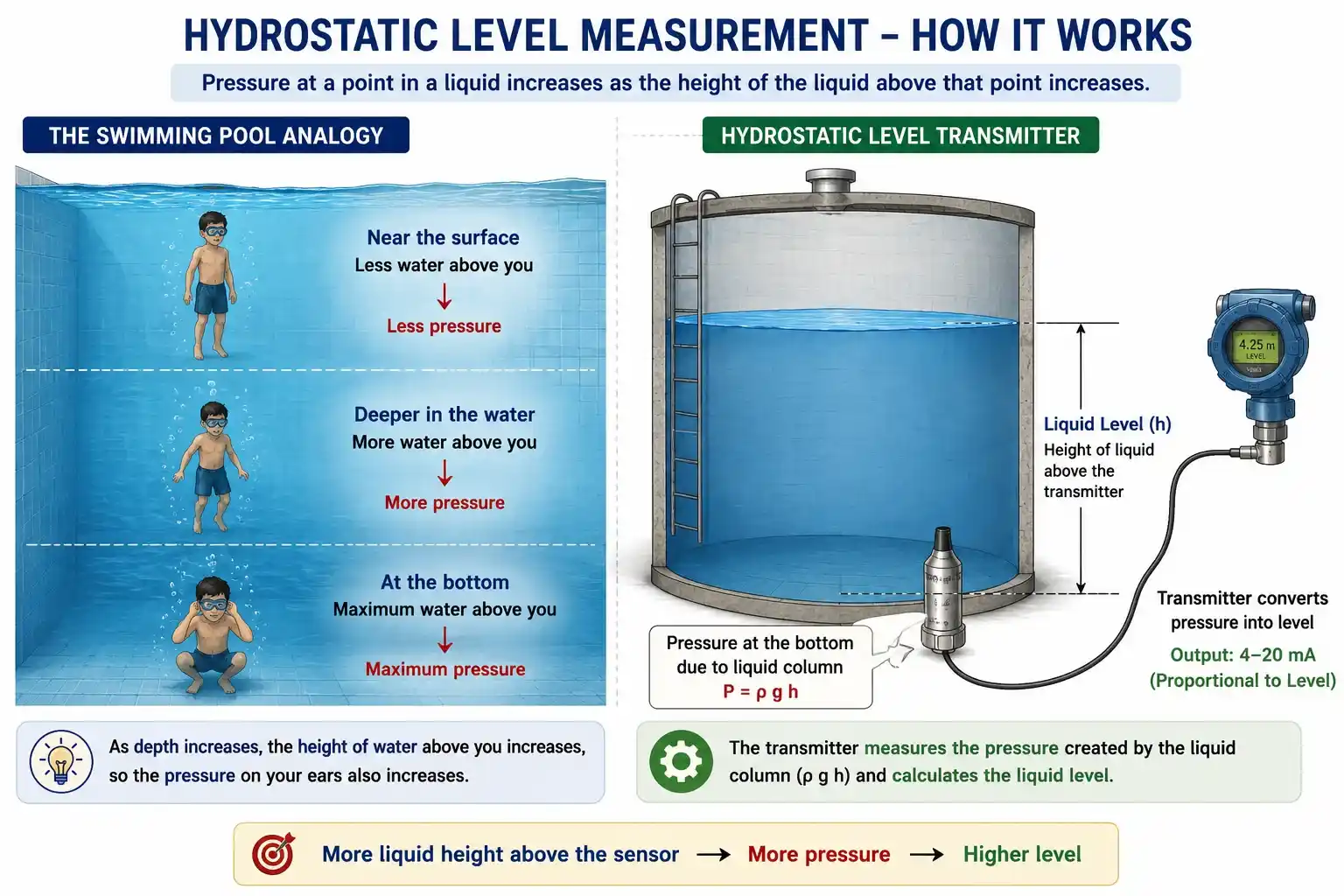
Imagine standing at the bottom of a swimming pool. As you move deeper into the water, you feel increasing pressure on your ears, because the height of water above you increases, producing greater hydrostatic pressure. A hydrostatic level transmitter works exactly the same way. It measures this pressure and calculates the liquid level from it.
Why is Hydrostatic Level Measurement Important?
Hydrostatic level measurement offers a simple, dependable way to monitor liquid level continuously. It provides continuous measurement, high reliability, good accuracy, simple installation, low maintenance, cost-effective operation, and compatibility with most liquids, making hydrostatic level measurement especially suitable for water tanks, storage vessels, underground reservoirs, and open process tanks.
5-Step Working Principle of Hydrostatic Level Measurement
The working principle rests on one basic idea: the pressure at the bottom of a liquid increases as the height of the liquid increases. When a pressure transmitter is installed near the tank bottom, it continuously measures the hydrostatic pressure created by the liquid column and converts it into an electrical signal, typically 4 to 20 mA, which is displayed as liquid level on a PLC, DCS, SCADA system, or digital indicator.
Tank is Filled
The tank is filled with liquid up to some level.
Weight Creates Pressure
The liquid's weight creates pressure at the bottom of the tank.
Sensor Measures Pressure
A pressure sensor measures this hydrostatic pressure directly.
Transmitter Converts Signal
The transmitter converts pressure into an electrical output signal.
Level is Displayed
The control system calculates and displays the corresponding liquid level.
Hydrostatic Pressure Formula
The relationship between pressure and liquid level is given by the hydrostatic pressure equation.
From this equation, hydrostatic pressure increases when the liquid level increases or the liquid density increases, while gravity stays constant.
Open Tank vs Closed Tank Hydrostatic Level Measurement
An open tank is exposed to the atmosphere, so atmospheric pressure acts equally on the liquid surface and the transmitter and cancels out automatically. A closed tank is sealed and may hold gas or vapor above the liquid, so industries commonly use a Differential Pressure (DP) Transmitter, connecting the high-pressure side to the tank bottom and the low-pressure side to the vapor space, so only the liquid column pressure is measured.
| Feature | Open Tank | Closed Tank |
|---|---|---|
| Tank Pressure | Atmospheric | Pressurized |
| Instrument Used | Pressure Transmitter | Differential Pressure (DP) Transmitter |
| Atmospheric Pressure Effect | Automatically cancelled | Must be compensated |
| Measurement Accuracy | High | High after compensation |
| Typical Applications | Water tanks, reservoirs | Chemical reactors, pressure vessels |
Advantages of Hydrostatic Level Measurement
Hydrostatic level measurement remains one of the most widely used techniques because of its simplicity and reliability.
Simple Working Principle
Based on a direct relationship between liquid height and pressure, easy to understand and implement.
Continuous Measurement
Provides continuous level information instead of only high or low indication.
Suitable for Large Tanks
Accurately measures level in deep tanks, wells, reservoirs, and underground storage.
Cost Effective
Generally less expensive than advanced radar or laser level transmitters.
Easy Integration
Standard 4 to 20 mA, HART, and Modbus outputs integrate easily with PLCs, DCS, and SCADA.
Reliable Operation
Simple measurement principle gives long service life with minimal maintenance.
Limitations of Hydrostatic Level Measurement
Although hydrostatic level measurement offers many advantages, it is not suitable for every application.
✅ Works Well When
- Liquid density stays constant or is well known
- The application involves liquids, not powders or bulk solids
- The sensor can be installed near the tank bottom
- Moderate cost, continuous measurement is the priority
❌ Watch Out For
- Depends heavily on constant liquid density for accuracy
- Not suitable for solids, powders, or granules
- Sensing element stays in contact with the process liquid
- Requires installation near the tank bottom, which is not always convenient
Industrial Applications of Hydrostatic Level Measurement
Hydrostatic level measurement is widely used wherever reliable liquid level monitoring is required.
Water Treatment Plants
Monitoring reservoir, storage tank, and clarifier levels.
Chemical Industries
Measuring levels in storage tanks, process vessels, and mixing tanks.
Oil and Gas Industry
Monitoring diesel tanks, fuel storage tanks, and process liquids.
Food and Beverage
Measuring levels of milk, edible oils, beverages, and syrups.
Pharmaceutical Industry
Level measurement in clean process vessels and storage tanks.
Power Plants
Monitoring boiler feedwater tanks, condensate tanks, and cooling water.
Hydrostatic vs Ultrasonic Level Measurement
| Feature | Hydrostatic Level Measurement | Ultrasonic Level Measurement |
|---|---|---|
| Measurement Principle | Pressure | Ultrasonic echo |
| Sensor Contact | Yes | No |
| Suitable for Corrosive Liquids | Limited | Excellent |
| Foam Effect | Minimal | Can affect accuracy |
| Vapor Effect | Minimal | May reduce performance |
| Installation | Bottom of tank | Top of tank |
| Cost | Moderate | Moderate |
Installation Best Practices and Common Mistakes
Follow these recommendations for accurate hydrostatic level measurement.
- Install the transmitter at the lowest point of the tank
- Use the correct liquid density during calibration
- Protect the sensing diaphragm from sediment buildup
- Avoid installing the sensor near pump suction points where turbulence is high
- Periodically inspect impulse lines in DP transmitter installations
- Select corrosion-resistant wetted materials for aggressive chemicals
- Do not ignore changes in liquid density between calibration and operation
- Do not forget to compensate for vapor pressure in closed tanks
Hydrostatic Level Measurement: Video Walkthrough
Frequently Asked Questions About Hydrostatic Level Measurement
- VEGA, Hydrostatic Level Measurement with Pressure Transmitters
- Control.com, What is Hydrostatic Pressure
- Inst Tools, Closed Tank Level Measurement Using DP Transmitters
What We Learn Today
- Hydrostatic level measurement determines liquid level by measuring the pressure created by the liquid column above the sensor
- The governing equation, P = ρgh, ties pressure directly to liquid height, density, and gravity
- Open tanks need only a pressure transmitter, closed tanks need a DP transmitter to cancel vapor pressure
- Constant, known liquid density is essential for accurate readings
- It is not suitable for solids, and the sensor must sit near the tank bottom
- Its simplicity, reliability, and low maintenance make it one of the most popular level measurement methods across industries