Those tiny black chips on every PCB carry their value as a short printed code. Learn to decode all three marking systems, check the power rating of the package and test a doubtful part with confidence.
An SMD resistor code is a short marking that tells you the resistance of a chip resistor without a meter. This guide covers every common system, a full EIA 96 table, package power ratings and a decoder calculator.
What Is an SMD Resistor Code?
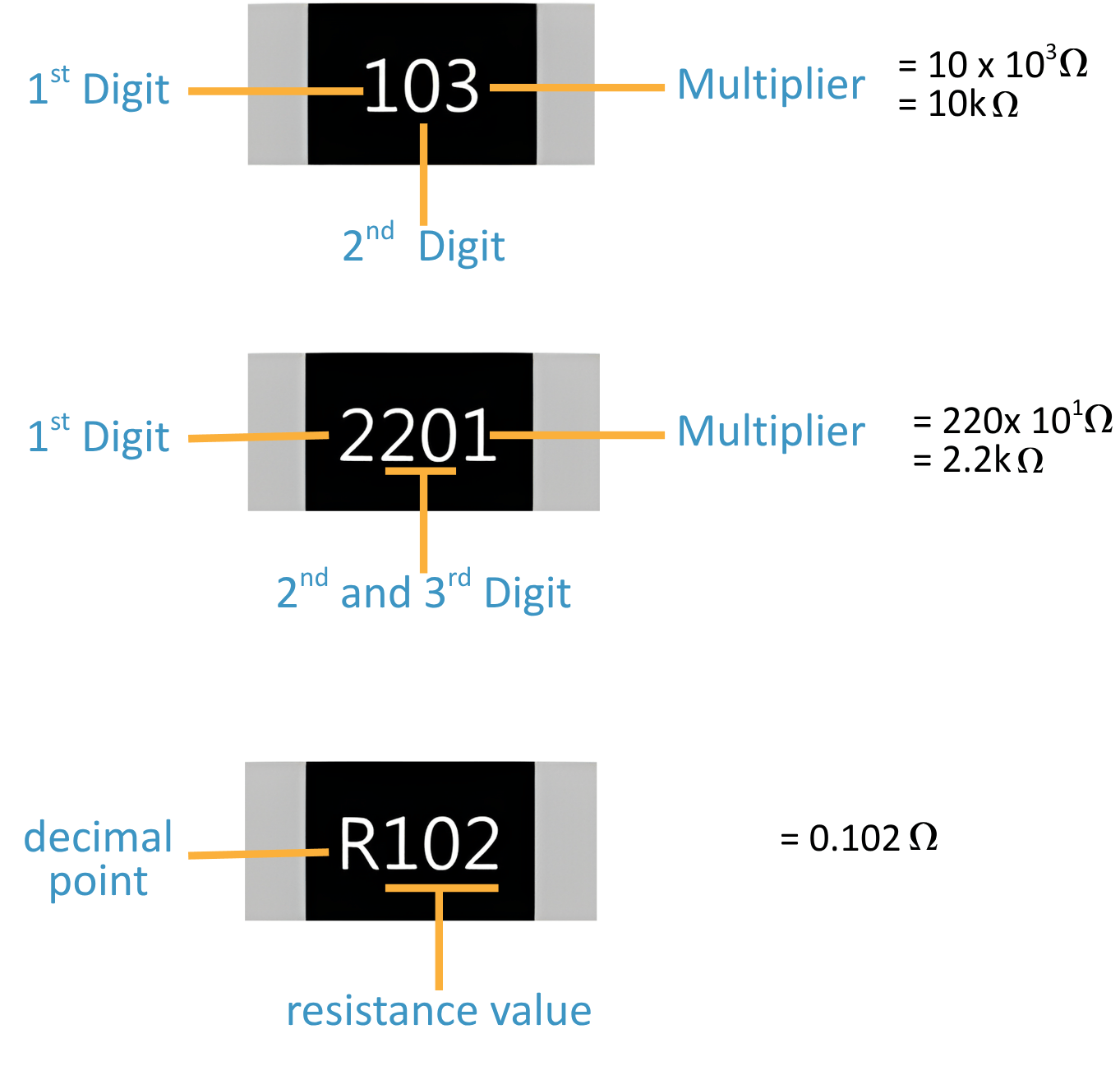
An smd resistor code is the number or letter marking printed on a surface mount chip resistor that gives its resistance value in a compact form. The three common systems are the 3 digit code, the 4 digit code and the EIA 96 code, with the letter R used as a decimal point.
| Marking | System | Value |
|---|---|---|
| 472 | 3 digit | 47 × 10² = 4.7 kΩ |
| 103 | 3 digit | 10 × 10³ = 10 kΩ |
| 4702 | 4 digit | 470 × 10² = 47 kΩ |
| 4R7 | R notation | 4.7 Ω |
| 01C | EIA 96 | 100 × 100 = 10 kΩ |
| 000 | Jumper | 0 Ω link |
The last digit of a numeric smd resistor code is always the multiplier, written as the number of zeros to add after the significant digits. Once you remember that one rule, most of the codes on an industrial PCB can be read in seconds.
Through hole parts use colour bands instead, as explained in our resistor color code guide. Chip parts are too small for bands, so a printed number is the cheaper option for the manufacturer.
JLCPCB notes that most 0201 and 01005 resistors carry no marking at all because the body is too small to print on. For these parts the bill of materials and the pick and place file are the only reliable record.
How to Read an SMD Resistor Code With 3 Digits
The 3 digit system is used for 2 %, 5 % and 10 % tolerance parts in the E24 series, according to the Vishay marking document. The first two digits are the significant figures and the third digit is the power of ten.
472 = 47 × 10² = 4700 Ω
472 = 4.7 kΩ
220 = 22 × 10⁰ = 22 Ω
A third digit of 0 means no zeros, so 100 is 10 Ω and not 100 Ω, which is the most common reading error by beginners. Values under 10 Ω cannot use this format, so the letter R takes over, as shown in the next section.
| 3 digit smd resistor code | Value | Common use |
|---|---|---|
| 100 | 10 Ω | Gate and series resistors |
| 221 | 220 Ω | LED current limit |
| 102 | 1 kΩ | Base resistors |
| 472 | 4.7 kΩ | I2C pull up |
| 103 | 10 kΩ | Pull up and pull down |
| 104 | 100 kΩ | Input dividers |
| 105 | 1 MΩ | Bleed resistors |
Pull up values such as 4.7 kΩ and 10 kΩ are the codes you will meet most often, and choosing them is covered in pull up and pull down resistor values. Calculating the current through any of them is basic Ohms law.
4 Digit Code and R Notation
Precision resistors of 1 % or better use a four digit smd resistor code, with three significant figures and one multiplier. Vishay gives the examples 1001 for 1 kΩ and 1000 for 100 Ω.
4702 = 470 × 10² = 47 kΩ
1001 = 100 × 10¹ = 1 kΩ
1000 = 100 Ω, not 1 kΩ
The letter R simply marks the decimal point and is used in both systems for small values. So 4R7 is 4.7 Ω, R10 is 0.1 Ω and 1R00 is 1.00 Ω in the 4 digit form, while Vishay uses L as the decimal point in milliohms for shunt values.
Read the smd resistor code with the text upright and the PCB silkscreen as a guide. A code like 601 read upside down becomes 109, which would point to a completely different value.
EIA 96 SMD Resistor Code Chart
The EIA 96 smd resistor code packs a 1 % value into only three characters, which suits small 0603 parts. Two digits give a code from 01 to 96 that maps to a three digit value in the E96 series, and a letter gives the multiplier.
| Letter | Multiplier | Letter | Multiplier |
|---|---|---|---|
| Z | 0.001 | B or H | 10 |
| Y or R | 0.01 | C | 100 |
| X or S | 0.1 | D | 1000 |
| A | 1 | E | 10000 |
| F | 100000 |
EEPower gives three worked examples: 01A is 100 Ω, 38C is 24.3 kΩ and 92Z is 0.887 Ω, all at 1 %. Use the full table below to find the base value for any code.
| Code | Value | Code | Value | Code | Value | Code | Value | Code | Value | Code | Value |
|---|---|---|---|---|---|---|---|---|---|---|---|
| 01 | 100 | 17 | 147 | 33 | 215 | 49 | 316 | 65 | 464 | 81 | 681 |
| 02 | 102 | 18 | 150 | 34 | 221 | 50 | 324 | 66 | 475 | 82 | 698 |
| 03 | 105 | 19 | 154 | 35 | 226 | 51 | 332 | 67 | 487 | 83 | 715 |
| 04 | 107 | 20 | 158 | 36 | 232 | 52 | 340 | 68 | 499 | 84 | 732 |
| 05 | 110 | 21 | 162 | 37 | 237 | 53 | 348 | 69 | 511 | 85 | 750 |
| 06 | 113 | 22 | 165 | 38 | 243 | 54 | 357 | 70 | 523 | 86 | 768 |
| 07 | 115 | 23 | 169 | 39 | 249 | 55 | 365 | 71 | 536 | 87 | 787 |
| 08 | 118 | 24 | 174 | 40 | 255 | 56 | 374 | 72 | 549 | 88 | 806 |
| 09 | 121 | 25 | 178 | 41 | 261 | 57 | 383 | 73 | 562 | 89 | 825 |
| 10 | 124 | 26 | 182 | 42 | 267 | 58 | 392 | 74 | 576 | 90 | 845 |
| 11 | 127 | 27 | 187 | 43 | 274 | 59 | 402 | 75 | 590 | 91 | 866 |
| 12 | 130 | 28 | 191 | 44 | 280 | 60 | 412 | 76 | 604 | 92 | 887 |
| 13 | 133 | 29 | 196 | 45 | 287 | 61 | 422 | 77 | 619 | 93 | 909 |
| 14 | 137 | 30 | 200 | 46 | 294 | 62 | 432 | 78 | 634 | 94 | 931 |
| 15 | 140 | 31 | 205 | 47 | 301 | 63 | 442 | 79 | 649 | 95 | 953 |
| 16 | 143 | 32 | 210 | 48 | 309 | 64 | 453 | 80 | 665 | 96 | 976 |
Each step in the table is about 2.4 % above the last, because the E96 series puts 96 values in every decade. Our page on resistor types explains where such precise values are needed in instrument circuits.
In an EIA 96 marking the third character is always a letter, so a code with three numbers can never be EIA 96. That single check stops most mix ups between 01C and an ordinary 3 digit smd resistor code.
What Does 000 Mean on an SMD Resistor?
A part marked 0, 000 or 0000 is a zero ohm resistor, used as a jumper to link two tracks or to select an option on the board. JLCPCB notes that designers often fit or leave out these links to configure a product.
A jumper is not a perfect short, and its current is limited by the package size. The Vishay CRCW datasheet lists a maximum of 20 mΩ for its jumpers, with the current ratings below.
| Size (inch) | Jumper max resistance | Jumper rated current |
|---|---|---|
| 0402 | 20 mΩ | 1.5 A |
| 0603 | 20 mΩ | 2.0 A |
| 0805 | 20 mΩ | 2.5 A |
| 1206 | 20 mΩ | 3.5 A |
| 2512 | 20 mΩ | 7.0 A |
SMD Resistor Size Chart and Power Ratings
The package code gives the length and width, in hundredths of an inch for the imperial name and in tenths of a millimetre for the metric one. The Vishay CRCW datasheet lists the rated power at 70 °C for each size.
| Imperial | Metric | Rated power P70 | Max element voltage |
|---|---|---|---|
| 0402 | 1005 | 0.063 W | 50 V |
| 0603 | 1608 | 0.10 W | 75 V |
| 0805 | 2012 | 0.125 W | 150 V |
| 1206 | 3216 | 0.25 W | 200 V |
| 1210 | 3225 | 0.50 W | 200 V |
| 2010 | 5025 | 0.75 W | 400 V |
| 2512 | 6332 | 1.0 W | 500 V |
Above 70 °C the allowed power falls, so a resistor near a hot regulator needs extra margin, as described in resistor power rating and derating. Wide copper and thermal vias under the pads also help to pull heat out.
- Small size and low cost in volume
- Low parasitic inductance for fast signals
- Machine placement with high accuracy
- Value printed on most sizes above 0402
- Tiny parts are hard to rework by hand
- Codes are easy to read upside down
- Smallest sizes carry no marking
- Low power per package compared to leaded parts
Solved Example and Decoder Calculator
Suppose you find a chip with the smd resistor code 472 in a 24 V sensor interface and want to check if it can sit across 12 V. First decode the value, then find the power and compare it with half of the package rating.
P = V² ÷ R = 12² ÷ 4700
P = 0.03064 W = 30.64 mW
0402 limit at 50 % = 31.5 mW, so 0402 just fits
The calculator decodes numeric codes only, so use the EIA 96 table above for letter codes. It uses the Vishay ratings and the common design habit of running a resistor at no more than half its rated power.
The same power check applies to an LED resistor calculation or a voltage divider feeding an ADC. In 4 to 20 mA loops, precision shunts are covered in shunt resistors in instrumentation.
How to Identify an Unknown SMD Resistor
Before you replace a burnt chip, read the code of an identical part on a healthy channel of the same board. A burnt body often hides the reason for failure, so check the power rating as well.
- SMD resistor code read with the part upright
- System identified as 3 digit, 4 digit, R or EIA 96
- Multiplier digit or letter applied correctly
- Package size measured
- Power checked against half of the rating
- Value confirmed with a meter out of circuit
Measuring in circuit gives wrong readings when parallel parts are present, the same trap seen in how to test a capacitor. Good layout habits from PCB design fundamentals also make markings easier to read later.
Our PCB trace width calculator is handy when a 0 ohm link carries supply current. The track on either side should never be the weak point of a jumper.
Keep this Vishay document with your repair kit, since it shows the exact codes used on their chip and MELF resistors.
SMD Resistor Code FAQ
First find which system is used: three numbers, four numbers, a letter R inside or a letter at the end. For number codes the last digit tells you how many zeros to add after the other digits.
A letter R marks the decimal point, so 4R7 means 4.7 ohms. A code ending in a letter is EIA 96, which needs the lookup table for the base value.
The code 103 means 10 followed by three zeros, which is 10,000 ohms or 10 kΩ in the common 3 digit system. It is one of the most used values for pull up and pull down duty.
In the 4 digit system the same 10 kΩ value is written as 1002. In the EIA 96 system it appears as 01C, since code 01 is 100 and C means a multiplier of 100.
EIA 96 is a three character marking for 1 % resistors, with two digits from 01 to 96 and one letter as the multiplier. The digits point to a three digit value in the E96 series.
For example, 38C means 243 times 100, which equals 24.3 kilohms. The letters run from Z for 0.001 up to F for 100,000, and the code always ends in a letter.
The letter R stands for the decimal point and is used for values below 10 ohms. So 4R7 is 4.7 ohms, R47 is 0.47 ohms and 1R0 is exactly 1 ohm.
Vishay uses the same idea in the 4 digit form, such as 1R00 for a precision 1 ohm part. Very low shunt values can also use the letter L as a decimal point in milliohms.
A marking of 0, 000 or 0000 shows a zero ohm resistor, which works as a jumper between two tracks. Designers use it to select options or to cross a track on a single layer board.
It still has a small resistance and a current limit. The Vishay CRCW range allows up to 20 mΩ, with a current rating from 1.5 A in 0402 to 7 A in 2512 size.
Unmarked parts, common in 0201 and 01005 sizes, must be identified from the bill of materials or the circuit diagram. Without those records, the only option is a careful measurement.
Lift one end of the part with a soldering iron and measure it with a good meter. Compare the reading with standard E24 or E96 values to find the nearest likely value of the original part.
Related Articles
- Resistor Color Code Guide
- Resistor Power Rating and Derating
- Resistor Types: Fixed, Variable and Special Purpose
- Pull Up and Pull Down Resistor Values
- LED Resistor Calculation
External References
- Vishay: Surface Mount Resistor Marking (PDF)
- EEPower: Resistor SMD Code
- Wikipedia: Surface mount technology
What We Learn Today
- Any numeric smd resistor code uses the last digit as the multiplier, so 472 is 4.7 kΩ and 4702 is 47 kΩ.
- EIA 96 codes use two digits for an E96 base value and a letter multiplier, so 01C is 10 kΩ and 92Z is 0.887 Ω.
- Package size sets the power, from 0.063 W for 0402 to 1 W for 2512 in the Vishay CRCW range, and jumpers also have current limits.