
Electrical Fundamentals · Circuit Theory · The Foundation Formula
Basics of Ohm's Law: The One Formula Every Electrical Circuit Obeys
Every 4-20mA loop, every resistor, every motor circuit you'll ever troubleshoot ultimately comes back to one equation. This guide covers the basics of Ohm's law in plain language, the water pipe analogy, the full power formula wheel, and a smart calculator that solves for any variable.
Basics of Ohms Law: Where It All Starts
Three quantities, voltage, current, and resistance, and one simple formula connecting them. That's Ohm's law, and you'll use it more than almost any other formula in electronics.
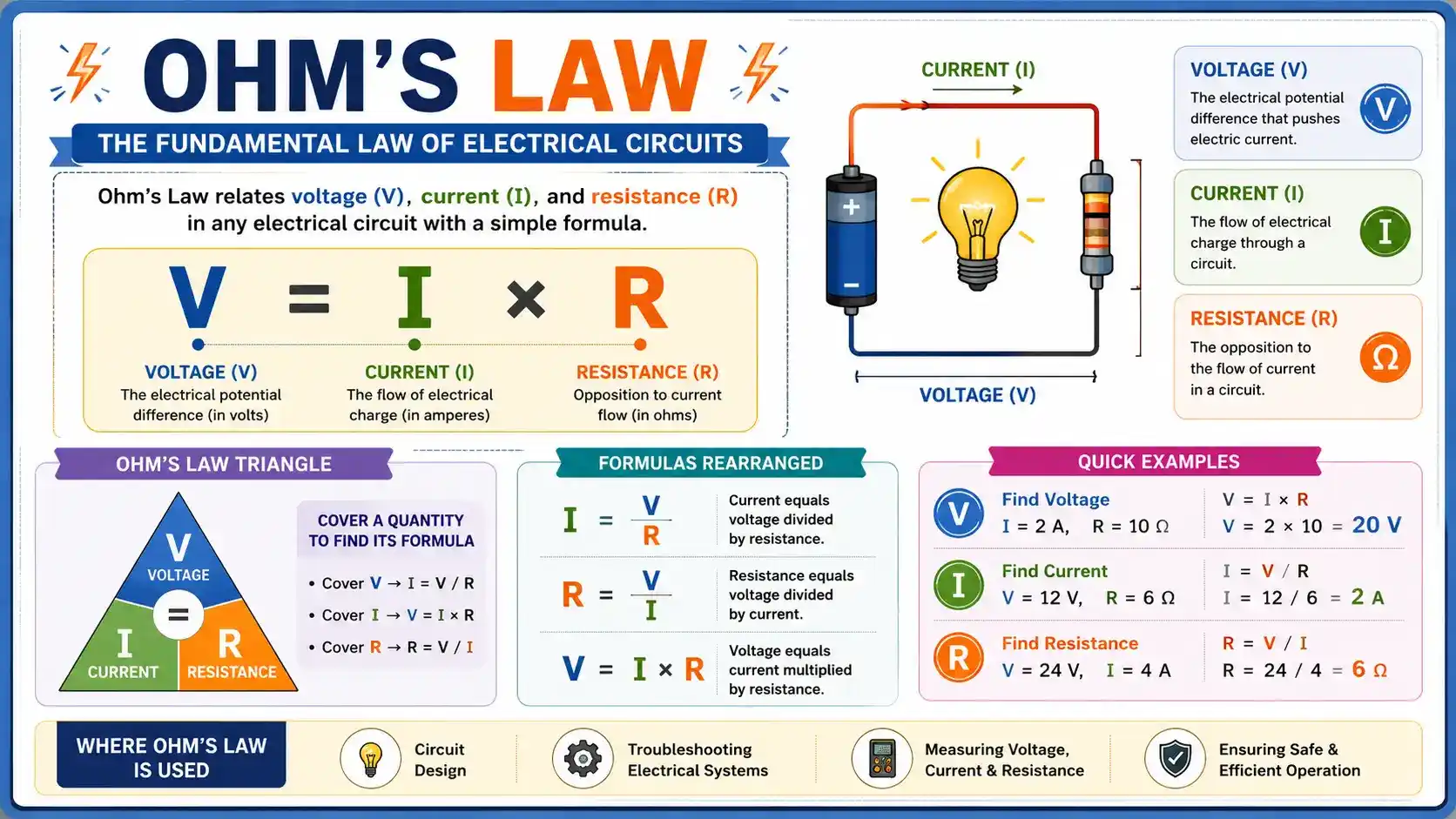
Here's the whole law in one line: voltage equals current times resistance, or V = I × R. Increase the voltage in a circuit while resistance stays the same, and you get more current. Increase the resistance while voltage stays the same, and you get less current. That's it, that's the whole idea. Once you have any two of the three values, you can always find the third.
When Georg Ohm first published his law in 1827, it was rejected outright. Germany's own education minister called his work "a web of naked fancies" and said a professor who taught such heresies was unworthy of the profession. Ohm resigned his post and lived in poverty for years before the Royal Society in London finally recognized his work, awarding him the Copley Medal in 1841, fourteen years after he first published the formula that now bears his name.
The Ohm's Law Triangle: A Memory Trick That Actually Works
Here's how to use it. Cover up the letter you want to find with your hand. If the two letters left over are side by side, multiply them. If one sits above the other, divide the top by the bottom.
Cover V: I and R sit side by side, so V = I × R. Cover I: V sits above R, so I = V ÷ R. Cover R: V sits above I, so R = V ÷ I.
Let's try it. Say you want to find current. Cover the I. What's left is V above R, so you divide: I = V ÷ R. Now try resistance. Cover the R. What's left is V above I, so again you divide: R = V ÷ I. That's the whole trick, and once you've used it a few times, you won't need to look at the triangle at all.
The Water Pipe Analogy: Why This Formula Actually Makes Sense
Electricity is invisible, so it helps to compare it to something you can actually see. Picture a garden hose.
Squeeze the hose and you add resistance. Same pressure, less water gets through. Open the nozzle wider and resistance drops, so more water flows for the same pressure. Turn up the pressure instead, and more water pushes through even a narrow opening. Same idea, just swap water for electrons.
Watch: Ohm's Law Explained
The Complete Ohm's Law and Power Formula Reference
Bring power into the picture and you get twelve formulas total, all built from the same core idea. Engineers sometimes call this the "Ohm's law wheel."
| To Find | Given Current and Resistance | Given Voltage and Resistance | Given Voltage and Current |
|---|---|---|---|
| Voltage (V) | V = I × R | — | — |
| Current (I) | — | I = V ÷ R | — |
| Resistance (R) | — | — | R = V ÷ I |
| Power (P) | P = I² × R | P = V² ÷ R | P = V × I |
Let's use it. Say you have a 12V battery connected to a 600Ω resistor, and you want to know the current. Cover the I in the triangle, you're left with V over R, so:
I = 12V ÷ 600Ω
I = 0.02A = 20mA
That's it. Twelve volts across six hundred ohms gives you twenty milliamps. Plug in different numbers and you'll get a different answer, but the steps never change.
Ohm's Law Smart Solver
Enter any two known values, voltage, current, or resistance, and this calculator solves for the rest, including power.
A Real Example: Picking a Resistor for an LED
Here's where Ohm's law earns its keep. An LED needs a resistor in series to limit its current, or it burns out fast. Say you have a 9V battery, and the LED itself drops 2V across it. That leaves 7V to drop across the resistor. Your LED is rated for a maximum of 10mA. What resistor do you need?
You know voltage across the resistor (7V) and the current you want (0.01A). Cover the R in the triangle, you're left with V over I:
R = 7V ÷ 0.01A
R = 700Ω
A 700Ω resistor gives you exactly 10mA through the LED. Pick the closest standard value, usually 680Ω or 750Ω, and you're done.
Ohm's law works cleanly on plain resistors, wires, and heating elements. It doesn't work as cleanly on diodes, transistors, or many sensors, since their resistance changes with voltage or temperature. V = IR still holds at any single instant, you just can't treat R as one fixed number the way you can with a resistor.
Where Ohm's Law Shows Up in Real Instrumentation Work
The 250Ω input resistor converts current signal into a readable voltage.
Resistance change with temperature is read back as a voltage via a known current.
A precisely known resistance converts current into a measurable voltage drop.
Long cable runs lose voltage exactly according to their resistance and current.
P = I²R determines whether a resistor will overheat under load.
Circuit protection devices are rated based on expected current under Ohm's law.
Quick FAQs: Basics of Ohm's Law
External References
What we learn today
- Ohm's law comes down to one line, V = I × R, connecting voltage, current, and resistance in any resistive circuit.
- The water pipe analogy, pressure as voltage, flow as current, restriction as resistance, makes the whole idea click fast.
- Power extends the same idea three ways: P = VI, P = I²R, and P = V²/R. P = I²R is why current, not voltage, is usually what causes overheating.
- Ohm's law works cleanly on fixed resistors. For parts like diodes, whose resistance shifts with voltage, it still holds at any instant, you just can't pin R to one number.