An AA cell holds two to three times the charge of an AAA cell of the same chemistry, yet both have the same nominal voltage. We compare sizes, IEC codes, capacity under real loads and runtime for the instruments you carry.
The AA vs AAA battery gap in capacity changes with load current, cutoff voltage and temperature. The figures here come from Energizer datasheets and Panasonic eneloop ratings, applied to meters, loggers and remote sensors.
What is the difference between an AA vs AAA battery?
AA vs AAA battery choice comes down to size and stored charge, not voltage. An AA is 14.5 mm by 50.5 mm and an AAA is 10.5 mm by 44.5 mm, and both give 1.5 V in alkaline or lithium and 1.2 V in NiMH. The AA has about twice the volume, so an Energizer L91 AA is rated 3400 mAh against 1250 mAh for the L92 AAA.
| Parameter | AA | AAA |
|---|---|---|
| Diameter x length (max) | 14.5 x 50.5 mm | 10.5 x 44.5 mm |
| IEC alkaline, NiMH, lithium | LR6, HR6, FR6 | LR03, HR03, FR03 |
| Nominal voltage | 1.5 V (1.2 V NiMH) | 1.5 V (1.2 V NiMH) |
| Typical capacity | 1900 to 3400 mAh | 750 to 1250 mAh |
| Alkaline weight | 23 g | 11.5 g |
| Best fit | Meters, calibrators, loggers | Slim probes, pen testers |
What Is the AA vs AAA Battery Difference?
The AA vs AAA battery difference is physical size and therefore capacity, because both sizes use the same chemistries and nominal voltages. An AA has roughly twice the internal volume of an AAA, so it delivers two to three times the milliamp hours at the same load.
- AA: 14.5 mm by 50.5 mm. AAA: 10.5 mm by 44.5 mm (IEC maximums).
- Alkaline and lithium cells are 1.5 V nominal; NiMH cells are 1.2 V.
- Capacity in mAh falls as load current and device cutoff voltage rise.
This matters more for an instrument technician than for a TV remote, because a loop calibrator or data logger draws current in bursts, works in heat and cold, and often sits unused for weeks.
Energizer notes that cylindrical alkaline cells lose about 3 % of their capacity per year when stored at 20 °C, so a spare AA in a cool drawer stays useful for years.
Is AA or AAA Battery Bigger? Sizes and IEC Names
The AA is bigger in both directions, 14.5 mm against 10.5 mm in diameter and 50.5 mm against 44.5 mm in length. IEC 60086 part 2 fixes these sizes, and the code on the jacket tells you size and chemistry.
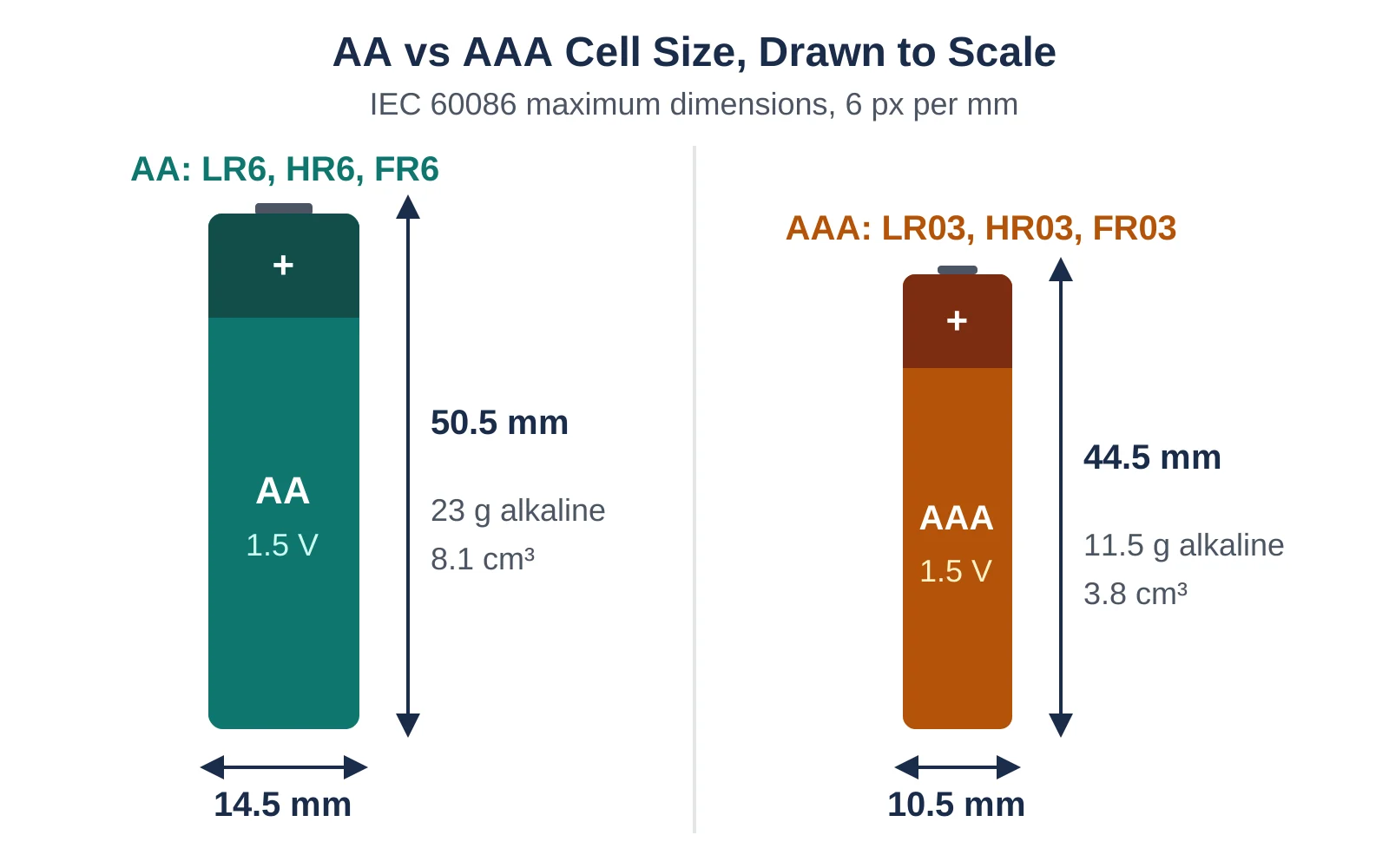
In the IEC code, 6 means AA and 03 means AAA. The letter in front is the chemistry: R alone is zinc carbon, L is alkaline, F is lithium iron disulfide and H is nickel metal hydride.
| Chemistry | AA code | AAA code | ANSI AA / AAA | Nominal voltage |
|---|---|---|---|---|
| Zinc carbon | R6 | R03 | 15D / 24D | 1.5 V |
| Alkaline (Zn/MnO2) | LR6 | LR03 | 15A / 24A | 1.5 V |
| Lithium iron disulfide | FR6 | FR03 | 15LF / 24LF | 1.5 V |
| NiMH rechargeable | HR6 | HR03 | 15H / 24H | 1.2 V |
| Lithium ion (not a drop in) | 14500 | 10440 | none | 3.6 to 3.7 V |
Go by the IEC code on the jacket. If a manual says LR6 only, a NiMH HR6 or a 14500 cell may fit the slot but is not what the designer tested.
What Voltage Does Each Chemistry Give?
Size does not change voltage, so an AA and an AAA of the same chemistry share the same nominal value. What changes is how well that voltage holds up under load.
Sloping curve from about 1.6 V down to 0.9 V, 150 to 300 milliohms fresh, minus 18 to 55 °C per Energizer.
Flat curve, light weight, minus 40 to 60 °C. The L91 allows 2.5 A continuous and the L92 allows 1.5 A.
Flat curve near 1.2 V, about 25 milliohms for an eneloop AA, up to 2100 recharges.
Same shape but 3.6 to 3.7 V, more than double a normal cell. It can damage 1.5 V instruments.
Cells in a holder are usually in series, so voltages add and mAh stays the same, as Kirchhoff voltage law shows. Two AA cells give 3 V, and the regulator choice in our LDO dropout voltage article decides how far they can be drained.
Which Lasts Longer, AA or AAA?
An AA lasts two to three times longer than an AAA of the same chemistry at the same load. Energizer rates the L91 AA lithium at 3400 mAh against 1250 mAh for the L92 AAA, and Panasonic rates eneloop AA at 1900 mAh minimum against 750 mAh for the AAA.
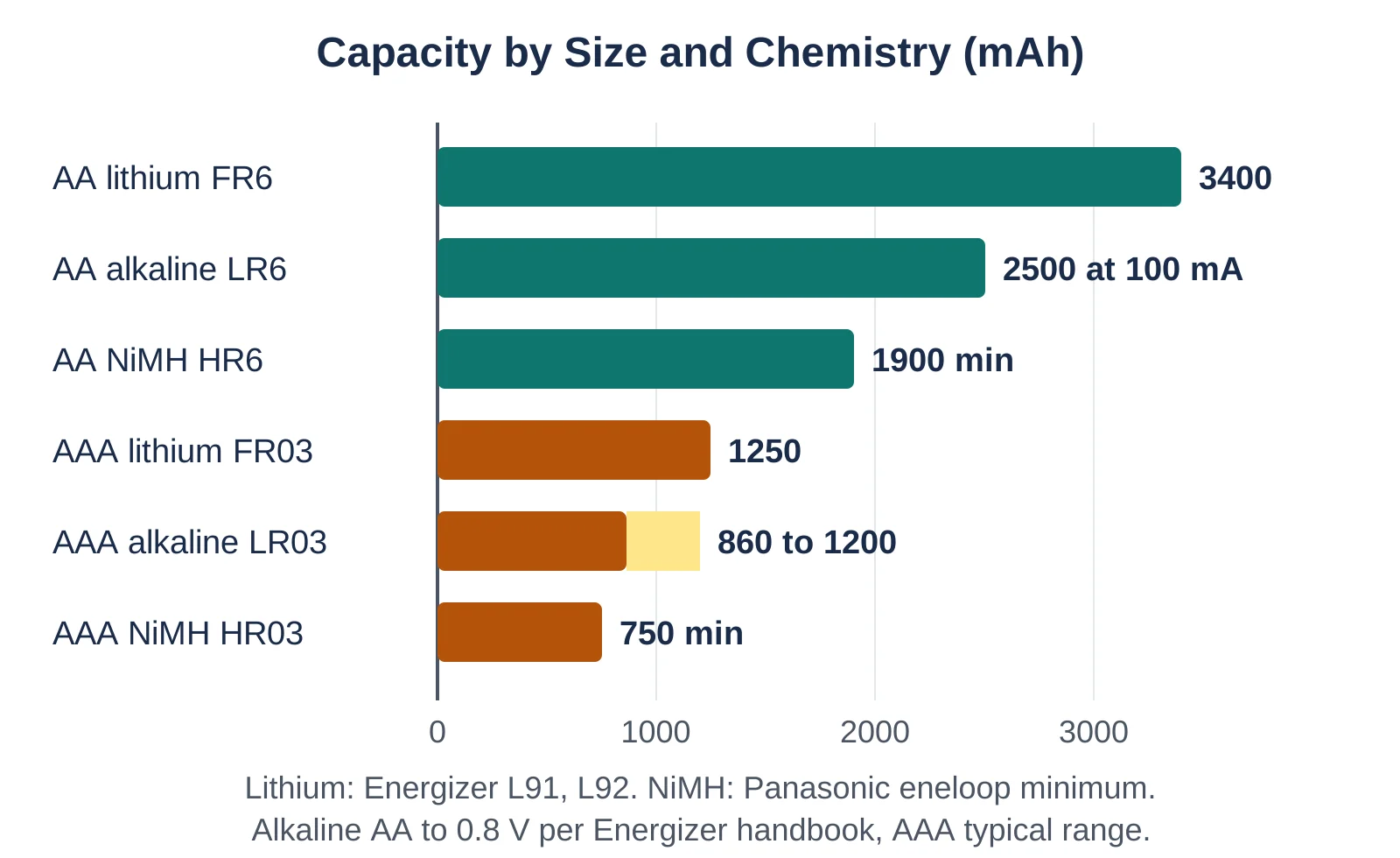
For alkaline cells a capacity figure means little without a test condition. The Energizer handbook shows an AA giving 2500 mAh at 100 mA down to 0.8 V, but only 1500 mAh when the device stops at 1.2 V.
To compare chemistries fairly, use energy in watt hours, roughly average voltage times amp hours, as in our energy consumption calculation.
AA NiMH: 1.2 V × 1.9 Ah = 2.28 Wh
AAA NiMH: 1.2 V × 0.75 Ah = 0.90 Wh
Internal resistance matters too. At a 1 A pulse, a fresh alkaline cell at 0.15 to 0.3 ohm drops 0.15 to 0.3 V by Ohm law, while a NiMH cell near 0.025 ohm drops only about 25 mV.
How Long Does an AA Battery Last? Runtime Calculation
An AA battery lasts its derated capacity divided by the average load current. So a 2500 mAh alkaline AA on a steady 100 mA load, derated by 20 %, runs about 20 hours.
= 2500 mAh × (1 minus 0.20) ÷ 100 mA
= 2000 mAh ÷ 100 mA
= 20.0 hours (0.8 days)
Series cells do not add mAh, so enter the capacity of one cell. You can cross check with the battery life calculator on Zenta Calculator.
Wireless sensors sleep most of the time and wake to transmit. Take a hypothetical node that sleeps at 20 µA and transmits at 25 mA for 0.1 s every 60 s on two AA lithium cells.
= 0.02 + 0.0417 = 0.0617 mA
Runtime = 3400 × 0.8 ÷ 0.0617
= about 44,100 h, or 5.0 years
On two AAA lithium cells the same node lasts about 1.85 years, which is why LoRaWAN field nodes favour the larger cell. The same method scales up in our battery backup time calculation.
Can I Use AA Instead of AAA?
An AA will not fit an AAA slot because it is 4 mm wider and 6 mm longer. You can only run an AAA device from AA cells through an external holder.
- The device has room and you want longer runtime.
- Load pulses reach hundreds of mA.
- The tool sits unused for months.
- The housing is slim, like a pen tester.
- Weight matters more than runtime.
- The maker certified only the AAA size.
In practice the designer fixes the AA vs AAA battery size, and you choose the chemistry. The Energizer handbook warns against mixing types or old and new cells.
AA vs AAA Battery Selection for Test Instruments and Wireless Sensors
Alkaline suits occasional use, NiMH suits tools used daily, and lithium wins in cold, long storage and high drain. Hazardous area equipment overrides all of this.
A calibrator in source mode supplies the full 4 to 20 mA loop current plus its electronics. If yours eats cells, try NiMH, whose low internal resistance keeps voltage above the cutoff longer.
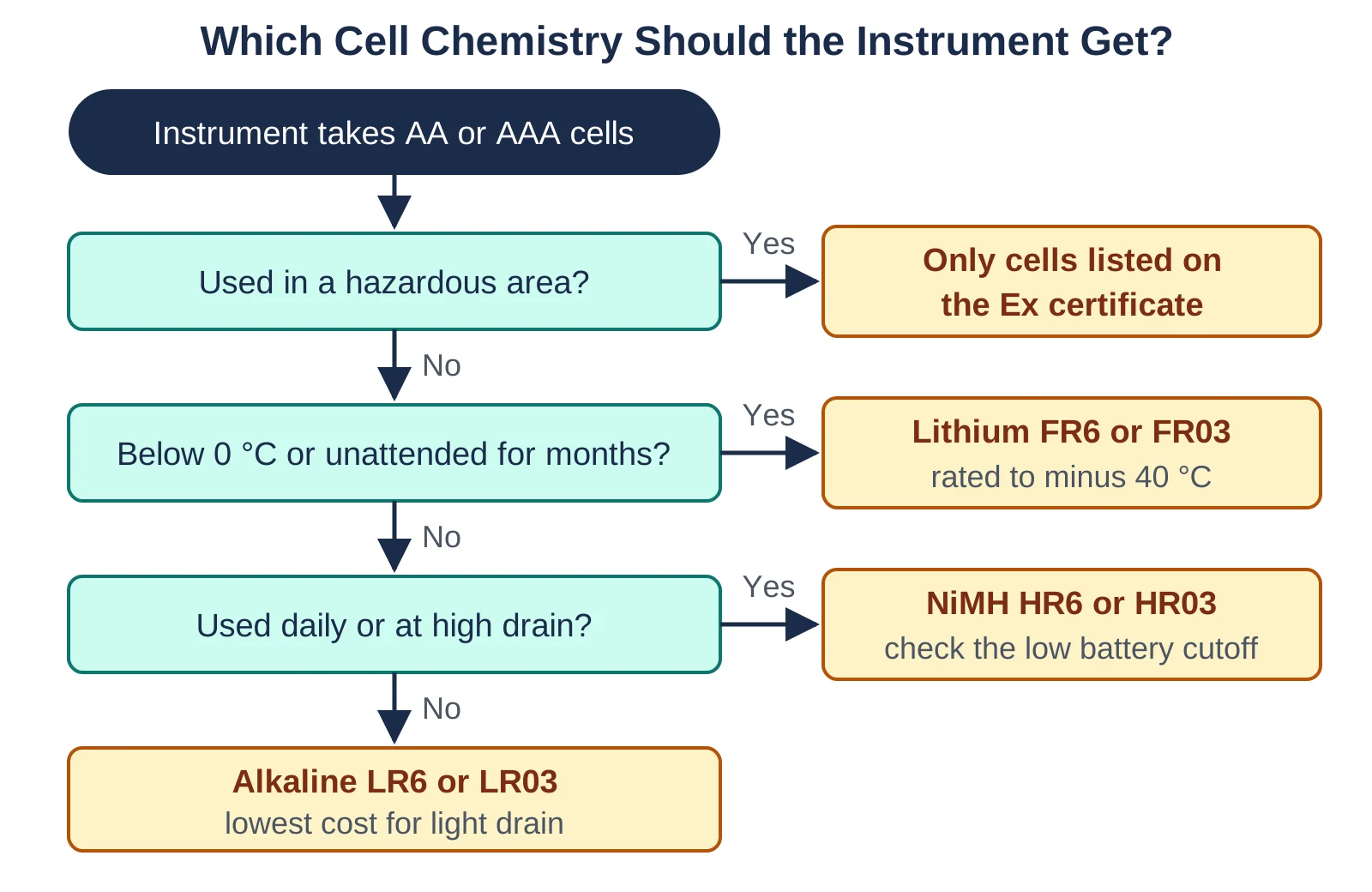
Energizer states that specially marked L91 and L92 cells are certified as components to EN 60079 part 11 with an Ex ia IIC T4 rating. The instrument certificate still decides, as explained in explosion proof vs intrinsically safe instruments.
Check the gas group too, and use our intrinsic safety entity calculator when you verify a loop.
Field Tips and Troubleshooting for AA and AAA Cells
Most battery trouble comes from a high device cutoff, cold, mixed cells or leakage.
| Symptom | Likely cause | Fix |
|---|---|---|
| Low battery icon with NiMH | Cutoff set for 1.5 V cells | Use alkaline or lithium |
| Dies in cold, recovers indoors | Alkaline below 0 °C | Use lithium FR6 or FR03 |
| Short runtime in source mode | Alkaline internal resistance | Switch to NiMH or lithium |
| White crust on terminals | Alkaline leakage | Clean contacts, remove cells |
| Dead after new cell | 14500 fitted by mistake | Remove it and check the device |
- Replace every cell in the holder together.
- Never mix chemistries or brands.
- Remove cells before storage.
- Test under load, not open circuit.
Energizer says cold makes alkaline capacity hard to reach without destroying it. Warm the cell up and most of the runtime returns.
Leakage and swelling are covered in causes of battery failure. For plant banks see IEEE 485 battery sizing and float and boost charging.
Energizer suggests a check under about a 10 ohm load for 1 to 2 seconds. A fresh alkaline reads near 1.5 V, and 1.1 V means about 20 % of service is left.
Video: Real Test of AA Cells Under Load
This Project Farm test compares AA alkaline, lithium and rechargeable cells for capacity, internal resistance and cold performance. Watch how far lithium pulls ahead at high drain.
We apply the same reasoning to wireless pressure transmitters.
AA vs AAA Battery FAQ
An AA is up to 14.5 mm in diameter and 50.5 mm long, while an AAA is up to 10.5 mm by 44.5 mm.
Energizer lists 8.1 cm³ against 3.8 cm³ of volume, so the AA holds about twice the charge or more.
Yes, both give 1.5 V nominal in alkaline and lithium iron disulfide, and 1.2 V in NiMH.
The AAA sags slightly more under the same current because its electrodes are smaller, but two AAA cells in series still make 3 V.
Divide the derated capacity by the average current in mA.
For example, 2500 mAh with 20 % derating at 100 mA gives 2000 divided by 100, or 20 hours, using the capacity read at your actual current and cutoff voltage.
Many instruments set the low battery warning for 1.5 V cells, so a 1.2 V NiMH trips it early.
Check the manual for a NiMH option or switch to alkaline or lithium, because the cells are usually still well charged.
Lithium iron disulfide FR6 or FR03 is the best choice for cold sites.
Energizer rates the L91 and L92 from minus 40 to 60 °C, while alkaline is rated only to minus 18 °C and loses usable capacity in the cold.
Usually not, because a 14500 cell gives 3.6 to 3.7 V instead of 1.5 V.
Fitting one into a device designed for AA cells can overvolt and damage its electronics, so use it only where the manufacturer clearly states 14500 support.
Related Articles
- How to Calculate Battery Backup Time
- Causes of Battery Failure
- LDO Regulator Dropout Voltage
- Explosion Proof vs Intrinsically Safe Instruments
- Temperature Data Logger Guide
External References
- Energizer Alkaline Manganese Dioxide Handbook and Application Manual (PDF)
- Panasonic eneloop rechargeable battery products
- AA battery, Wikipedia
What We Learn Today
- An AA vs AAA battery comparison shows the same nominal voltage per chemistry, but the AA has about twice the volume and two to three times the capacity.
- IEC codes such as LR6, HR6, FR6, LR03, HR03 and FR03 tell you both the cell size and the chemistry before you fit any instrument.
- Runtime equals derated capacity divided by average load current, and capacity must come from the datasheet curve at your real current and cutoff voltage.