Some level sensors sit in the liquid and some look at it from above, and that single choice decides maintenance, accuracy and cost. We sort every common technology into the right group and show you how to pick one for your tank.
Float, DP, capacitance and guided wave radar touch the process, while ultrasonic, radar, laser and nuclear gauges do not. We compare both groups and solve a time of flight example.
What is the difference in a contact vs non contact level sensor?
Contact vs non contact level sensor choice depends on whether the sensing part touches the process. Float, displacer, DP, capacitance, vibrating fork, magnetostrictive and guided wave radar are contact types, while ultrasonic, free space radar, laser and nuclear gauges measure from outside or above. For example, an ultrasonic sensor 5 m above the tank bottom with a 20 ms echo at 30 °C reads a level of 1.51 m.
| Point | Contact type | Non contact type |
|---|---|---|
| Examples | Float, displacer, DP, capacitance, GWR, fork | Ultrasonic, radar, laser, nuclear |
| Touches process | Yes, probe, float or diaphragm | No, mounted above or outside |
| Coating and build up | Can cause drift or sticking | Mostly unaffected |
| Vacuum, vapour, foam | GWR handles foam and vapour well | Ultrasonic fails in vacuum, radar copes |
| Typical cost | Low for switches and DP | Medium to high, nuclear highest |
What Is the Difference Between Contact and Non Contact Level Sensors?
In a contact vs non contact level sensor comparison, a contact sensor has a float, probe, rod or diaphragm that physically touches the liquid or solid, while a non contact sensor sends sound, microwaves, light or gamma rays from above or outside the vessel. Both give a level reading, but they differ in maintenance, process limits and price.
| Feature | Contact sensors | Non contact sensors |
|---|---|---|
| Working idea | Buoyancy, pressure, capacitance, guided pulse | Echo time of sound or microwave, beam absorption |
| Wetted parts | Probe, float, diaphragm, fork | None, only the antenna or face sees vapour |
| Best media | Clean liquids, interfaces, foam with GWR | Sticky, corrosive, sanitary or hot products |
| Weak spots | Coating, wear, moving parts | Foam, dust, false echoes, blanking zone |
| Installation | Long probes, bottom nozzles, sometimes a lift | Small top nozzle, often 3 inch or less |
Use the table as a first filter. For each technology in depth, see our article on types of level transmitters.
The Wikipedia entry on level sensors lists radar transmitters working from about 1 GHz to 60 GHz, and it notes that non contact radar can even track molten metal above 1200 °C.
Which Is the Contact Type Level Sensor?
Any level sensor with a part that must sit in or touch the process is a contact type, and that includes float, displacer, DP or hydrostatic, capacitance, guided wave radar, vibrating fork, conductive and magnetostrictive sensors. They are simple and usually cheaper.
A buoyant float rides on the surface and moves a reed switch or magnet.
A displacer loses apparent weight as level rises, and a torque tube turns that into a signal.
A bottom pressure transmitter reads liquid head, so level is pressure divided by density and gravity.
A probe and the vessel wall form a capacitor that changes with the material around it.
A microwave pulse travels down a rod or cable and reflects from the surface.
A tuning fork changes frequency when the liquid covers it.
Probes complete a small current path through a conductive liquid.
A float magnet on a waveguide tube gives a precise time based position.
Read our guides on the float level switch, the displacer transmitter and DP level measurement for wiring and calibration details. For probe based designs, start with capacitance level measurement and our guided wave radar transmitter article.
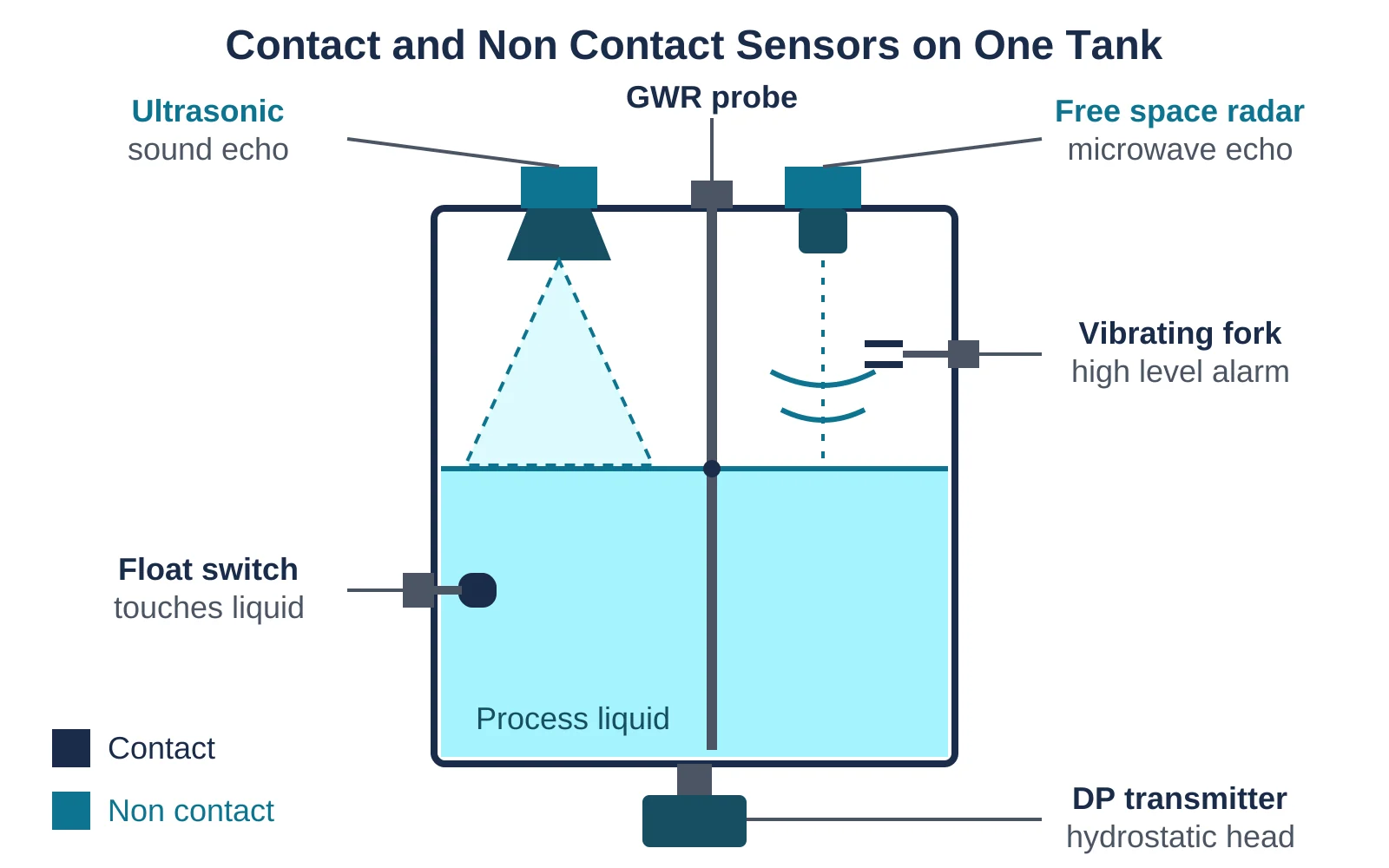
Guided wave radar confuses many students because it uses radar and still counts as a contact sensor. Its rod or cable sits in the liquid, and Wikipedia notes it shares the mechanical limits of an RF capacitance probe.
If a sensor has a wetted part that you must clean or replace during a shutdown, treat it as a contact sensor in your maintenance plan.
What Are Non Contact Level Sensors?
Non contact level sensors measure from above or outside the vessel without touching the material, and the main types are ultrasonic, free space radar, laser and nuclear gamma gauges. They suit sticky, corrosive or hygienic products where a probe would coat or contaminate the batch.
For the details of each one, see our posts on ultrasonic level transmitter working, the radar type level transmitter and laser level transmitters. Nuclear gauges are explained in types of nuclear level measurement, and in India their sources fall under AERB licensing.
How Does a Non Contact Ultrasonic Sensor Calculate Level?
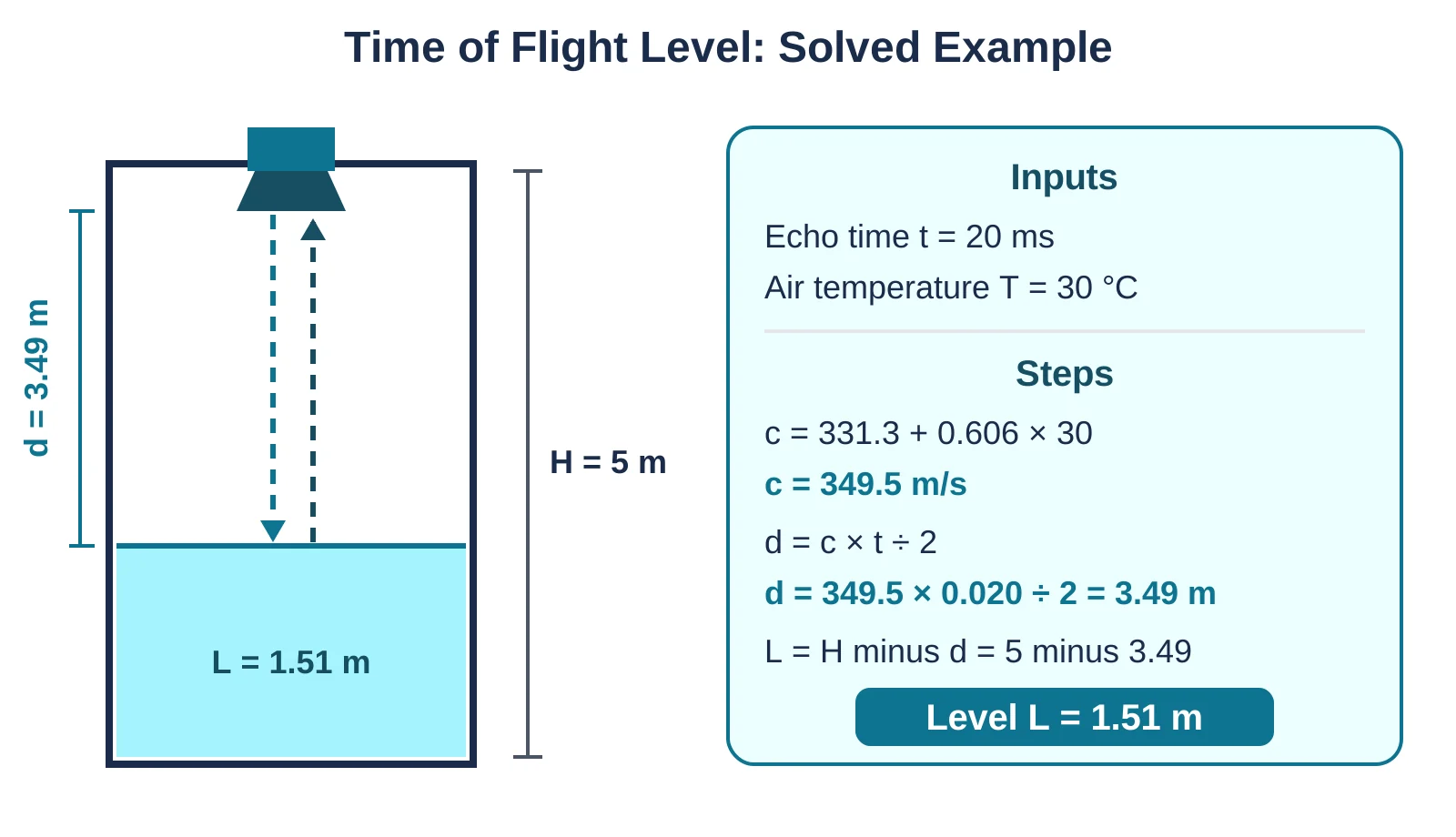
An ultrasonic sensor measures the round trip time of a sound pulse, halves it to get the distance to the surface, and subtracts that distance from the tank height to get level. Sound speed changes with air temperature, so good transmitters correct it with a built in temperature sensor.
Distance: d = c × t ÷ 2
Level: L = H minus d
Solved example: H = 5 m, t = 20 ms, T = 30 °C
c = 331.3 + 0.606 × 30 = 349.5 m/s
d = 349.5 × 0.020 ÷ 2 = 3.49 m
L = 5 minus 3.49 = 1.51 m
Skip the temperature correction and the error shows up quickly. If the same transmitter assumed 0 °C air, it would use 331.3 m/s, calculate 3.31 m distance and report 1.69 m, which is 0.18 m wrong on a 5 m tank.
The calculator below uses the same formula with the sensor height, echo time and air temperature.
Keep the level below the blanking zone, which Wikipedia puts at about 150 mm to 1 m depending on the transducer. You can cross check your result with the ultrasonic level calculator on Zenta during commissioning.
Contact vs Non Contact Level Sensor: Which One Should You Choose?
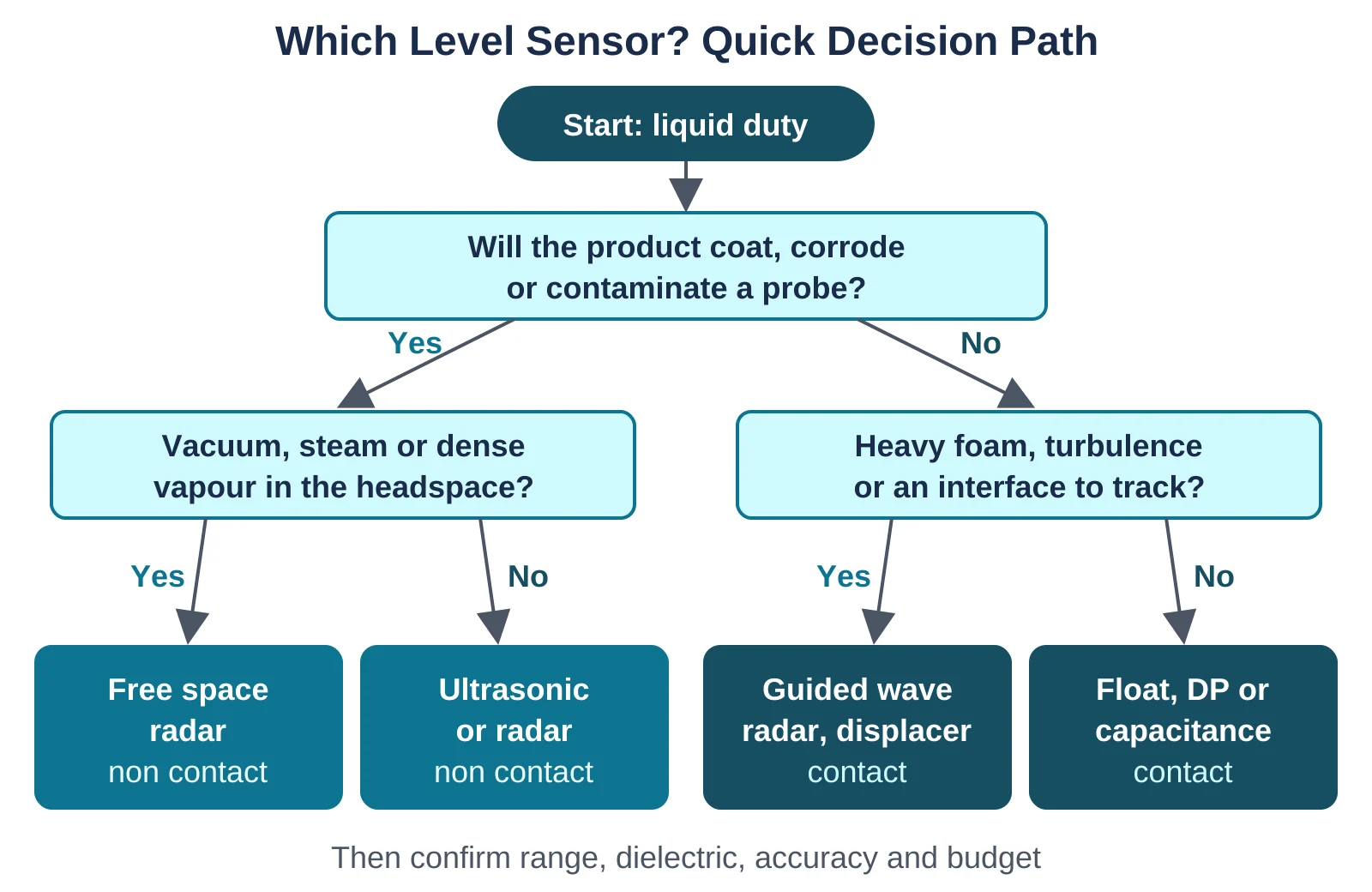
Choose a non contact sensor when the product would coat, corrode or contaminate a probe, and choose a contact sensor when you need low cost, interface measurement or reliable readings through heavy foam and vapour.
- No wetted parts, so no coating, wear or corrosion of a probe
- Small top nozzle, APG notes many fit a 3 inch NPT fitting or less
- No contamination risk for food and pharma
- Radar works through vapour, high pressure and vacuum
- Foam absorbs ultrasonic pulses and can hide the radar echo
- Ultrasonic cannot work in vacuum because it needs an atmosphere
- Blanking zone and false echoes from nozzles and agitators
- Higher price than a float switch or simple DP transmitter
Endress+Hauser explains that guided wave radar handles foam and condensation better than free space radar, while capacitance needs a metal vessel or a ground reference rod. Our comparison of non contact vs guided wave radar goes deeper into that particular choice.
How to Select a Level Sensor for Your Process?
Start with the process conditions, then decide between contact and non contact, and only then compare range, accuracy and price.
Our full guide on how to select the right level sensor adds solids, interfaces and safety duty, and the level switch vs level transmitter article helps you decide whether a simple alarm is enough.
Endress+Hauser points out that radar reflection strength rises with the dielectric constant of the product, so oils and solvents return a weaker echo than water.
Once the level reading is right, the tank volume from level calculator turns it into litres for inventory reports. Low dielectric products need extra care, and our post on dielectric constant in level measurement shows how to check the echo margin.
What Goes Wrong With Level Sensors in the Field?
Most level faults start in the process rather than the electronics: contact sensors suffer from coating and wear, and non contact sensors from foam, false echoes and condensation.
| Symptom | Likely sensor and cause | First check |
|---|---|---|
| Float stuck at one value | Float switch, sludge or crystal build up | Clean the float and stem, check the guide |
| Slow drift upward | Capacitance, coating on the probe | Clean the probe, recheck empty and full |
| Reading jumps to full | Ultrasonic or radar, echo from a nozzle or ladder | Run a false echo map with an empty tank |
| Signal lost when foaming | Ultrasonic, foam absorbs the pulse | Move to guided wave radar or reduce foam |
| Wrong level after recipe change | DP, liquid density changed | Update density in the transmitter range |
Before you blame the transmitter, open the echo curve or the live raw value. It often shows a false echo, a weak echo or a blanking zone problem that a setting can fix.
- Mount ultrasonic and radar away from the fill stream and agitator blades
- Keep the maximum level below the blanking zone of the sensor
- Ground capacitance probes to the vessel or use a reference rod
- Record liquid density for every DP level application
- Run a false echo map on radar while the tank is nearly empty
For deeper fault finding, use our level transmitter troubleshooting guide and the article on radar false echo handling. Foam is covered separately in why foam affects level sensors, and slurry duty in level measurement in slurries.
Contact vs Non Contact Level Sensor FAQ
A contact sensor has a float, probe or diaphragm in the process, while a non contact sensor measures from above or outside with sound, microwaves, light or gamma rays.
Float and DP are typical contact types, and ultrasonic and free space radar are typical non contact types.
Float, displacer, DP, capacitance, conductive, vibrating fork, magnetostrictive and guided wave radar are all contact type level sensors, because a part of each one touches the process.
If an option list shows ultrasonic, radar, laser and float, the float is the correct contact type answer every time.
Guided wave radar is a contact sensor, because its microwave pulse travels along a rod or cable that sits in the liquid.
Endress+Hauser notes that it works at about 1.2 GHz and handles foam and condensation better than free space radar.
First find sound speed as 331.3 plus 0.606 times air temperature, then distance equals speed times echo time divided by 2.
Level equals tank height minus distance, so 5 m with a 20 ms echo at 30 °C gives 1.51 m.
Sound needs a gas to travel through, so there is no echo in vacuum, and foam absorbs the pulse before it returns.
In those tanks, free space radar handles vacuum while guided wave radar copes better with foam, according to Endress+Hauser.
A non contact radar is usually best, because nothing touches the product, so there is no coating, corrosion or hygiene risk.
APG also points out that non contact sensors avoid contaminating food and beverage batches, which a submerged probe can do.
A contact float switch or a DP transmitter is normally cheaper than radar for a clean water or storage tank.
Non contact costs more upfront, but it can pay back on dirty duty where a probe would need frequent cleaning.
Related Articles
- Radar Level Selection: Non Contact vs Guided Wave
- How to Select the Right Level Sensor
- Types of Level Transmitters
- Guided Wave Radar vs Non Contact Radar
- Level Switch vs Level Transmitter
External References
- Endress+Hauser: Basics of Continuous Level Measurement (PDF)
- APG: When Should You Consider a Non Contact Sensor?
- Wikipedia: Level sensor
What We Learn Today
- Float, displacer, DP, capacitance, conductive, vibrating fork, magnetostrictive and guided wave radar all touch the process, so they are contact type sensors.
- Every contact vs non contact level sensor decision starts with process conditions such as coating, corrosion, vacuum, vapour and foam, before range or price.
- Ultrasonic level equals tank height minus half the echo time multiplied by sound speed, and sound speed must be corrected for air temperature.