
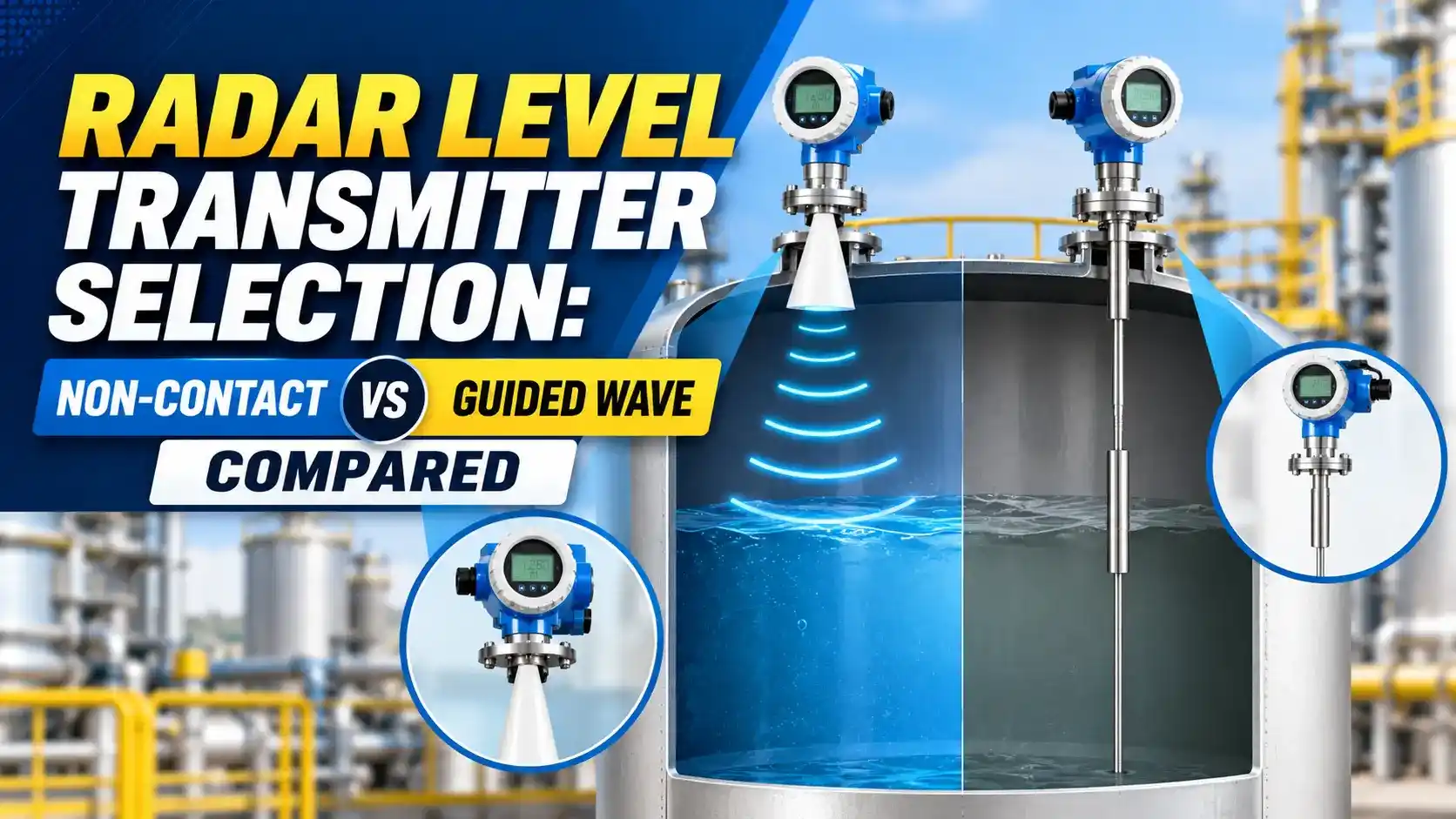
Selecting the right radar level transmitter means choosing between two different signal propagation methods. Non-contact radar sends a microwave beam through air. Guided wave radar (GWR) conducts the pulse along a probe immersed in the liquid.
Both measure level by time-of-flight, but each suits different process conditions.
This guide covers how each type works, the seven selection factors that determine which is correct for your vessel, and a practical selection checker. Output is 4-20 mA via a HART-capable transmitter; see the smart transmitter guide for configuration details.
A radar level transmitter measures level by timing a microwave pulse from transmission to return. Non-contact types suit clean liquids and open tank geometry. Guided wave radar excels in low dielectric liquids and foam.
Radar Level Transmitter: Time-of-Flight Principle
Both non-contact and guided wave radar level transmitters measure level using the same underlying physics: a microwave pulse is transmitted, reflects from the process surface, and returns to the receiver. The elapsed time divided by two gives the distance to the surface.
Three process properties determine which type is correct: the dielectric constant of the liquid, the presence of foam, vapour or turbulence, and the vessel geometry and nozzle constraints. Click any term to expand.
Non-Contact vs Guided Wave Radar Level Transmitter: Full Comparison
| Parameter | Non-Contact Radar | Guided Wave Radar (GWR) |
|---|---|---|
| Signal method | FMCW or pulsed radar through air (free space) | TDR pulse conducted along a probe (rod, cable, or coaxial) |
| Contact with process | No physical contact with the liquid | Probe is immersed in the liquid |
| Minimum dielectric (εr) | 1.6 to 2.0 depending on frequency and antenna size | 1.4 (suitable for light hydrocarbons and LPG) |
| Effect of foam | Foam can attenuate or scatter the beam | Not affected: pulse travels along the probe through foam |
| Effect of vapour or condensation | Dense vapour can reduce signal strength | Not affected by vapour space conditions |
| Minimum nozzle size | Typically 50 mm or larger | 25 mm and above |
| Blind zone (near range) | 150 to 300 mm below the antenna face | Minimal: a few centimetres at the top of the probe |
| Maximum range | Up to 70 m (liquid), 100 m (solids) | Up to 75 m (cable probe) |
| Suitable for solids / bulk material | Yes: wide-beam antennas for silos and hoppers | Limited: probes can break or bend in heavy solids |
| Interface level measurement | Not suitable (cannot distinguish two liquid layers) | Yes: coaxial probe detects upper and lower liquid interface |
| Maintenance | Antenna cleaning only if coated | Probe must be inspected for coating, corrosion, or bending |
| Typical applications | Open tanks, large vessels, silos, sumps, water treatment | Sealed pressure vessels, low-dielectric liquids, foam, bypass chambers, interface |
7 Factors for Radar Level Transmitter Selection
1. Dielectric Constant
If the liquid εr is below 2.0, choose guided wave radar. For water, aqueous solutions, and most acids above εr 2.0, non-contact radar is reliable. See the level measurement basics guide and the HART protocol guide for dielectric constant reference values by fluid type.
2. Foam or Agitation
Heavy foam blankets the surface and absorbs the radar beam in a non-contact type. Guided wave radar propagates through foam along the probe. For fermenters, bioreactors, distillation sumps, and pump tanks with surface agitation, guided wave radar is preferred.
3. Process Pressure and Temperature
Both types handle high pressure and high temperature. GWR probes must be specified in compatible materials (316 SS, Hastelloy C, PTFE-coated).
Non-contact radar antenna materials and flange ratings must be checked for vapour service above 200°C.
4. Vessel Geometry
Non-contact radar requires a clear beam path. Agitators, coils, and internal pipes cause false echoes.
GWR in a bypass chamber eliminates all internal interference. For vessels under 300 mm diameter, only a coaxial GWR probe is practical.
5. Interface Level
For interface measurement (oil over water, solvent over brine), only GWR with a coaxial probe can distinguish the two layers. Non-contact radar sees only the upper surface.
See the DP transmitter level guide for the DP-based interface alternative.
6. Solids and Slurries
Non-contact radar with a wide-beam flat face antenna is standard for silos and hoppers. GWR probes cannot be used in bulk solids as the material buries and stresses the probe.
For slurries, probe coating is a concern for GWR, and non-contact radar is preferred.
7. Frequency Band
Modern non-contact radar level transmitters operate at 26 GHz or 80 GHz. The 80 GHz units have a narrower beam angle (3° versus 10°), smaller antenna, and better low-dielectric performance. Prefer 80 GHz for new liquid level installations.
Probe Type for GWR
Single rod probes suit clean low-viscosity liquids. Cable probes suit tall vessels up to 75 m. Coaxial probes handle low dielectric (εr below 2.0) and interface applications.
Specify probe material, diameter, and end fitting for the process.
Radar Level Transmitter Selection Checker
Watch: Guided Wave Radar vs Non-Contact Radar Level Transmitter
Radar Level Questions
External References
- Radar Level Transmitter Product Catalog and Selection Guide | VEGA
- Radar Level Measurement Solutions | Emerson Rosemount
What We Learn Today
- Both types measure level by time-of-flight. Non-contact sends a beam through air; guided wave radar (GWR) conducts the pulse along an immersed probe.
- Minimum dielectric: non-contact radar needs εr above 1.6 to 2.0. GWR works from εr 1.4, covering light hydrocarbons and LPG.
- GWR is immune to foam, vapour, and vapour space condensation. Non-contact radar can be affected by dense foam or heavy vapour loads.
- Interface measurement between two liquid layers requires a guided wave radar with a coaxial probe. Non-contact radar cannot detect sub-surface interfaces.
- Bulk solids in silos and hoppers require non-contact radar with a wide-beam flat-face antenna. Probes cannot be used in bulk solid applications.
- 80 GHz is the preferred frequency for new liquid level installations: narrower beam, smaller nozzle, better low-dielectric performance.