
A narrow infrared beam and a fast timer give non contact level readings where radar and ultrasonic struggle.
A laser level transmitter fires short infrared pulses at the material surface and times the reflection to calculate distance. Its very narrow beam lets it aim past ladders, beams and wall buildup inside tall silos.
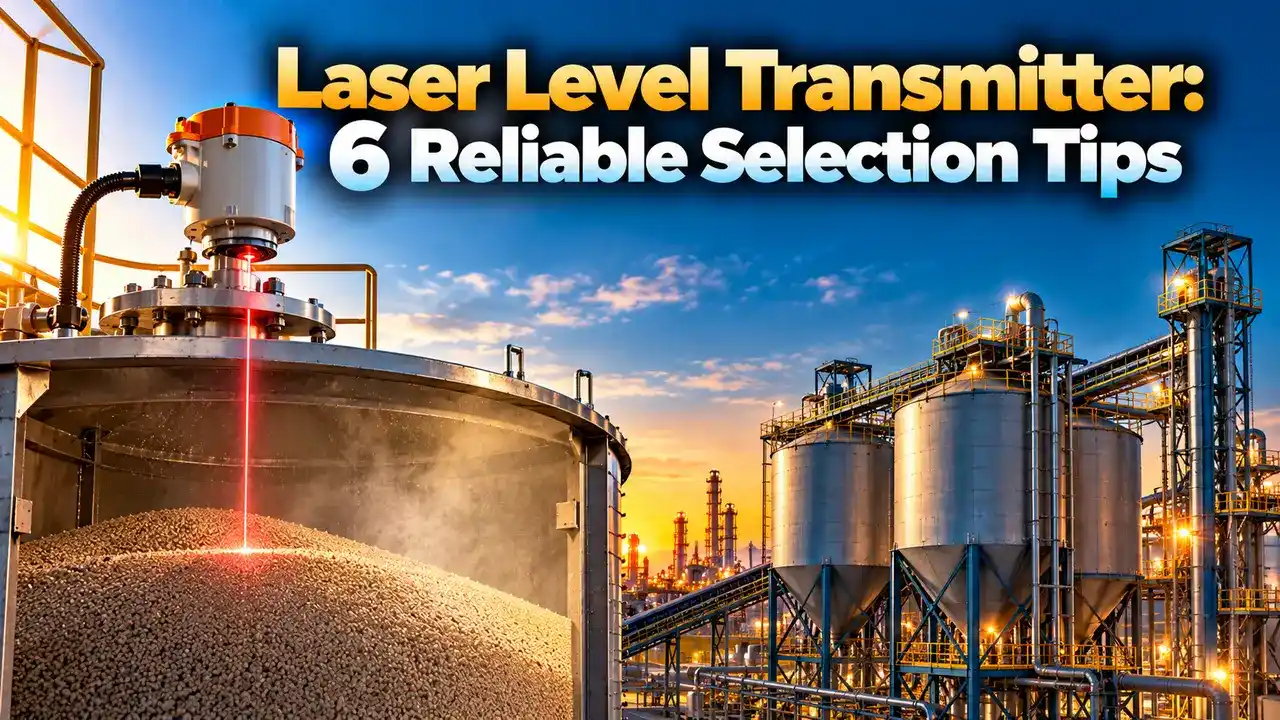
What Is a Laser Level Transmitter?
A laser level transmitter is a non contact instrument that measures the distance to a liquid or solid surface using pulses of infrared light. It then converts that distance into level, volume or percent fill, just like other types of level transmitters.
Most industrial units use an eye safe Class 1 laser, so no special protective equipment is needed during normal operation. The electronics, optics and display sit in one compact housing mounted on the vessel roof.
.jpg "Laser level transmitter for non contact solids and liquid level")
Suppliers quote ranges up to about 30 m on liquids and up to about 100 m on solids, with some models advertising 200 m. That long reach suits tall silos, deep sumps and open pits.
The beam divergence is typically below 0.3 degrees. That is far narrower than radar or ultrasonic sensors, which is the key reason engineers choose laser.
Time of Flight Measurement Principle
Light travels at about 300,000 km per second, so the round trip to a surface 15 m away takes only 100 nanoseconds. Fast timing electronics and averaging of many pulses give stable readings.
Because the speed of light hardly changes with gas composition, temperature or pressure, the reading does not need the compensation that ultrasonic sensors require. This makes laser attractive for hot or vapour filled spaces where sound speed changes.
The receiver needs only a small part of the light to return. That is why dull, dark or rough solids surfaces can still be measured at long range.
Laser Distance and Level Formula
Level L = H minus d
c = speed of light, about 300,000,000 m/s
t = round trip time of the pulse
H = distance from sensor to vessel bottom
Worked example:
t = 100 ns = 0.0000001 s
d = (300,000,000 × 0.0000001) ÷ 2 = 15 m
H = 20 m
L = 20 minus 15 = 5 m, which is 25 percent full
The same level calculation is used by every non contact sensor. Our guide on tank volume from level measurement shows how to turn that level into volume for cylinders and cones.
The division by two accounts for the pulse going down and coming back. Forgetting it is a classic mistake when engineers first work with time of flight data.
6 Reliable Selection Tips for a Laser Level Transmitter
Tip 4 deserves attention because clear water or light oils can let the beam pass through. For such cases, a radar level transmitter is usually the safer choice.
Tip 5 links directly to your hazardous area classification. Many laser models carry Zone 0 and Zone 1 certification for dusty or flammable atmospheres.
Laser vs Radar vs Ultrasonic Level Measurement
| Feature | Laser | Radar | Ultrasonic |
|---|---|---|---|
| Beam angle | Below 0.3 degree | About 3 to 10 degrees | About 5 to 12 degrees |
| Range on solids | Up to about 100 m | Up to about 120 m | Usually below 60 m |
| Dust effect | Needs care | Little effect | Moderate |
| Vapour and steam | Can scatter beam | Little effect | Affects sound speed |
| Echo mapping | Rarely needed | Often needed | Often needed |
| Cost | Medium | Medium to high | Low |
For a full discussion of radar options, see our non contact vs guided wave radar guide. For low cost water tanks, the ultrasonic level transmitter is still hard to beat.
Laser wins when the vessel is narrow, tall and full of obstructions. Radar wins when dense dust, steam or foam dominate the vapour space.
Types of Laser Level Instruments
Measures long distances with short infrared pulses.
Compare the phase of a modulated beam for high resolution.
Scan the whole surface to estimate volume, as in 3D LiDAR sensors.
Track distance to moving equipment such as cranes.
Phase shift devices give millimetre resolution but usually over shorter distances. Pulsed units dominate in process level work because of their range.
Where Laser Level Sensors Are Used
Low dielectric solids such as plastic pellets reflect radar poorly, but they reflect light well. This makes laser a strong option in polymer plants.
For general guidance across all these choices, our article on how to select the right level sensor compares every major technology.
Installation and Maintenance Checklist
Mount the sensor on a rigid bracket so vibration does not move the beam spot. Use the built in alignment aid or a visible pointer to aim at the desired point.
Fit a dust tube or purge air connection on dusty vessels to keep the lens clean. For hot vessels, a cooling jacket keeps the electronics within their rated temperature.
Clean the window during scheduled shutdowns and check the signal strength value in the diagnostics. A falling signal strength is an early warning of lens fouling.
Laser Level Calculator
Enter the sensor mounting height carefully, measured from the reference point of the instrument. A wrong H value shifts every level reading by the same amount.
- Very narrow beam avoids internal obstructions.
- Long range on solids.
- No echo mapping in most vessels.
- Unaffected by gas composition and temperature.
- Heavy dust, steam or fog can block the beam.
- Clear liquids may let the beam pass through.
- Lens needs periodic cleaning.
- Careful aiming is required.
LLT100 Operating Instruction PDF
Watch the Laser Level Transmitter in Action
Common Questions on Laser Level Measurement
Related Articles
- Types of Level Transmitters
- Radar Type Level Transmitter
- Ultrasonic Level Transmitter Working
- Level Measurement in Slurries
- Why Foam Affects Level Sensors
External References
- Industrial Laser Level Measurement of Solids and Liquids, AZoM
- LLT100 Laser Level Transmitter, ABB
- Laser Level Transmitter Range, Hawk Measurement
- Laser Level Sensors for Bulk Solids, BinMaster
- Time of Flight, Wikipedia
What We Learn Today
- This instrument measures distance from the travel time of infrared pulses.
- Its narrow beam suits tall, cluttered silos better than radar or ultrasonic.
- Dust, vapour and clear liquids need careful planning before selection.