A level switch tells you that liquid has reached one point, while a level transmitter tells you where the level is at every moment. This guide compares the two side by side and shows when a plant needs one, the other or both together.
Switch or transmitter is one of the first choices on any tank or vessel datasheet. We compare outputs, safety use, cost and typical duties, then show how to cross check a switch against a transmitter with a solved example and calculator.
What Is the Difference in Level Switch vs Level Transmitter?
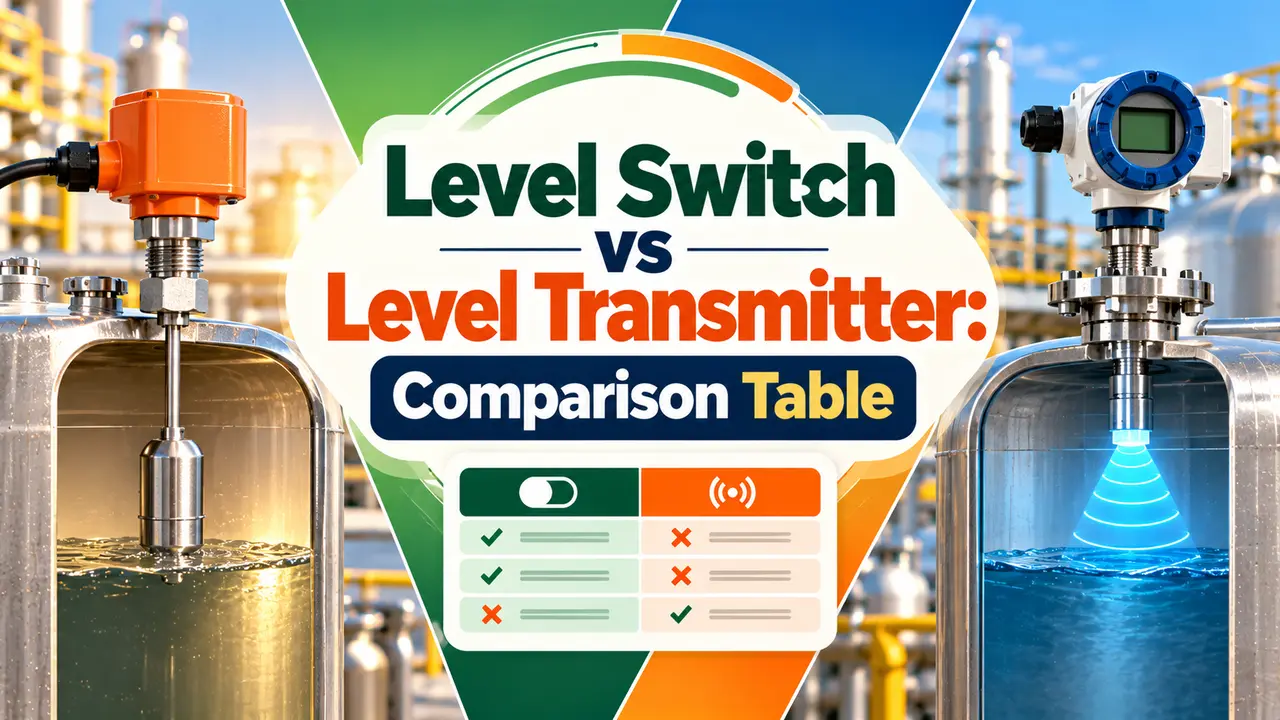
In the level switch vs level transmitter choice, a level switch gives a single on or off signal when liquid reaches one fixed point, while a level transmitter gives a continuous signal across the full range. Use a switch for alarms, trips and pump protection, and a transmitter wherever you must know or control the actual level.
| Feature | Level Switch | Level Transmitter |
|---|---|---|
| Measurement | Point level, one fixed height | Continuous, whole range |
| Output | Relay or solid state contact, NAMUR | 4 to 20 mA, HART, fieldbus |
| Information | Wet or dry, high or low | Actual level, volume, trend |
| Typical duty | High high trip, dry run, pump start or stop | Inventory, PID control, VFD pumps |
| Safety use | Independent alarm or trip layer | Trip with diagnostics, or both |
| Cost | Usually lower | Usually higher |
| Setup | Mount at the trip height | Configure LRV, URV and damping |
| Testing | Wet the probe or simulate | Loop check, level simulation |
Our guide on level switch selection covers the switch types in depth, and types of level transmitters covers the continuous side. Read this page first to decide which family you need, then go to those pages for the exact technology.

Float switches like these are the classic point level device. WIKA describes a level switch as one that switches as soon as a level is exceeded or dropped below.
How a Level Switch Works
A level switch watches one height in the vessel and changes state when the liquid covers or uncovers its sensing element. Whitman Controls explains that these devices use electrical contacts that open or close once the media reaches the sensor position.
A buoyant float moves a reed contact or microswitch as level rises or falls.
A tuning fork changes frequency when covered by liquid.
Current flows between probes when a conductive liquid touches them.
Capacitance changes as liquid or solid covers the probe.
For safety duties, the ISA InTech article by Lydia Miller says vibrating fork switches are more suitable because they have no mechanical moving parts. You can read how the fork senses liquid in our page on the vibrating fork level switch, and the float option in float level switch working principle.
How a Level Transmitter Works
A level transmitter measures the level continuously, using pressure, radar, guided wave, ultrasonic, displacer or magnetostrictive principles. It scales the result to a 4 to 20 mA signal between its LRV and URV, for example by measuring hydrostatic head as in DP transmitter level measurement.
Non contact and contact radar are now common on storage tanks, as covered in guided wave radar level transmitters. The ISA InTech article notes that continuous measurement tracks the liquid level in real time, which is what any control or inventory job needs.
A smart transmitter can report its own failure with the signal itself, driving the loop to a fault current outside the normal 4 to 20 mA band. A simple contact switch has no such built in way to say that it is broken.
Output Signals: Contact vs 4 to 20 mA and HART
A switch output is binary, so the control system sees only open or closed, often wired fail safe so that a broken wire looks like an alarm. Our page on de energize to trip vs energize to trip explains why most trip contacts sit energised in normal service.
A transmitter sends an analogue current, and with HART it also carries diagnostics and configuration on the same pair of wires. That extra data is a major reason the level switch vs level transmitter debate has shifted toward transmitters on new projects.
Level Switch vs Level Transmitter in SIL and Overfill Protection
The ISA InTech article states that both continuous and point measurements can be used in safety instrumented functions to prevent overfill. The choice depends on the SIL target, the proof test plan and how much independence the hazard study demands.
Emerson describes tank systems that support everything from an independent additional level switch up to SIL 2 or SIL 3 overfill prevention, and adds that proof testing can be done automatically from the control room. Our article on tank overfill protection to API 2350 shows how these layers are arranged.
For a high high trip, install the switch or trip transmitter on its own nozzle, separate from the control transmitter. A shared nozzle or impulse line can blind both devices with one plug or one deposit.
When to Use Both: Switch Point Cross Check
Whitman Controls describes point level switches as a redundant safety hedge alongside a continuous transmitter. When both are fitted, compare them every time the switch trips, because a growing gap warns that one of them is drifting.
Expected mA = 4 + 16 × (1800 minus 0) ÷ 2000
Expected = 18.40 mA at the switch point
Transmitter reads 18.6 mA when the switch trips
Level = (18.6 minus 4) ÷ 16 × 2000 = 1825 mm
Deviation = 25 mm = 1.25 % of span
A deviation of 25 mm on a 2000 mm span is small and usually fine. If the next trip shows the transmitter at 17.8 mA, the level would be 1725 mm and the gap would be minus 75 mm, a signal to check the density setting or the switch itself.
Switch Point Cross Check Calculator
Enter the heights from the same datum as the transmitter range. The calculator prints a negative gap as the word minus so that it reads clearly on a logbook copy.
To set the transmitter range used above, try our DP level range calculator. The same mA arithmetic is in the 4 to 20 mA signal conversion calculator.
Typical Uses of Each Device
WIKA lists dry run protection for pumps among the main uses of level switches. Whitman Controls notes that continuous measurement is necessary when modulating pump speed through variable frequency drives.
Level Switch vs Level Transmitter Selection Checklist
- Duty is clearly stated as alarm, trip, control or inventory.
- Process conditions such as foam, coating and density are on the datasheet.
- SIL target and independence from the control loop are confirmed.
- Output type matches the system input card, contact, NAMUR or 4 to 20 mA.
- Mounting height and nozzle location agreed with the mechanical team.
- Proof test method agreed before purchase.
Foam is a common trap in the level switch vs level transmitter decision, since it fools some switches and some transmitters in different ways, as covered in why foam affects level sensors. For a broader method, see how to select the right level sensor.
Cost, Maintenance and Testing
Whitman Controls says point level sensing is often the more economical choice for simple alarm states or idle protection logic. The transmitter costs more, but it gives far more information per cable and per nozzle.
- Low purchase cost and simple wiring.
- Independent of range settings and density for many types.
- Easy to understand for operators.
- Good as a separate safety layer.
- No level value or trend.
- A stuck switch may hide its own failure.
- Testing often needs the level raised to the trip point.
- One device per alarm point.
Common Mistakes and Field Troubleshooting
| Symptom | Likely Cause | Field Fix |
|---|---|---|
| Switch trips but transmitter shows normal | Wrong density, plugged leg or coated sensor | Check density setting and clean or flush |
| Transmitter at high high, switch silent | Stuck float or coated fork | Proof test switch, clean or replace |
| Switch chatters | Turbulence or waves at trip point | Add delay or still pipe, relocate |
| False high alarm in foam | Foam covers switch probe | Choose foam tolerant technology |
| Pump starts and stops too often | Switch points too close | Widen gap or use transmitter with deadband |
For deeper fault finding on the continuous side, follow our level transmitter troubleshooting guide. The same switch or transmitter logic also appears for pressure duty in pressure switch vs pressure transmitter.
The same comparison exists for every process variable. Temperature and pressure switches face the same trade off of simple contact versus continuous signal, as our page on temperature switches and transmitters shows.
Mark the switch trip height on the tank strapping table and on the transmitter range sheet. During commissioning, record the transmitter mA at the moment of the first trip, so later checks have a baseline.
Emerson Overfill Prevention Flyer PDF
Video: Level Switches and Level Transmitters
Level Switch vs Level Transmitter FAQ
A level switch detects liquid at one fixed point and gives an on or off output. A level transmitter measures the level across the whole range and sends a continuous signal.
Switches suit alarms, trips and pump protection. Transmitters suit control, inventory and any job where you need to know the actual level at every moment of the batch or shift.
Yes, a transmitter with set points in the control system or a trip amplifier can act as a switch. Many plants use this for high and low alarms on the same tank.
For safety trips, the transmitter must be independent of the control loop and suitable for the SIL target. Its proof test and diagnostics must also be planned in the safety lifecycle.
Choose a switch when you only need to know that level has reached one point, such as a sump alarm or pump dry run protection. It is usually the lower cost and simpler option.
A switch is also a good independent backup to a transmitter on a critical tank. That gives a second, different way to catch an overfill.
The transmitter controls the level and gives trends, while the switch provides an independent alarm or trip at a fixed height. Whitman Controls calls this pairing a redundant safety hedge.
Comparing the two at every trip also reveals drift early. A growing gap points to a density error, a coated sensor or a stuck switch.
Both can work, and the ISA InTech article says both point and continuous devices can be used in safety instrumented functions. The choice depends on the SIL target, diagnostics and proof test needs.
Vibrating fork switches are often preferred for point trips because they have no moving parts. Transmitters give extra diagnostics and allow testing without raising the level.
Most level switches give a relay or solid state contact that opens or closes at the set point. Some give a NAMUR or a current step signal for intrinsically safe loops.
A level transmitter instead gives a continuous signal, usually 4 to 20 mA with HART data on top. That is the key output difference in any level switch vs level transmitter comparison.
Related Articles
- Level Switch Selection: Float, Vibrating Fork, Conductivity and Capacitance
- Types of Level Transmitters
- Vibrating Fork Level Switch Working
- Tank Overfill Protection API 2350
- Pressure Switch vs Pressure Transmitter
External References
- Overfill Prevention Solutions for Bulk Liquid Storage, Emerson
- How to Measure Liquid Level in Vessels, ISA InTech
- Level Sensor, Wikipedia
What We Learn Today
- In the level switch vs level transmitter choice, a switch detects one fixed point while a transmitter measures the level continuously across its full range.
- Switches suit alarms, trips and pump protection at low cost, while transmitters suit control, inventory and VFD pumps with diagnostics over HART.
- Many critical tanks use both, and comparing the transmitter reading at every switch trip is a simple way to catch drift early.