
Mining tailings. Cement slurry. Wastewater sludge. Drilling mud. Every one of these fights back against a level sensor differently than a clean liquid ever would.
Ok, let me explain it properly. A slurry isn't just a "thick liquid." It's a liquid carrying solid particles that settle, abrade, and change the fluid's density on their own schedule.
Level measurement in slurries is difficult because suspended solids settle unevenly, abrade wetted sensor parts, and continuously change the mixture's density, so technologies that assume a stable, uniform liquid, or that need direct wetted contact, often struggle where nucleonic, well-protected hydrostatic, or properly rated radar approaches succeed.
Level Measurement in Slurries: Why Settling Solids Change Everything
Level measurement in slurries starts with a question that clean-liquid applications never have to ask: how much solid is actually suspended in this liquid right now?
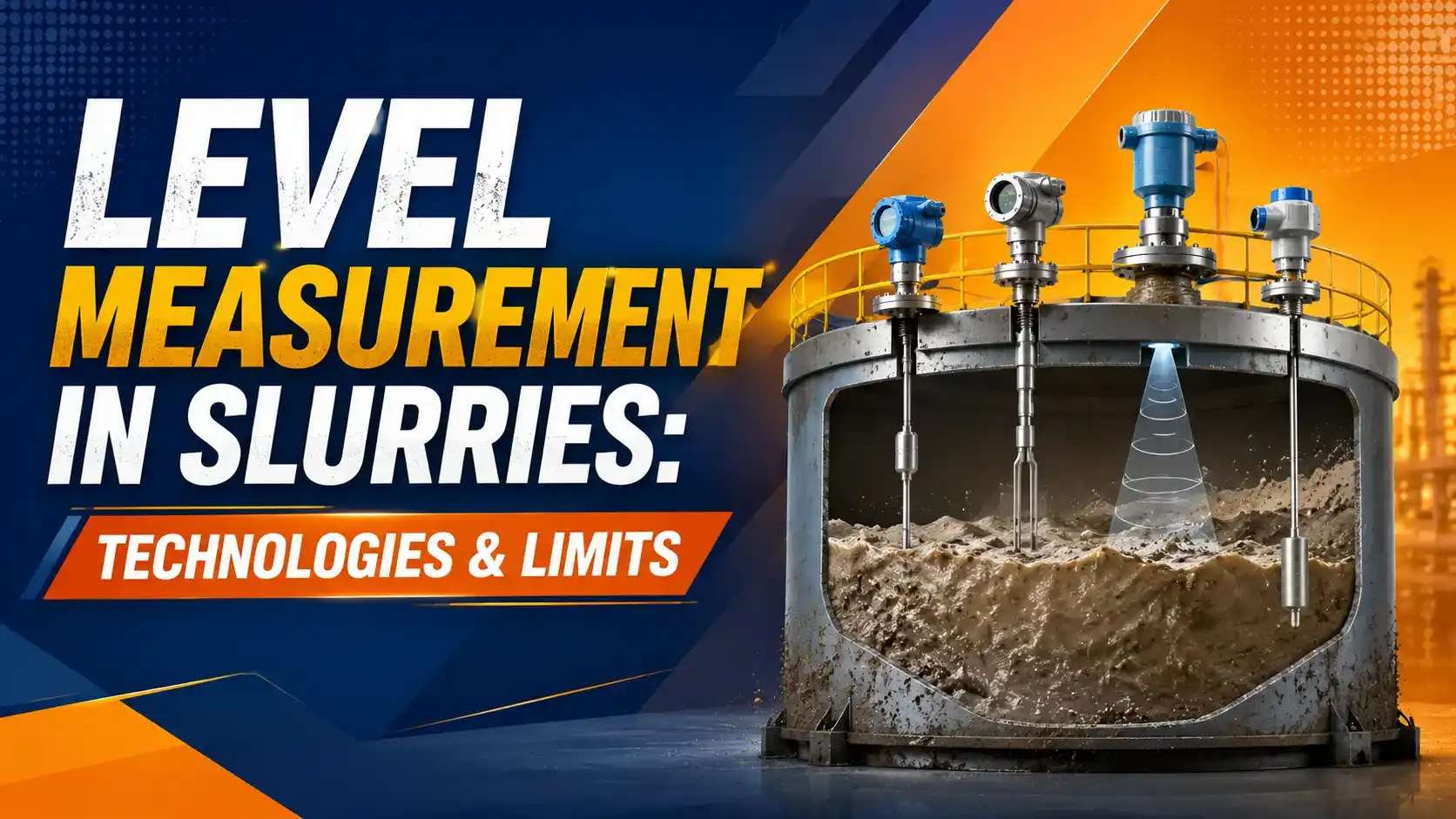
That solids concentration doesn't stay fixed. It shifts with mixing intensity, flow rate, and how long the slurry has been sitting still.
Have you got it so far? Good, because this single fact, that slurry properties keep moving, is why a technology that works perfectly in high viscosity liquid level measurement can still fail in a slurry with a similar apparent thickness.
Six Ways Slurries Trip Up Level Sensors
Solids Settling and Stratification
When flow slows or stops, heavier particles sink. The vessel ends up with distinct layers, clear liquid, mixed slurry, and dense settled solids, each with a different density.
Abrasive Wear on Wetted Parts
Mineral particles in mining and industrial slurries are often hard enough to erode probes, floats, and diaphragms over time, especially at high flow velocity.
Probe and Face Buildup
Solids settle out of suspension and cake onto anything they contact. A coated probe or transducer face behaves the same way it does in viscous service, only faster.
Continuously Changing Density
Slurry density depends directly on percent solids by weight. A hydrostatic level reading is only as accurate as the density value used to convert pressure into height.
Turbulent, Uneven Surface
Agitated or actively pumped slurries rarely present a flat, calm surface. Waves, froth, and splashing all interfere with non-contact ranging technologies.
Signal Absorption and Scattering
Dense suspended solids absorb and scatter ultrasonic and some radar signals far more than a clean liquid surface would, weakening the return echo.
Technologies for Slurry Level Measurement: Advantages and Limitations
No single technology is right for every slurry. The comparison below reflects how each one typically performs once real solids, abrasion, and settling enter the picture.
| Technology | Advantage | Limitation |
|---|---|---|
| Nucleonic (gamma) level | No contact at all, completely unaffected by abrasion, coating, or settling | Higher cost, radiation source handling and licensing required |
| Hydrostatic (DP) pressure | Simple, well understood, works if density is actively tracked | Accuracy depends entirely on correct slurry density compensation |
| Guided wave radar | Reliable if the probe uses an abrasion and coating-resistant sleeve | Probe wear and buildup are real risks in abrasive, sticky slurries |
| Non-contact radar (FMCW) | No wetted parts, no abrasion risk at all | Turbulent or foamy surfaces can weaken or scatter the return signal |
| Ultrasonic (non-contact) | Simple and inexpensive for mild slurries | Heavy solids loading and foam can attenuate the echo badly |
| Float or displacer | Low cost for simple point-level detection | Abrasion and clogging make it unreliable for continuous measurement |
Cause 1 in Detail: How Settling Distorts a Level Reading
Ok, let's slow down on this one, because it explains a lot of confusing field behavior.
A settled slurry tank often has three distinct zones. Understanding this layering is the key to picking the right measurement point and technology.
A non-contact sensor only sees the top surface. A hydrostatic sensor at the bottom sees the combined weight of everything above it, which is why density compensation matters so much here.
Try It: Slurry Density and Hydrostatic Level Calculator
Enter the percent solids by weight along with the solids and liquid specific gravities to calculate the actual slurry density, then convert a DP reading into a corrected level.
Let Us Take an Example
A mineral processing tank holds a slurry of crushed ore in water.
Lab analysis shows 35% solids by weight, with a solids specific gravity of 2.7 and water as the liquid phase. A DP transmitter at the tank base reads 50 kPa.
Cw = 35%
SGs = 2.7
SGl = 1.0
P = 50 kPa
Step 1: Slurry specific gravity
SGslurry = 100 ÷ (35÷2.7 + 65÷1.0)
SGslurry = 100 ÷ (12.96 + 65)
SGslurry = 100 ÷ 77.96
SGslurry = 1.2827
Step 2: Slurry density
ρslurry = 1.2827 × 1000
ρslurry = 1282.7 kg/m³
Step 3: Level from DP reading
h = (50 × 1000) ÷ (1282.7 × 9.81)
h = 50000 ÷ 12583.3
h ≈ 3.974 m
Have you got it? Good. If a technician had assumed plain water density instead, the calculated level would come out around 5.097 m, over a meter higher than the true 3.974 m.
Ok, let me explain why that gap is so large. Water is roughly 22% less dense than this slurry, so using it as the reference badly overstates the calculated height for the same pressure reading.
This is exactly why slurry density needs to be verified regularly, not assumed once and left alone.
Cause 2 in Detail: Abrasion and Why Nucleonic Gauges Are Often the Answer
Abrasive slurries, especially in mining and mineral processing, can wear through a wetted probe surprisingly fast, a challenge covered in Icon Process Controls' guide to corrosion-resistant mining instrumentation.
According to Emerson's guide to level measurement in slurry vessels from the mining industry, this is exactly why nucleonic, or gamma-ray, level gauges are so widely used in the toughest slurry applications.
A nucleonic gauge mounts a sealed radiation source on one side of the vessel and a detector on the other. Nothing touches the process at all, so abrasion, coating, and buildup simply don't apply, as explained in this technical guide to nucleonic density measurement.
The tradeoff is cost and regulatory handling, since a radiation source requires licensing, shielding, and periodic compliance checks.
For many slurry applications, though, this is still cheaper over the sensor's lifetime than repeatedly replacing worn contact-based probes.
A Step-by-Step Approach to Selecting a Slurry Level Sensor
Characterize the solids
Get typical percent solids by weight, particle size, hardness, and specific gravity before evaluating any technology.
Confirm the settling behavior
Find out how quickly solids settle when flow stops, since this affects where and how the sensor should be positioned.
Weigh abrasion against budget
If abrasion is severe, compare the lifetime cost of a nucleonic gauge against repeated contact-probe replacement.
Plan for density compensation
If using hydrostatic measurement, build in a way to verify or update slurry density regularly, not just at commissioning.
Account for surface turbulence
For agitated or actively pumped tanks, check whether non-contact technologies can reliably see through froth and waves.
Schedule inspection and cleaning
Even a well-chosen sensor benefits from periodic checks for buildup, wear, and settled solids near the measurement point.
Good Practices for Slurry Level Measurement
✓ Do
- Verify slurry density regularly rather than relying on a single value from commissioning
- Consider nucleonic gauges for highly abrasive or heavily coating-prone slurries
- Specify wear-resistant sleeves for any contact-based probe in abrasive service
- Account for settled solids layers when deciding where to mount a hydrostatic sensor
✗ Don't
- Assume slurry density stays constant across changing flow and mixing conditions
- Specify a bare metal contact probe for a genuinely abrasive slurry without a wear evaluation
- Ignore froth and turbulence as a possible cause of erratic non-contact readings
- Skip periodic inspection just because the technology chosen is generally reliable
Worth Reading if You Want to Go Deeper
Questions Students and Technicians Often Ask
External References
- Level Measurement in Slurry Vessels from the Mining Industry, Emerson
- Comprehensive Guide to Mining Liquid Level Sensors, Icon Process Controls
- Corrosion-Resistant Mining & Mineral Processing Instrumentation, Icon Process Controls
- Nucleonic Density Measurement: The Technical Guide, Endless Process Automation
What we learn today
- Level measurement in slurries is difficult mainly because settling, abrasion, buildup, and constantly changing density interfere with technologies built for stable, clean liquids.
- Nucleonic gauges are often the most reliable choice for abrasive or heavily coating-prone slurries, since they have zero wetted contact with the process.
- A worked example showed a 35% solids-by-weight slurry giving a specific gravity of 1.2827, converting a 50 kPa reading into a true level of 3.974 m, versus a mistaken 5.097 m if water density had been assumed.
- Hydrostatic measurement can work well in slurry service, but only if density is verified and compensated regularly rather than assumed once.
- Floats and bare metal contact probes generally struggle in genuinely abrasive slurries and need careful evaluation or should be avoided for continuous measurement.