
A glass tube bent into a U and half filled with liquid is still one of the most trusted pressure instruments in any calibration room. It needs no power and no calibration chain beyond a ruler, the liquid density and gravity.
Before transmitters and digital gauges, every low pressure was read on a column of liquid. The U tube manometer still sets the reference for draft, filter and duct pressures because its physics is simple and traceable.

What Is a U Tube Manometer?
A U tube manometer is a transparent tube bent into a U shape and partly filled with a liquid, where the difference in liquid level between the two legs shows the pressure difference applied across them. It is the simplest member of the instrument family covered in basics of pressure measurement.
When both legs are open to air, the liquid stands at the same height on each side. Apply a higher pressure to one leg and the liquid is pushed down there and up in the other leg until the weight of the raised column balances the extra pressure, as Pascal law predicts.
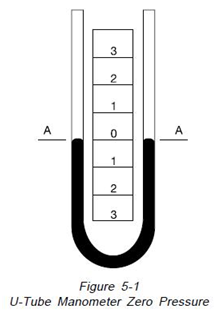
Because the reading depends only on height, liquid density and gravity, the instrument is called a primary standard. Nothing inside can drift the way a spring or a strain gauge drifts.
Manometer Formula and Pressure Balance
Take a horizontal reference at the lower liquid surface. The pressure there is the same in both legs, so the applied pressure difference equals the weight of the extra column h of manometer liquid, minus the weight of the fluid sitting above it on the other side.
Inclined tube: h = L × sin θ
ρm = manometer liquid density, ρf = density of the fluid above it, g = 9.81 m/s²
Example, water manometer measuring air pressure:
ρm = 1000 kg/m³, ρf = 1.2 kg/m³, h = 250 mm, vertical tube
ΔP = (1000 minus 1.2) × 9.81 × 0.25
ΔP = 998.8 × 9.81 × 0.25
ΔP = 2449.56 Pa = 2.450 kPa = 24.50 mbar
For gas service the term ρf is tiny and is often ignored. For liquid over the manometer fluid, such as water over mercury, it must be included or the error becomes large, a point that also matters in hydrostatic level measurement.
A pressure of 1 inch of water column is only about 249 pascals, roughly a quarter of one percent of atmospheric pressure. Yet a good inclined manometer resolves a small fraction of that.
U Tube Manometer Pressure Calculator
Write down which leg was connected to the higher pressure before you read. A reversed connection on a differential job is one of the most common field mistakes with liquid columns.
Types of Liquid Column Manometers
Two equal vertical legs, read the difference between both levels.
One leg replaced by a large reservoir, so only one column is read.
The reading leg is tilted at a small angle to stretch the scale.
Both legs connected to process points.
In a well type design the reservoir area is much larger than the tube area, so the reservoir level hardly moves. Manufacturers compensate the scale for that small movement, which is why a well type scale is not graduated in true millimetres.
Calright Instruments explains that an inclined manometer can stretch 12 inches of scale length to represent 1 inch of vertical height. That gives fine resolution for draft, duct and clean room pressures that a vertical tube cannot read well.
The same differential idea appears in a differential pressure gauge and a differential pressure transmitter, which replaced liquid columns in most plant service.
Second Worked Example: Inclined Tube
An inclined manometer uses red oil of density 827 kg per cubic metre at 10 degrees, and the liquid moves 120 mm along the tube. The vertical height is 120 × sin 10° = 120 × 0.1736 = 20.84 mm.
The pressure is ΔP = 827 × 9.81 × 0.02084 = 169.1 Pa, ignoring the air term. The same 169 Pa would raise a vertical water column by only about 17 mm, so the inclined U tube manometer gives about seven times more scale.
Choosing the Manometer Fluid
| Fluid | Specific Gravity | Typical Use |
|---|---|---|
| Water with dye | 1.00 | Draft, duct and low gas pressures |
| Red oil | About 0.827 | Inclined gauges, finer scale |
| Unity oil | 1.00 | Stable oil that reads like water |
| Mercury | About 13.54 | Higher pressures, vacuum, legacy labs |
Thomasnet lists red oil at a specific gravity of 0.827 at 60 °F and high purity mercury at 13.54 at 71.6 °F. Learn how this ratio is defined in what is specific gravity.
A lighter liquid rises further for the same pressure, so it improves resolution but shortens range. Mercury gives about 13.5 times more range than water in the same tube length, but its toxicity has pushed most plants toward oil filled or digital instruments.
Never mix fluids or top up with plain water in an oil manometer. Use only the fluid named on the scale, because the scale is graduated for that exact density.
Reading the Meniscus Correctly
The Meriam installation manual tells users to read the top of a convex mercury meniscus and the bottom of the concave meniscus formed by water and oils. Keep your eye level with the meniscus to avoid parallax, which can easily add a millimetre of error.
These five steps are the backbone of a good U tube manometer reading. They also apply when the instrument checks a Bourdon tube pressure gauge on the bench.
The Meriam manual stresses that a manometer reads correctly only at one standard temperature. Liquid density changes with temperature, so precise work applies a density ratio correction.
Corrections for Precise Work
Calright Instruments notes that a 10 °C shift from the scale reference temperature causes about 0.023 percent error in an aluminium scale. A change of 10 degrees in latitude at sea level adds roughly 0.1 percent through local gravity.
For laboratory work, apply corrections for fluid density, scale expansion and local gravity, then state the result with its uncertainty as described in measurement uncertainty in calibration. The approach matches the correction factor in calibration method.
Using the U Tube Manometer as a Calibration Reference
For low pressures below a few hundred millibar, a U tube manometer is a convenient working reference for draft gauges, low range transmitters and switches. Higher pressures move to a dead weight pressure tester or a digital reference.
Connect the device under test and the manometer in parallel to the same hand pump or bellows. Step through the range and record readings, converting units with care using field instrument unit conversion so that mmWC, Pa and mbar are not mixed.
- Instrument level and scale zeroed with both legs vented.
- Correct fluid at the correct density for the scale.
- No air bubbles or broken columns in the tube.
- Tubing connections leak tested before readings.
- Ambient temperature recorded for density correction.
- Meniscus read at eye level on the correct side.
- No power, no electronics and no drift
- Primary standard from height and density
- Very sensitive at low pressures
- Cheap and easy to understand
- Fragile glass and fluid spill risk
- Range limited by tube length
- Slow response and no output signal
- Mercury is toxic and now restricted
Troubleshooting Common Reading Problems
A U tube manometer that will not return to zero usually has a leak, trapped air or fluid stuck on the tube wall. Clean the tube, refill with fresh fluid and leak test the tubing before you suspect the scale, and compare against static versus dynamic pressure if the tapping faces the flow.
A reading that keeps rising slowly often means a pinhole leak or a temperature change in a closed leg. Fluid blown out of the open leg means pressure was applied too quickly, and the scale must be zeroed again after topping up, a habit shared with any multifunction process calibrator check.
Where Liquid Columns Are Still Used
For pressures below atmosphere, an open leg reads vacuum directly, as covered in how to calculate vacuum pressure and absolute versus gauge pressure.
Meriam Manometer Installation Manual
U Tube Manometer Video Lesson
U Tube Manometer FAQ
It is a transparent U shaped tube partly filled with a liquid such as water, oil or mercury. The difference in liquid height between the two legs shows the pressure difference applied.
It needs no power and has no moving parts that can drift with age. That makes it a trusted primary standard for low pressure measurement and calibration work.
The basic relation is ΔP = (ρm minus ρf) × g × h, where h is the height difference. For gas service the fluid above is very light and its density is often ignored.
For example, 250 mm of water gives about 2450 Pa or 24.5 mbar. An inclined tube uses the vertical height, found as tube length times sine of the angle.
Tilting the tube makes the liquid travel further along the scale for the same vertical rise. Calright Instruments notes that 12 inches of scale can represent 1 inch of height.
This makes very small draft and filter pressures easy to read. The trade off is a much shorter pressure range for the same tube length.
Read the bottom of the curved surface for water and oils, which form a concave meniscus. Read the top for mercury, which forms a convex meniscus that bulges upward.
Keep your eye exactly level with the liquid surface to avoid parallax error. The Meriam manual also recommends levelling the instrument case on the side and front before every reading.
Use water or unity oil for draft and low gas pressures, and red oil for fine inclined scales. Mercury suits higher pressures but is toxic and increasingly restricted.
Always use the fluid named on the scale, since the scale is graduated for that density. Mixing fluids or topping up with plain water quietly ruins the accuracy of every reading.
A well type design replaces one leg with a large reservoir, so only one column needs to be read. The reservoir level still falls slightly, so the scale is compensated for it.
This makes reading faster and suits panel mounting. The principle and the ρ g h formula remain the same as the simple U tube.
Yes, it is a good working reference for low range transmitters, draft gauges and pressure switches. Connect it in parallel with the device under test using a hand pump or bellows.
Record fluid temperature and apply density corrections for precise work. For higher ranges, a dead weight tester or a digital reference is far more practical.
Related Articles
- Basics of Pressure Measurement
- Differential Pressure Gauge Working
- Dead Weight Pressure Tester
- What Is Specific Gravity
- Absolute vs Gauge Pressure
External References
- General Installation, Operation and Maintenance Instructions for Meriam Manometers
- Types of Manometers, Calright Instruments
- Pressure Measurement, Wikipedia
What We Learn Today
- A U tube manometer measures pressure difference from liquid height, using ΔP = (ρm minus ρf) × g × h, with no power and no drift.
- Well type designs need only one reading, while inclined tubes stretch the scale so 12 inches of travel can represent 1 inch of height.
- Accurate readings need a level instrument, the correct fluid, no bubbles and reading the meniscus bottom for water or top for mercury.