A gas detector that reads zero in clean air looks healthy, yet a blocked or poisoned sensor reads zero too. A short exposure to known gas before each shift is the only quick way to prove the sensors and alarms really respond.
A bump test exposes a portable gas detector to gas above its alarm set points and confirms that every sensor and alarm reacts. It takes about a minute, while full calibration adjusts the readings and is done less often.

What Is a Bump Test?
A bump test is a quick qualitative function check in which a portable gas detector is exposed to a known test gas at a concentration high enough to trigger all its alarms, proving that the sensors respond and the alarms work. It does not adjust readings, which is the job of calibration as defined in instrument calibration terms.
Personal monitors for oxygen, combustible gas, carbon monoxide and hydrogen sulphide protect people entering tanks, pits and process areas. If a sensor has lost sensitivity, the worker gets no warning, so the check must come before the instrument is trusted.
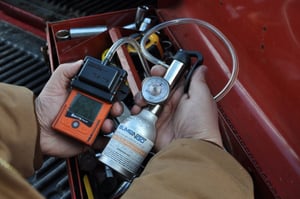
Industrial Scientific points out that in clean air an oxygen sensor reads about 20.9 percent while toxic and combustible sensors read zero. A zero reading does not prove that a sensor works, which is why gas must actually be applied.
Bump Test, Calibration Check and Full Calibration
The International Safety Equipment Association, ISEA, published a statement on validating direct reading portable gas monitors that is still the common reference. It separates three different procedures.
| Procedure | Type | What It Proves | Usual Frequency |
|---|---|---|---|
| Bump test | Qualitative | Sensors and alarms respond to gas | Before each day of use |
| Calibration check | Quantitative | Readings within maker limits | Before each day of use, as an option |
| Full calibration | Adjustment | Sensor response set to the true value | Maker, company or regulator interval |
ISEA defines the function check as passing challenge gas over the sensors at a concentration and time sufficient to activate all alarm indicators, at least at their lower alarm setting. A calibration check uses a known traceable gas to show that the readings fall within the manufacturer limits.
Full calibration actually adjusts the sensor response to match the traceable gas value. It is the same idea as the zero and span adjustments done on process transmitters, only applied to gas sensors.
ISEA states that any portable gas monitor that fails a function check or calibration check must be fully calibrated before further use or removed from service. A failed bump test is therefore never a reason to just try again tomorrow.
How Often Should You Bump Test?
ISEA recommends a bump test or calibration check before each day of use, following the manufacturer instructions. Honeywell BW, according to Frontline Safety, recommends a daily check or a check before each use for its Clip4 detector.
Industrial Scientific ties the routine to each shift and calls the bump test the only way to make sure the sensors and alarms are working. Many plants in India write the same rule into their gas test and work permit procedures.
ISEA also asks for extra validation after unusual events. These include extreme temperature or humidity, exposure to gas above the sensor range, contact with sensor poisons, rough handling or a change of the person using the instrument, all of which can be logged in a maintenance programme.
Do the check in clean air away from the work area, ideally at the gas test station near the permit office. Background gas during the test can hide a slow sensor and confuse the result.
Choosing the Right Test Gas
Most four gas monitors use a quad mix cylinder. Frontline Safety lists the BW Clip4 test gas as 25 ppm H2S, 100 ppm CO, 2.2 percent methane and 18 percent oxygen, balanced in nitrogen.
Taking the methane lower explosive limit as 4.4 percent by volume, 2.2 percent methane equals 50 percent LEL on the display. The 18 percent oxygen is below the usual 19.5 percent low alarm, so the oxygen alarm is also exercised.
H2S, CO, methane and low oxygen in one cylinder for four gas monitors.
One gas such as H2S or CO for single gas clip on monitors.
Gases like chlorine, ammonia or SO2 for special sensors.
Use only gas that is traceable and within its expiry date, since reactive gases such as H2S slowly decay inside the cylinder. Traceability follows the same chain used in ISO 17025 calibration laboratories.
Combustible sensors are often calibrated with methane but used for other hydrocarbons. Check the correction factor in the manual, because the same sensor gives a different reading on propane or hexane, much like gas group effects in gas groups IIA, IIB and IIC.
7 Essential Bump Test Steps
On the BW Clip4, Frontline Safety explains that the unit gives 60 seconds to apply gas after the countdown. A pass screen then appears, followed by a screen showing the days left until the next bump test is due.
If the test fails, the monitor must be calibrated before use. Never hand it over on the assumption that the next calibration and troubleshooting round will catch the problem.
Pass Criteria and Response Formula
BIC Magazine notes that a bump test usually passes on a sensor response time or a minimum response, such as 80 percent of the applied gas. For a calibration check the accepted range is typically plus or minus 10 to 20 percent of the applied gas, unless the maker or company policy says otherwise.
Error % = (Reading minus Applied) ÷ Applied × 100
Example, methane channel:
Applied gas = 50 % LEL, Reading = 44 % LEL
Response = 44 ÷ 50 × 100 = 88 %
Error = (44 minus 50) ÷ 50 × 100 = minus 12 %
Passes an 80 % bump criterion, fails a 10 % calibration check limit
This example shows why a monitor can pass a function check yet still need calibration. A drift of this size is typical of a combustible sensor that is ageing, which is the same concept as span error in offset, zero and span error.
Test Gas Cylinder Life Calculator
Planning gas stock for a shutdown is easier when you know how many checks one cylinder supports. The number depends on cylinder volume, regulator flow and the time gas is applied in each test.
Days of supply = Tests ÷ Monitors per day
V = 58 L, Q = 0.5 L/min, t = 1.0 min, 10 monitors
Tests = 58 ÷ (0.5 × 1.0) = 116
Days = 116 ÷ 10 = 11.6 days
Use a demand flow regulator with pumped monitors and a fixed flow regulator with diffusion monitors, as the manual specifies. The wrong regulator can starve the pump or waste gas.
Docking Stations and Automated Testing
Automated docking stations run the bump test and calibration with no manual menu work. The worker drops the monitor into the dock, the station applies gas, checks the response and stores the result with date, time and serial number.
Docks reduce human error and gas waste, and they build the record that auditors ask for. Large sites with dozens of wearable gas detectors usually prefer them over manual kits.
- Proves sensors and alarms respond before entry.
- Detects blocked filters and poisoned sensors.
- Takes about a minute per monitor.
- Builds evidence for audits and investigations.
- Does not verify accuracy like a calibration.
- Uses test gas, which costs money and expires.
- Needs clean air and correct regulators.
- Manual records are easy to skip or falsify.
Full Calibration Intervals
ISEA leaves the full calibration interval to the manufacturer, company policy or regulator. PK Safety quotes the RKI Instruments president as saying that a daily bump test routine can extend calibration to three to six months for instruments that pass.
PK Safety also notes that a full calibration of a four gas monitor takes about five minutes. Set the interval using history, as described in calibration interval determination, and shorten it whenever the bump test failure rate rises.
BIC Magazine notes that a monitor which fails a bump test must pass a full calibration within two attempts before use. If it still fails, the instrument is pulled from service.
Records and Audit Trail
BIC Magazine reports that OSHA may ask for one year of bump test and calibration data if an incident with injury or reportable exposure occurs. Each record should show the monitor serial number, gas lot, result, date, time and the person who tested it.
- Monitor serial number and sensor types listed.
- Test gas cylinder lot number and expiry recorded.
- Result recorded as pass or fail for each sensor.
- Date, time and tester name or ID captured.
- Failed units tagged and sent for calibration.
- Records stored for at least one year.
Docking station software and fleet management tools make this easy, but a simple logbook also works if it is filled honestly. The same discipline is expected for the fixed detectors in a fire and gas system.
Gas Checks on Fixed Detectors
Fixed point detectors in plants are checked by applying gas through a calibration adapter or remote gas line, often during the proof test of the fire and gas system. Infrared sensors described in NDIR gas analyzers cannot be poisoned the way catalytic beads can, but their optics still get dirty.
Before gassing a fixed detector, inhibit its outputs with a proper permit so that no trip or deluge starts. The isolation follows the same thinking as lockout tagout for energy sources.
ISEA Statement on Portable Gas Monitors
How to Bump Test a BW Gas Detector Video
Bump Test FAQ
It is a short function check in which known gas is applied to a gas detector. The gas must be strong enough to trigger every alarm on the instrument.
It proves that the sensors respond and that the alarms sound and flash. It does not prove that the displayed values are accurate to the gas concentration.
A function check only confirms response, while calibration adjusts the sensor so that its reading matches traceable gas. A calibration check sits between them and compares readings with limits.
ISEA describes all three procedures in its statement on portable gas monitors. Most sites run the quick check daily and schedule full calibration at longer intervals.
ISEA recommends a function check or calibration check before each day of use. Manufacturers such as Honeywell BW and Industrial Scientific also advise a check before each shift.
Extra checks are needed after rough handling, high gas exposure or contact with sensor poisons such as silicones. Following the maker manual is always the safest rule for your model.
Use a mix that matches every sensor in the monitor, at levels above the alarm set points. Four gas monitors commonly use a quad mix of H2S, CO, methane and low oxygen.
The cylinder must be traceable and within its expiry date. Reactive gases such as H2S decay over time, so expired gas can cause false failures.
It must not be used until a full calibration has been done and passed. BIC Magazine notes that it should pass within two attempts or be removed from service.
Tag the failed unit clearly so nobody picks it up by mistake at the start of a shift. Record the failure, because a pattern of failures points to ageing sensors.
A docking station performs the same check automatically, using less gas and with fewer human errors. It also stores each result with the date, time and monitor serial number.
Manual kits remain useful at remote sites or when the dock is down for repair. Both methods must use correct, traceable gas and must keep complete, honest records.
Yes, because a sensor reading 88 percent of applied gas can still trigger all alarms. That same reading would fail a calibration check limit of plus or minus 10 percent.
This is why full calibration is still scheduled even when daily checks pass. Treat a falling response trend as a warning sign of sensor ageing.
Related Articles
- H2S Gas Detector Working Principle and Safety
- Fire and Gas System in Process Plants
- Gas Analyzers Explained
- Calibration Interval Determination
- Measurement Uncertainty in Calibration
External References
- ISEA Statement on Validation of Operation for Direct Reading Portable Gas Monitors
- Bump Testing Versus Calibration, BIC Magazine
- Gas Detector, Wikipedia
What We Learn Today
- A bump test applies known gas above the alarm set points to prove that sensors and alarms respond, but it does not adjust or verify accuracy.
- ISEA recommends a function check or calibration check before each day of use, and a failed monitor must be fully calibrated or removed.
- Full calibration intervals come from the maker, company policy or regulator, and records should cover at least one year of results.