
Pressure Measurement · Fundamentals · Units · Instrument Selection
Basics of Pressure Measurement: 5 Essential Concepts Every Engineer Must Know
Nearly every instrument on this site, from Bourdon tubes to diaphragm seals, exists to answer one question well: how much force is pushing on a given area. This guide covers the basics of pressure measurement, with a live unit converter, a video, and links to deeper articles on every instrument type mentioned here.
Pressure Is Simple, the Reference Point Is Not
Pressure is force divided by area, and on paper that is a genuinely simple definition. What makes pressure measurement confusing in practice is that the same physical force can be reported as five different numbers, depending entirely on what reference point you measure it against. Two engineers can both be technically correct while quoting completely different values for the exact same reading.
Every dedicated instrument on this site, the diaphragm seal, the safety relief valve, the DP transmitter, exists to solve some specific version of this measurement problem. This article is the map that connects them all.
Live Pressure Unit Converter
Convert between the units you will actually encounter on a datasheet or gauge dial.
5 Essential Pressure Measurement Concepts
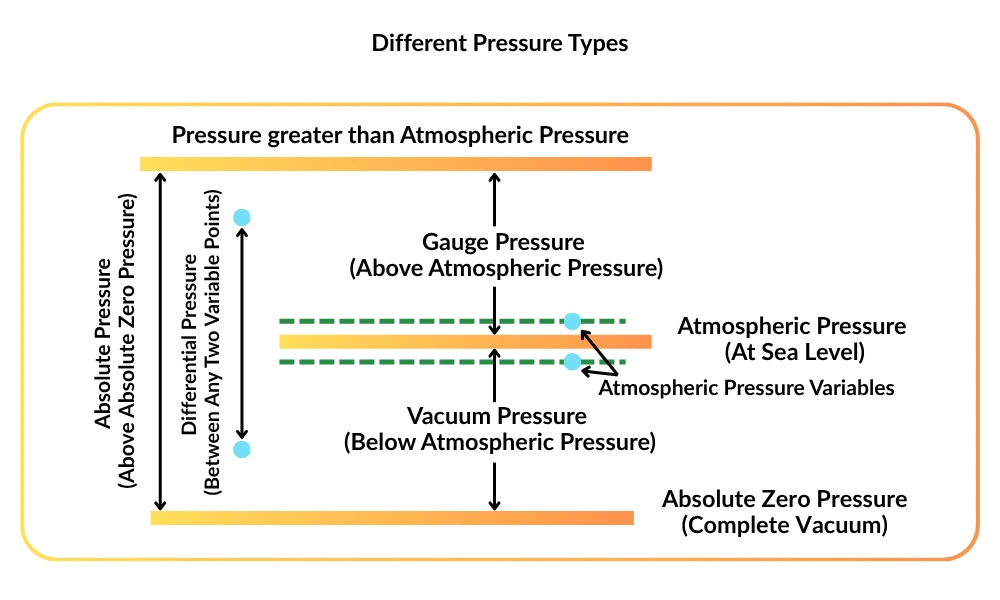
Measured against a perfect vacuum as zero. Since nothing exists below a perfect vacuum, absolute pressure is always positive, and it forms the basis of most thermodynamic gas calculations.
Measured against local atmospheric pressure as zero, the most common reading in industrial systems. Gauge pressure equals absolute pressure minus atmospheric pressure, and it can be positive or negative.
The difference between two separate pressure readings, regardless of what each individual point is referenced against. Most flow and level measurement is fundamentally a differential pressure measurement.
Simply negative gauge pressure, describing anything below atmospheric pressure. A vacuum reading of zero corresponds to atmospheric pressure, not to a perfect vacuum.
The pressure exerted by the weight of the air above a given point, roughly 1.013 bar at sea level, but genuinely variable with altitude and weather.
All Five Concepts on One Scale
Common Pressure Units and Conversion Factors
Fluency with these conversions is one of the practical basics of pressure measurement every field engineer eventually needs.
| Unit | Equivalent in Pascals (Pa) | Common Region / Use |
|---|---|---|
| Pascal (Pa) | 1 | SI base unit |
| Kilopascal (kPa) | 1,000 | General industrial, SI countries |
| Bar | 100,000 | Europe, general process industry |
| PSI | 6,894.757 | United States, imperial systems |
| Standard Atmosphere (atm) | 101,325 | Reference and scientific use |
| mmHg | 133.322 | Medical, barometric, vacuum service |
| inHg | 3,386.39 | US vacuum and HVAC applications |
| kg/cm² | 98,066.5 | Older metric systems, some Asian markets |
Watch: Types of Pressure
What is Pressure and basics of pressure is explained in this video. Pressure has different types. Various types of pressures like Atmospheric pressure, Gauge pressure, Vacuum pressure, Absolute pressure & Differential pressure are explained.
Common Measurement Instruments and Their Principles
| Instrument | Measurement Principle | Best Suited For |
|---|---|---|
| Bourdon Tube Gauge | Mechanical deflection of a curved tube under pressure | Local gauge pressure indication, general duty |
| Manometer | Height difference of a liquid column | Low pressure and reference calibration standards |
| Diaphragm Sensor | Deflection of a thin membrane under pressure | Corrosive, viscous, or hygienic process media |
| Capacitive Sensor | Capacitance change as a diaphragm deflects | Electronic transmitters, wide pressure ranges |
| Piezoresistive Sensor | Resistance change in a strained silicon element | Compact, low cost electronic pressure sensing |
Common Myths About Pressure Measurement
Even experienced engineers occasionally trip over these basics of pressure measurement, usually from years of casual shorthand.
Where These Concepts Apply in a Real Plant
Quick FAQs: Basics of Pressure Measurement
- Fill Fluid Selection for Diaphragm Seals: 5 Costly Mistakes Engineers Must Avoid
- Safety Relief Valve (PSV) Sizing: 4 Essential Steps to Prevent Overpressure
- Orifice Plate Bidirectional Flow: 5 Surprising Facts Engineers Get Wrong
- Tank Volume from Level Measurement: 3 Vital Methods Every Engineer Should Know
External References
- Wikipedia: Pressure Measurement
- Tameson: Atmospheric, Absolute, Gauge and Differential Pressure
- WIKA: Pressure Measurement Technology
What we learn today
- The basics of pressure measurement come down to reference point: absolute uses a perfect vacuum, gauge uses local atmosphere, and differential compares any two points directly.
- Vacuum pressure is simply negative gauge pressure, using the same atmospheric reference point.
- Common units like Pa, bar, psi, and mmHg all convert cleanly through Pascals as a common intermediate unit.
- Instrument choice, Bourdon tube, diaphragm, capacitive, or piezoresistive, depends on the process media and required pressure type, not just the pressure range.