
What is Specific Gravity? Formula, Calculation, and Applications
Why a steel bolt sinks, a wooden block floats, and a plastic bottle can do either, all explained by one dimensionless number.
Specific gravity compares the density of a material with the density of water. Learn its formula, calculation methods, practical examples, and industrial applications in this beginner-friendly engineering guide.
What is Specific Gravity?
Imagine placing a piece of wood, a steel bolt, and a plastic bottle into a bucket of water. The wood floats on the surface, the steel bolt sinks to the bottom, while the plastic bottle may float or remain partially submerged depending on whether it is empty or filled with water. Although these objects have different sizes and weights, their behavior in water mainly depends on a property called specific gravity.
Specific gravity is one of the most important physical properties used in engineering, process industries, and flow measurement. It helps engineers determine whether a material will float or sink, calculate pressure in liquid columns, size pumps, design piping systems, and select suitable flow meters. Many industrial calculations involving hydrostatic pressure, differential pressure flow measurement, tank level measurement, and fluid handling require the correct specific gravity value.
Unlike density, which has units such as kilograms per cubic meter (kg/m³), this ratio has no unit. This makes it easy to compare different liquids and solids regardless of the measurement system being used.
Specific gravity is the ratio of the density of a substance to the density of a reference material. For liquids and solids, the reference material is usually pure water at 4°C, because water reaches its maximum density at this temperature. Since both densities use the same unit, the units cancel out, making it a dimensionless quantity.

Real Life Example
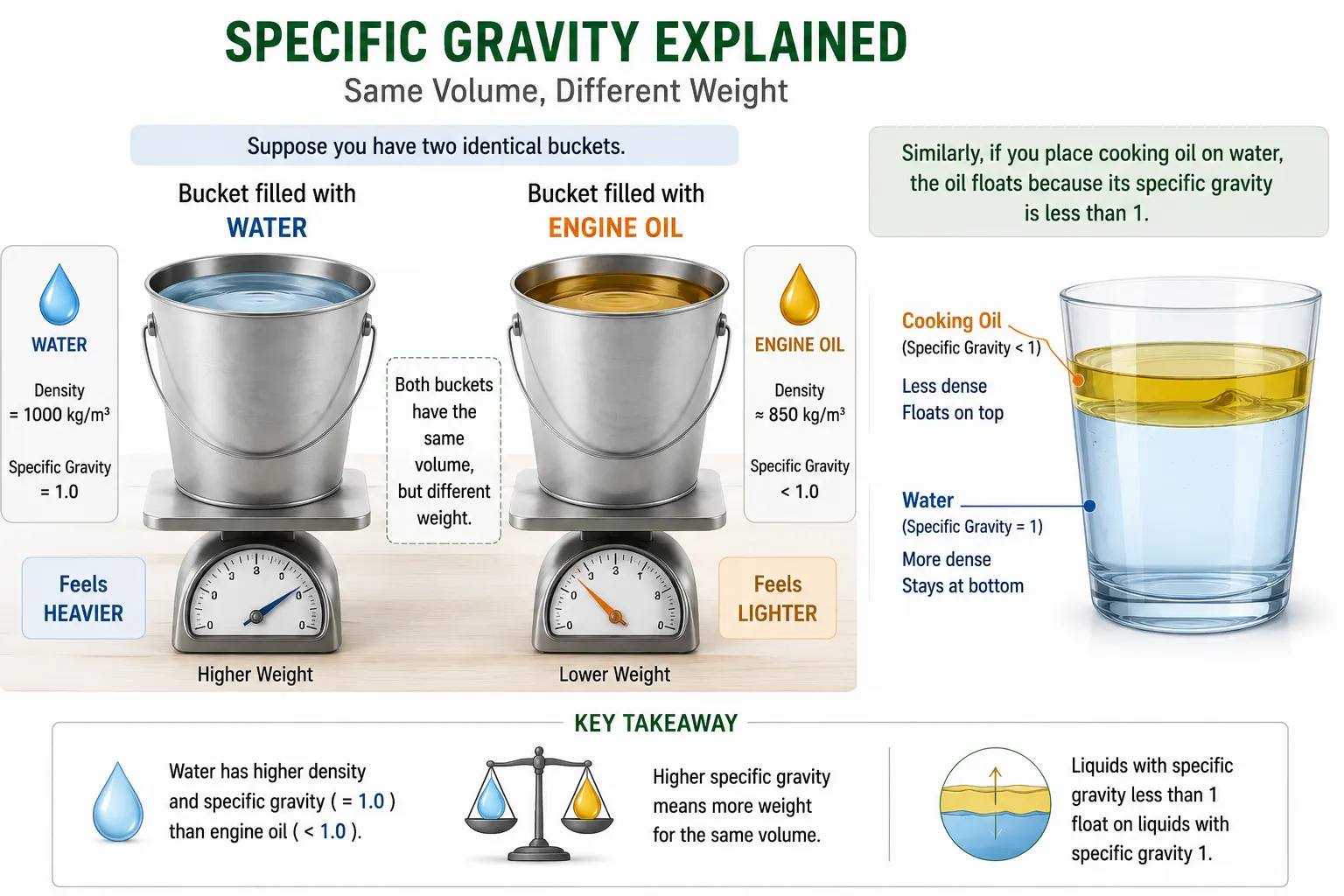
Suppose you have two identical buckets. Fill one bucket with water and the other with engine oil. Even though both buckets contain the same volume, the bucket filled with water feels heavier. This is because water has a higher density, and therefore a higher ratio, than engine oil. Similarly, if you place cooking oil on water, the oil floats because its value is less than 1.
Why is Specific Gravity Important?
This ratio is widely used because it provides a quick comparison of how heavy or light a material is relative to water. Engineers use it to select suitable pumps, calculate hydrostatic pressure, design piping systems, size storage tanks, select flow meters, calculate differential pressure, determine whether materials float or sink, and identify unknown liquids. Many flow meter manufacturers require the process fluid's value before sizing or calibrating an instrument.
What Does Specific Gravity Tell Us?
This ratio provides useful information about the relative heaviness of a material. A value greater than 1 means the material is heavier than water, a value equal to 1 means the material has approximately the same density as water, and a value less than 1 means the material is lighter than water. Mercury has a value of about 13.6, making it much heavier than water, while gasoline has a value of approximately 0.72, so it floats on water.
Specific Gravity Formula
More Step-by-Step Examples
| Example | Given | Formula | Result |
|---|---|---|---|
| Density from specific gravity | SG = 1.25, Density of Water = 1000 kg/m³ | Density = SG × Density of Water | 1250 kg/m³ |
| Specific gravity of a chemical | Density = 1450 kg/m³, Water = 1000 kg/m³ | SG = Density ÷ Water | 1.45 (heavier than water) |
| Specific gravity in g/cm³ | Density = 7.8 g/cm³, Water = 1 g/cm³ | SG = Density ÷ Water | 7.8 (much denser than water) |
Specific Gravity Calculator
Specific Gravity and Density Calculator
Pick what you want to solve forSpecific Gravity vs Density
Although these terms are closely related, they are not the same.
| Feature | Specific Gravity | Density |
|---|---|---|
| Definition | Ratio of two densities | Mass per unit volume |
| Unit | No unit | kg/m³, g/cm³ |
| Reference | Compared with water | No reference required |
| Symbol | SG | ρ (rho) |
| Typical Use | Fluid comparison | Engineering calculations |
4 Factors Affecting Specific Gravity
Temperature
As temperature increases, many liquids expand, causing their density and this ratio to decrease.
Pressure
Pressure has little effect on most liquids but can significantly affect gases. As gas pressure increases, gas density and the ratio also increase.
Material Composition
Adding dissolved solids or impurities changes the density of a liquid. Salt water reads higher than fresh water.
Concentration
Increasing the concentration of a solution generally increases the value, used to monitor acid, sugar, and chemical mixtures.
Specific Gravity of Common Materials
| Material | Approximate Value |
|---|---|
| Air | 0.0012 |
| Gasoline | 0.70–0.75 |
| Diesel | 0.82–0.86 |
| Kerosene | 0.78–0.81 |
| Cooking Oil | 0.91–0.93 |
| Water | 1.00 |
| Sea Water | 1.02–1.03 |
| Milk | 1.03 |
| Glycerin | 1.26 |
| Sulfuric Acid (Concentrated) | 1.84 |
| Mercury | 13.6 |
Note: these values are approximate and may vary depending on temperature and composition.
Applications of Specific Gravity
Flow Measurement
Many flow meters require this value for the process fluid for accurate calibration and flow calculations.
Level Measurement
Hydrostatic and differential pressure level transmitters use it to convert pressure into liquid level accurately.
Pump Selection
Pump performance depends on liquid density. This ratio helps estimate required pump power and operating conditions.
Chemical Processing
It is used to monitor chemical concentration and ensure consistent product quality.
Petroleum Industry
Fuel quality and product identification often rely on this measurement.
Food and Beverage
It helps determine sugar concentration, milk quality, and beverage consistency.
Common Mistakes
Avoid these common misunderstandings.
- Confusing this ratio with density
- Assuming it has a unit
- Ignoring temperature effects
- Using water density at the wrong reference temperature for high-accuracy calculations
- Assuming all oils have the same value
- Using incorrect values during flow meter or level transmitter calibration
What is Specific Gravity: Video Walkthrough
Frequently Asked Questions About Specific Gravity
- Chemistry LibreTexts, Density and Specific Gravity
- Khan Academy, Relative Density (Specific Gravity)
- Industrial Physics, Specific Gravity vs Density for Liquid Testing
What We Learn Today
- Specific gravity is the ratio of the density of a substance to the density of water, making it a dimensionless quantity with no unit
- A value greater than 1 indicates the material is heavier than water, while a value less than 1 indicates it is lighter and generally floats
- It is widely used in flow measurement, level measurement, pump selection, chemical processing, petroleum industries, and food manufacturing
- Accurate values improve the performance of flow meters, pressure transmitters, and hydrostatic level measurement systems