
Taking a protective signal out of service, even briefly, changes the actual risk a plant carries, and a safety signal bypass done without a structured process is one of the most common contributors to major incidents.
A safety signal bypass temporarily removes a protective function from active service, usually through a maintenance override switch, and must always be paired with a documented reason, a time limit, and a compensating measure.
This topic sits alongside safety signal override and force vs override, since a bypass is often carried out using one of those two mechanisms.
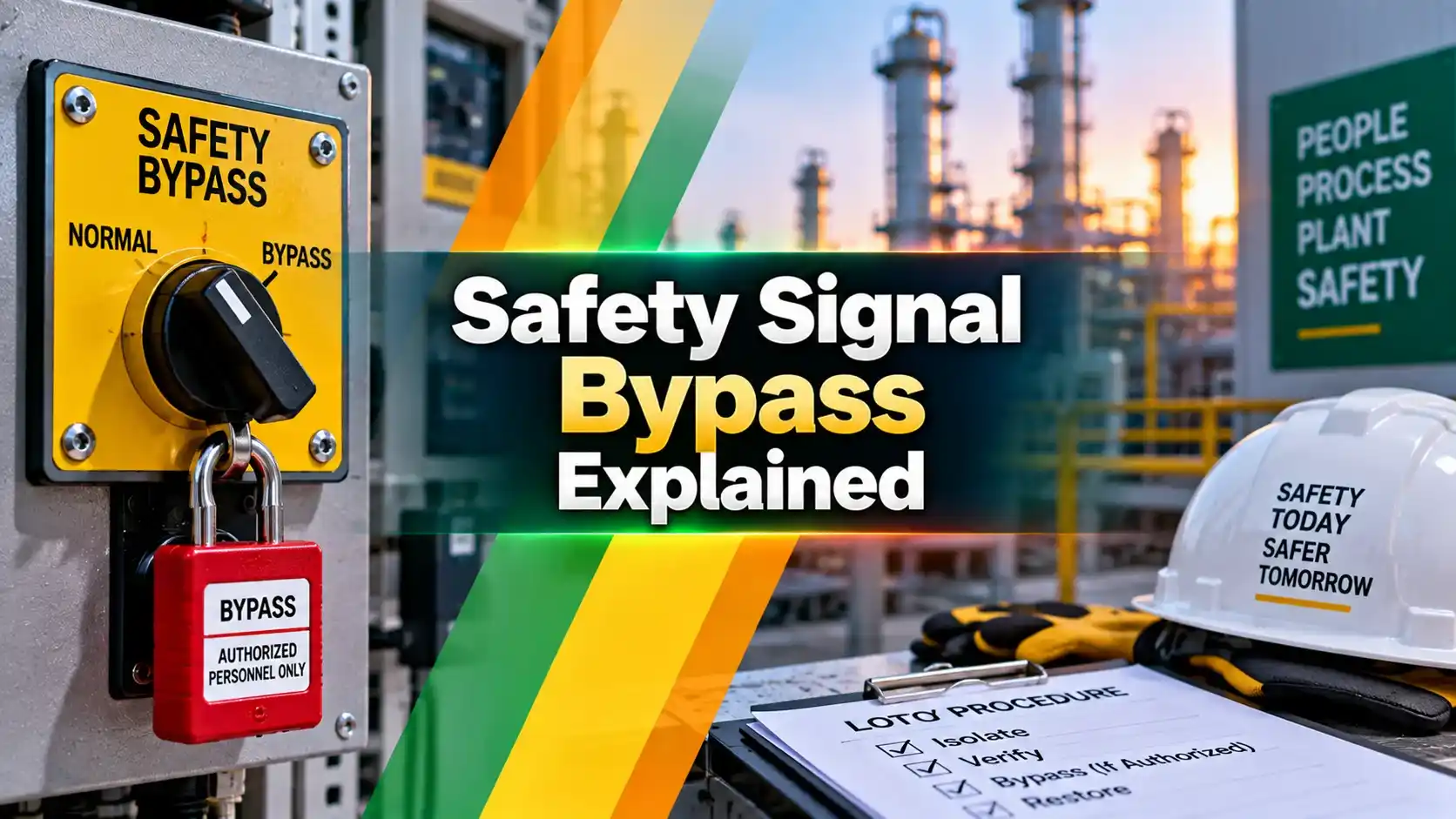
What Is a Safety Signal Bypass
A safety signal bypass is any deliberate action that stops a safety instrumented function from responding normally to its input, usually so a technician can test, calibrate, or repair the loop without causing a spurious trip.
The bypass itself can be implemented through a maintenance override switch at the field junction box, a software override inside the logic solver, or a manual isolation valve on a final element.
Whatever the method, taking this step always means the plant is running with one less layer of protection until the bypass is removed and the function is restored to active duty.
How This Differs From a Permanent Design Change
A permanent design change, such as removing a trip altogether or replacing it with a different detection method, goes through a full management of change process with its own hazard review.
Taking a function temporarily out of service is meant to be reversible and short lived by comparison, which is exactly why the surrounding controls focus on time limits and restoration rather than a fresh hazard study each time.
Why Plants Need a Bypass Capability at All
Without any bypass mechanism, every proof test or repair on a safety loop would force a full unit shutdown, which is neither practical nor, in some cases, safer than a controlled bypass with compensating measures in place.
A well designed bypass capability lets routine testing happen while the process keeps running, provided the surrounding administrative controls are strong enough to catch problems the disabled function would normally catch.
Controls Every Safety Signal Bypass Needs
| Element | Purpose | Typical Owner |
|---|---|---|
| Bypass request | Documents why the bypass is needed and for how long | Maintenance planner or technician |
| Approval | Confirms the risk is understood and acceptable | Shift supervisor or safety engineer |
| Compensating measure | Covers the gap the bypassed function leaves behind | Operations team |
| Closeout | Confirms the function is restored and tested | Technician plus supervisor sign off |
The Full Lifecycle of a Bypass
What Goes Wrong Without Good Bypass Management
Documenting Every Bypass for the Audit Trail
A written record for each bypass should show the tag number, the reason, the person who approved it, the compensating measure applied, and the date it was cleared once work finished.
During a periodic functional safety audit, reviewers typically pull this history and check whether any tag shows up far more often than expected, since repeated bypassing of the same loop usually points to an unresolved equipment problem rather than a genuine one off need.
Training Operators to Question an Active Bypass
New operators sometimes treat an indicated bypass as background information rather than an active condition requiring attention, so training should walk through what each summary display icon actually means for the loop's real protection.
A short scenario exercise, such as reviewing a shift log with three tags shown as bypassed, helps a new hire practice deciding whether the compensating measures already in place are still adequate.
Tracking an Active Safety Signal Bypass
Modern DCS and SIS platforms usually offer a dedicated bypass or override summary display, listing every function currently taken out of service along with who approved it and when it is due back.
A control room operator should be able to see this list at a glance during shift handover, since an unexpected new hazard combined with an existing bypass can quietly change the plant's real risk picture.
Plants without an automated summary often rely on a shift log or a whiteboard, which works only if the discipline to update it every single time is genuinely maintained.
Bypass vs Leaving the Function Active
Bypass
Allows testing and repair without a full shutdown, but removes a protective layer while active.
Active Function
Keeps full protection in place, but may force a shutdown for even minor test or repair work.
The goal is never to avoid bypass altogether, since some testing genuinely requires it, but to make every bypass of this kind short, authorized, compensated, and visible for as long as it exists.
Who Should Be Involved in a Safety Signal Bypass Decision
A single technician deciding alone whether to bypass a trip is rarely the right setup, even when the individual request seems small and routine on the surface.
A shift supervisor or safety engineer brings visibility into what else is happening on the unit at the same time, which matters because a bypass that looks harmless in isolation can combine with another ongoing activity to create a much larger gap in protection.
Some plants also require a second check from the process engineer responsible for the loop, particularly when the bypass is expected to last through more than one shift change.
How Modern Platforms Support Safer Bypassing
Many current DCS and SIS platforms let engineers configure a bypass with a built in expiry timer, automatically raising an alarm if the time limit is reached before the tag is restored.
Some systems go further and require the compensating measure to be entered as a text field before the bypass is even accepted, so the control system itself enforces part of the procedure rather than relying purely on paperwork.
These features do not remove the need for good discipline around a safety signal bypass, but they do close some of the gaps that come from relying entirely on human memory during a busy shift.
Common Mistakes With Bypass Management
Watch: Override, Bypass, and MOS Explained
Safety Signal Bypass FAQs
Related Articles on This Site
- Safety Signal Override Explained
- Force vs Override in Safety Systems
- What Is SIL, Safety Integrity Level
- Safety Instrumented Function SIF Design
- Process Safety vs Functional Safety
External References
What We Learn Today
- This kind of bypass takes a protective function out of service, usually for testing or repair.
- Every bypass needs authorization, a time limit, a compensating measure, and visible indication.
- IEC 61511 requires structured bypass management since defeated protection contributed to major past incidents.