
Flame Arrester Explained: Quenching Gap, MESG, and Deflagration vs Detonation
A flame arrester doesn't fight fire with water, foam, or chemicals. It fights fire with pure geometry, forcing the flame through gaps so narrow that it simply runs out of heat to keep burning.
A flame arrester is a passive safety device that allows gas or vapor to flow freely while physically preventing a flame from passing through it. This guide explains the quenching gap principle, the Maximum Experimental Safe Gap (MESG), and how deflagration and detonation arresters differ in what they're built to survive.
How a Flame Arrester Actually Stops a Flame
A flame arrester works by removing heat, not fuel or oxygen. Its internal element, typically crimped stainless steel ribbons wound or stacked to form a dense matrix of narrow parallel channels, forces gas to flow through gaps small enough that any flame entering those channels rapidly loses heat to the surrounding metal. Once the burning gas mixture cools below its auto-ignition temperature, the flame simply cannot sustain itself and is extinguished before it reaches the protected side.
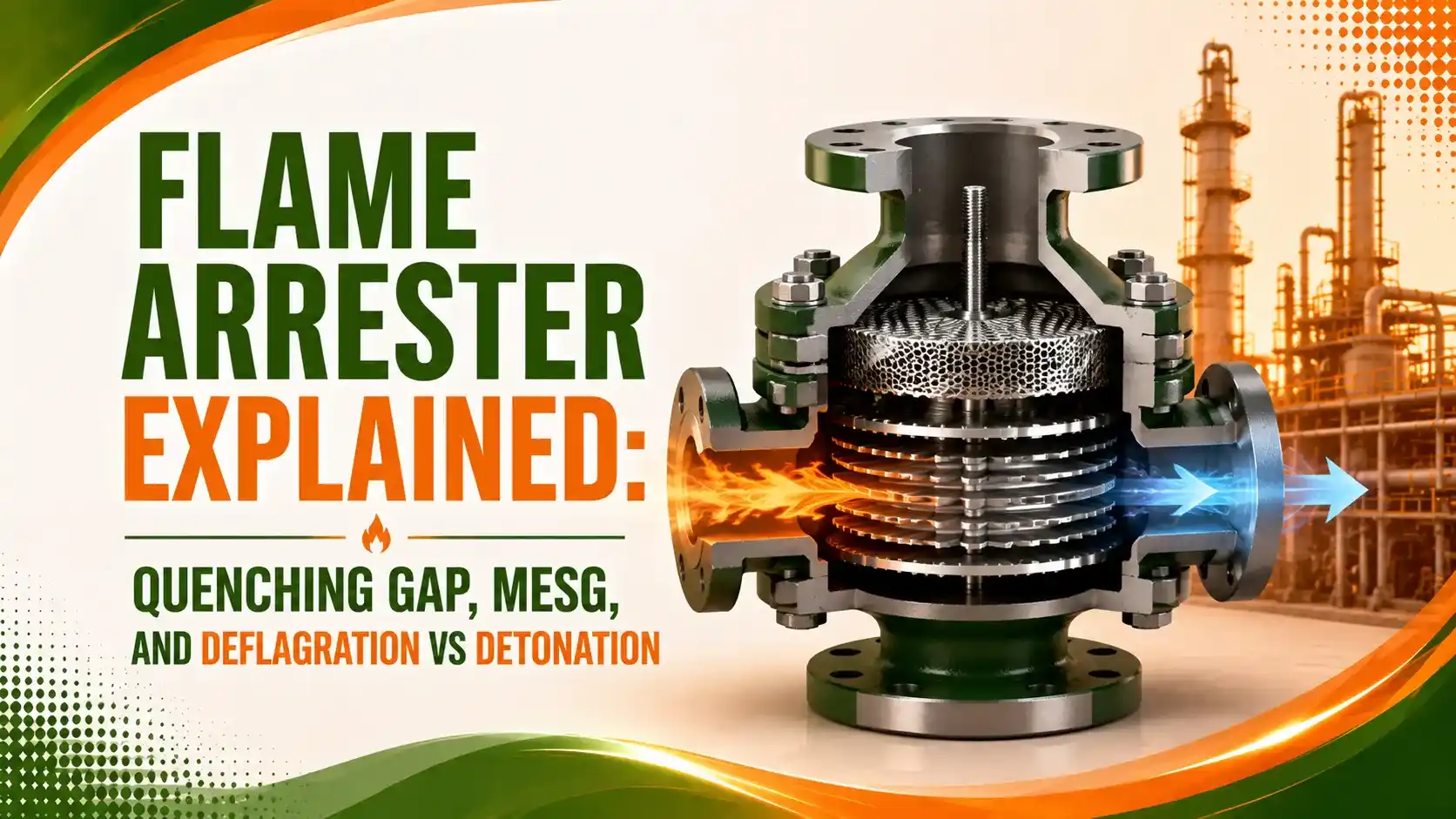
This is a purely passive, geometry-based defense: no power, no moving parts, no control signal required. The device sits in the flow path continuously, ready the instant an ignition event occurs, which is exactly why it complements active systems like hazardous energy control and hot work permitting rather than replacing them.
Cross-Section: How the Quenching Gap Works
The flame enters the crimped metal element on the left and is forced through many narrow parallel channels. Heat transfers into the metal so rapidly that gas exits the right side below its ignition temperature, no flame, just cool, safe gas flow.
Real Life Example
Think of blowing through a fine metal tea strainer versus blowing through an open cup. Air passes through the strainer's mesh easily enough, but anything larger, like a flame front trying to sustain itself, simply cannot squeeze through those tiny gaps intact. Now imagine that strainer is also an excellent heat sink: every bit of hot gas forced through those tiny metal-lined openings loses its heat to the metal almost instantly, arriving on the other side too cool to keep burning. That's the entire trick behind a flame arrester, just precision-engineered instead of improvised.
Deflagration vs Detonation Arresters
🔥 Deflagration Arrester
- Stops flame fronts traveling at subsonic speeds
- Handles slower-burning ignitions, like vapor releases
- Generally cannot withstand high-pressure shock waves
- Many designs work bi-directionally
- Common on tank vents and low-risk vapor lines
💥 Detonation Arrester
- Built to survive flame fronts at supersonic velocities
- Must withstand extreme pressures (1,500 psi at 2,500 m/s not uncommon)
- Uses reinforced elements to handle shock loading
- Required wherever detonation transition is credible
- Common on flare headers and vapor recovery systems
Both device types use the exact same core thermal mechanism, heat absorption through the quenching gap. What changes is the mechanical robustness required: a detonation arrester must physically survive the shock wave and extreme pressure of a supersonic flame front, not just quench the heat, which is why it's a fundamentally more rugged design, not simply a "stronger" version of the same part.
Key Numbers to Know
Applications
Storage Tank Vents
End-of-line arresters protect atmospheric tanks from external ignition sources.
Flare Header Piping
Detonation arresters stop flashback from a lit flare tip reaching upstream vessels.
Vapor Recovery Lines
In-line arresters prevent flame travel between connected process equipment.
Fuel Gas Systems
Arresters protect gas supply piping from burner flashback events.
Marine Loading Arms
Ship-to-shore vapor return lines require flame protection during transfer.
Chemical Process Vents
Reactor and process vessel vents rely on arresters matched to specific gas groups.
Flame Arrester: Video Walkthrough
Frequently Asked Questions
- Wikipedia, Flame Arrester
- Cashco, Understanding MESG: The Key to Safe Flame Arrestor Design
- Cashco, Deflagration vs Detonation Flame Arrestors: Differences Explained
What We Learn Today
- A flame arrester quenches flame by removing heat through narrow channels, not by blocking fuel or oxygen
- MESG defines the largest gap a specific gas mixture cannot propagate flame through; arrester gaps are engineered smaller
- Deflagration arresters handle subsonic flame fronts; detonation arresters must survive supersonic shock loading
- Both device types share the same thermal principle but differ enormously in mechanical robustness
- Pipe length between an ignition source and an arrester matters, since deflagration can accelerate into detonation en route