
A hot work permit is the written approval a site requires before anyone welds, cuts, grinds, or brazes in an area that was never built to handle open flame or sparks.
That single sheet of paper stands between a routine repair job and a fire that starts from a spark nobody was watching for.
Most hot work fires do not start during the job itself. They start afterward, from a smoldering ember nobody caught because the fire watch left too soon.
This guide covers what counts as hot work, who is responsible for each step, and the fire watch timing that actually prevents a delayed ignition.
A hot work permit is a formal, time bound authorization confirming that an area has been inspected, combustibles have been removed or shielded, and a fire watch is in place before welding, cutting, grinding, or brazing can begin.
Most industrial fires linked to welding and cutting do not happen because a worker was careless with the torch. They happen because a spark landed somewhere nobody checked, and nobody was still watching when it finally caught.
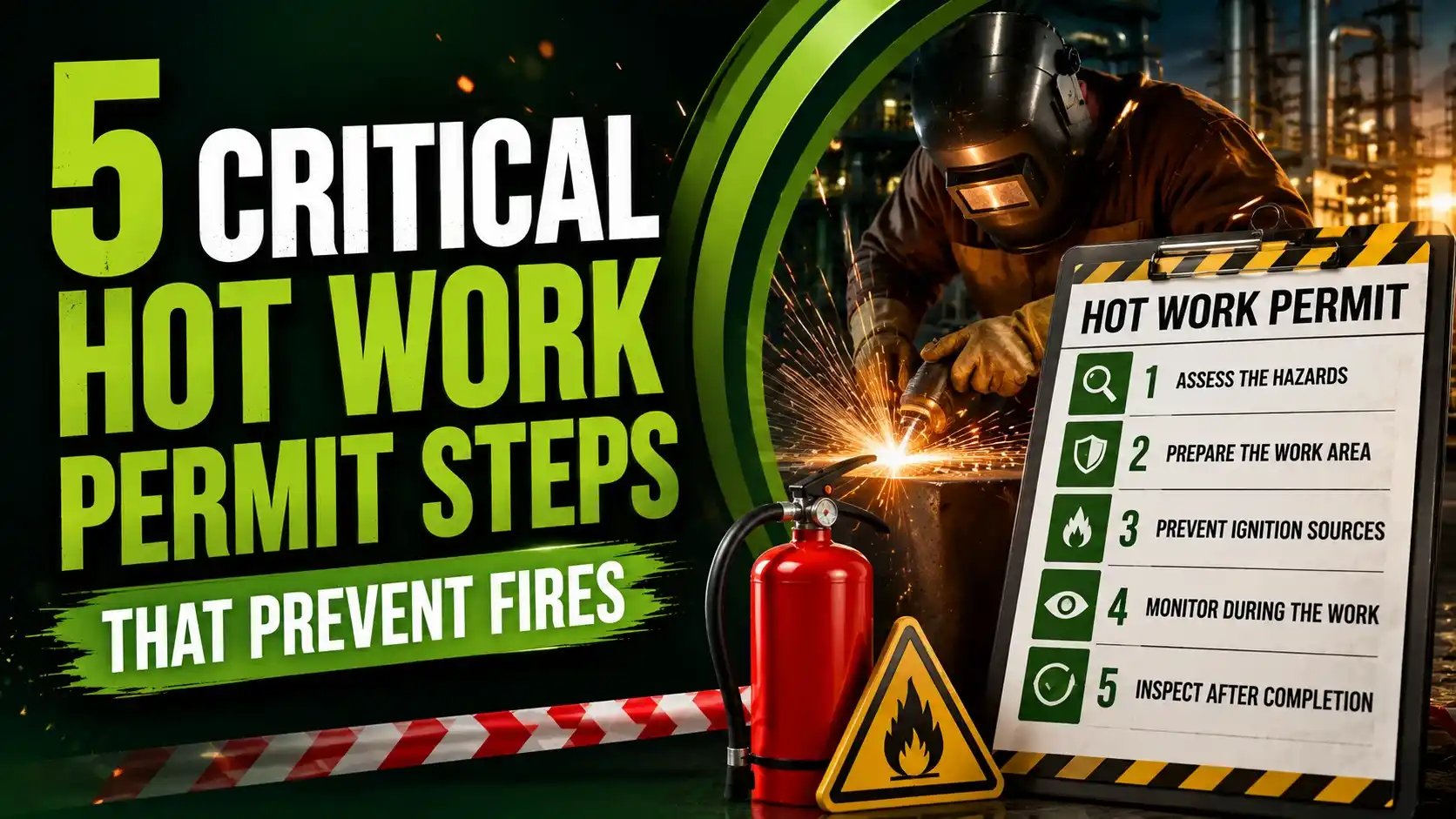
The permit exists to force that checking to happen every single time, rather than relying on memory or good intentions on a busy shift.
This article walks through what the permit actually covers, the roles involved, and the fire watch timing rules that turn the paperwork into a real safeguard.
What a Hot Work Permit Actually Is
A hot work permit documents that a defined area has been inspected, that nearby combustible material has been removed or shielded, and that a trained fire watch will stay in place during and after the job.
In the United States, general industry hot work falls under OSHA 29 CFR 1910.252, while construction sites use 1926.352. Many facilities also follow NFPA 51B, the dedicated fire prevention standard for hot work.
The permit is only valid for a limited time window and a specific location, so moving the job or extending it past the approved hours means a new permit is required.
What Counts as Hot Work
Welding
Arc and gas welding both produce sparks, spatter, and enough heat to ignite nearby material.
Cutting
Oxy fuel and plasma cutting throw molten metal that can travel well beyond the immediate work area.
Grinding
Angle grinders and cutoff wheels shower sparks in every direction, often unnoticed by the operator.
Brazing and Soldering
Lower temperature than welding, but still hot enough to ignite dust, oil residue, or paper.
Torch Applied Roofing
Open flame torches used to melt roofing membrane sit directly on a combustible substrate.
Heat Guns and Thawing
Any open flame or intense localized heat source used near piping or structural members.
Any task that produces flame, heat, or sparks capable of starting a fire falls under this definition, whether it looks like a major repair job or a five minute touch up.
The Hot Work Permit Process Step by Step
The process follows a fixed sequence every time, regardless of how routine the job looks on paper.
Once work finishes, the fire watch stage does not end immediately. It continues for a defined monitoring period afterward, which is where the calculator below comes in.
Who Is Responsible During Hot Work
Permit Issuer
Inspects the work area, confirms controls are in place, and authorizes the specific time window for the job.
Hot Work Performer
Carries out the welding, cutting, or grinding task, and must stop immediately if conditions change.
Fire Watch
A separate, dedicated person who watches for sparks and smoldering material, both during the job and after it stops.
Gas Tester
Checks the atmosphere for flammable vapor or low oxygen before work starts in a confined or enclosed space.
The fire watch can never be the same person performing the hot work, since a single person cannot weld and keep continuous watch on the surrounding area at the same time.
Hot Work Permit Clearance and Fire Watch Calculator
Enter the distance to the nearest combustible material and whether concealed spaces such as wall cavities or ceiling voids are present, to see the clearance and monitoring outcome.
Two Job Site Scenarios Compared
Scenario one is a repair job close to stored packaging material, with no hidden spaces nearby.
Concealed spaces = No
Result = Combustible material must be removed or shielded, 30 minute fire watch required
Scenario two is a job at a safe distance from stored material, but inside a wall with a hidden ceiling void above it.
Concealed spaces = Yes
Result = Distance clears the 35 foot zone, 60 minute extended fire watch required
Distance alone does not decide the outcome. A job that looks safe by distance can still need the longer monitoring window once a concealed space enters the picture.
Comparing Hot Work Requirements Across Standards
| Standard | Scope | Minimum Fire Watch | Notes |
|---|---|---|---|
| OSHA 1910.252 | General industry hot work | 30 minutes after work stops | Federal baseline in the United States |
| OSHA 1926.352 | Construction site hot work | 30 minutes after work stops | Mirrors the general industry rule for construction |
| NFPA 51B | Fire prevention during hot work | 30 minutes, often extended locally | Widely adopted by insurers and site fire codes |
| Marine Chemist Certification | Shipboard and marine hot work | Set by the certifying chemist | Required in addition to standard permit controls on vessels |
What Happens When Fire Watch Precautions Are Skipped
A spark or a hot fragment can smolder inside insulation, sawdust, or packing material for far longer than most workers expect, sometimes flaring into open flame only after everyone has already left the area.
Skipping the post work monitoring period, or cutting it short because the crew wants to move on, removes the one safeguard designed specifically to catch that delayed ignition.
Treating the fire watch as a real assignment rather than a formality is what separates a permit that protects the site from a permit that only protects paperwork.
Hot Work Permit Do's and Don'ts
✓ Do
- Inspect above, below, and on both sides of the work area, not just the immediate spot
- Assign a fire watch who is not also performing the hot work
- Keep a charged extinguisher within immediate reach of the fire watch
- Test the atmosphere before starting work in any enclosed or confined space
✗ Don't
- Assume a quick job does not need a permit just because it will only take a few minutes
- End the fire watch the moment the torch or grinder stops
- Leave openings or gaps unsealed where sparks could pass into a hidden space
- Extend work past the approved permit window without getting it reissued
Standards and Guidance Worth Reviewing
Hot Work Permit Questions Site Teams Ask
External References
- Fast Fire Watch Guards: OSHA Hot Work Permit Checklist and Safety Requirements
- OSHA: Fire Watch Duties During Hot Work
What We Learn Today
- A hot work permit confirms an area is inspected, combustibles are cleared, and a fire watch is assigned before welding, cutting, or grinding begins.
- Combustible material within 35 feet generally must be removed or shielded before work starts.
- The fire watch must continue for at least 30 minutes after work stops, longer if concealed spaces are present nearby.
- The fire watch role must always be a separate person from whoever is performing the hot work itself.