
Drives and rectifiers pull current in sharp pulses, and a fast power electronic unit can inject the exact opposite pulses to cancel them.
Nonlinear loads such as VFDs, UPS units and LED drivers draw distorted current that heats cables and transformers. An active filter measures that distortion and injects a correcting current in real time.
What Is an Active Harmonic Filter?
An active harmonic filter is a power electronic device connected in parallel with nonlinear loads that measures their harmonic current and injects an equal and opposite current to cancel it. The supply then sees a nearly sinusoidal current, which reduces the problems described in power harmonics.
Eaton explains that the unit is connected in parallel and injects equal and opposite harmonic currents. At the same time, it can supply reactive current for power factor correction.
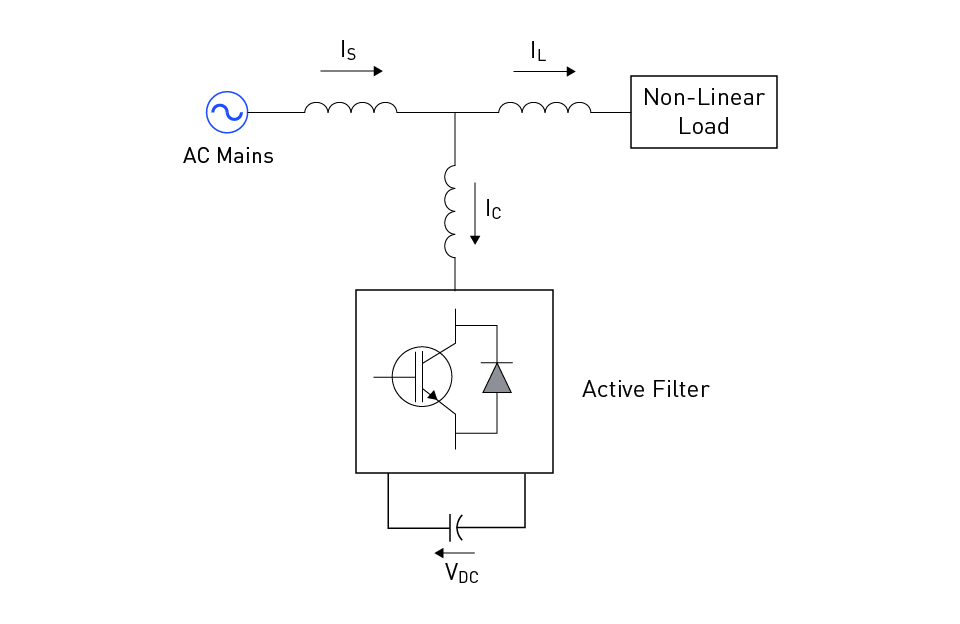
Inside is an IGBT inverter with a DC capacitor, similar to the output stage of a VFD. It switches at high frequency to shape its current precisely.
Because it is not tuned to a single frequency, it cannot resonate with the network. It also cannot be overloaded, because it limits its output at the rated current.
How Harmonic Cancellation Works
The control loop works within about one cycle and typically covers harmonic orders up to the 50th. Current transformers can be placed on the source side for closed loop control or the load side for open loop control.
Closed loop placement lets the filter correct its own errors. It is the preferred choice for most installations.
6 Brilliant Active Harmonic Filter Benefits
The Eaton guide specification targets total demand distortion and voltage distortion of 5 percent or less, with power factor corrected to 0.95 or better. These values line up with IEEE 519 recommendations at many sites.
Lower distortion also cools transformers and neutrals and prevents nuisance trips in UPS and generator systems.
Active vs Passive Harmonic Filter
| Feature | Passive Tuned Filter | Active Filter |
|---|---|---|
| Principle | LC circuit tuned to one order | Injects opposite current |
| Harmonic range | One or two orders | Broad, up to 50th |
| Resonance risk | Yes | No |
| Load changes | Performance varies | Adapts automatically |
| Overload | Can be overloaded | Self limiting |
| Cost | Lower | Higher |
Passive filters remain good value for large, steady loads. For mixed or changing loads, the active approach usually wins, as discussed in power quality issues with VFDs.
Other options include line reactors, 12 pulse rectifiers and active front end drives. A site study decides the most economical mix.
Sizing Formula and Example
I fundamental = I rms ÷ √(1 + THDi²)
Worked example, drive bus:
I rms = 400 A, THDi = 35 percent
I fundamental = 400 ÷ 1.06 = 377.5 A
I harmonic = 400 × 0.35 ÷ 1.06 = 132.1 A
Target THDi 5 percent leaves 18.9 A
Correction needed ≈ 113 A, add margin and select a 150 A unit
Measure THDi with a power quality analyser at full production load. The THD calculation guide explains the definitions.
If the filter also corrects power factor, add the reactive current to the harmonic current as a vector sum. Undersized units run at their limit and leave some distortion.
Typical Applications
Data centres use these units to meet tight supply limits, see Tier IV data centre power. Hospitals value the clean voltage for imaging systems.
Install the unit near the main distribution board that feeds the drives, and leave space for cooling air. Commission it with a before and after power quality log so the improvement is documented for the utility.
Harmonic Current Calculator
Round up to the next standard frame, often 100 A, 150 A or 200 A. Check the maker software for the final choice.
- Broad harmonic range.
- Adapts to load changes.
- No resonance.
- Also corrects PF and imbalance.
- Higher cost than passive filters.
- Needs cooling and space.
- Adds some switching losses.
- Requires correct CT placement.
Eaton AHF Guide Specification PDF
How an AHF Works Video
Active Harmonic Filter FAQ
Related Articles
- Power Harmonics Explained
- THD Calculation in Power Systems
- Power Quality Issues With VFDs
- Power Factor Correction Explained
- Voltage Sag, Swell and Flicker
External References
What We Learn Today
- Parallel injection of opposite current cancels harmonics.
- The unit adapts to load changes and cannot resonate.
- Size from measured harmonic current with a margin.