
A VFD and a PLC can be built with genuine precision and still fail for a reason that has nothing to do with either device. Power quality issues are the quiet cause behind a huge share of nuisance trips, resets, and communication dropouts across modern automation. This guide covers all seven of them in plain, plant floor language.
A VFD or PLC rarely fails because of its own design. Far more often, it fails because the power feeding it was never as clean as everyone assumed. Power quality issues rarely look like an electrical problem at first, which is exactly why they get misdiagnosed so often.
VFDs and PLCs are the technological backbone of modern industry, controlling motor speed, process accuracy, and production consistency. For all their sophisticated design, both share the same vulnerability: they need clean, stable electrical input, and even small power quality issues make them behave abnormally.
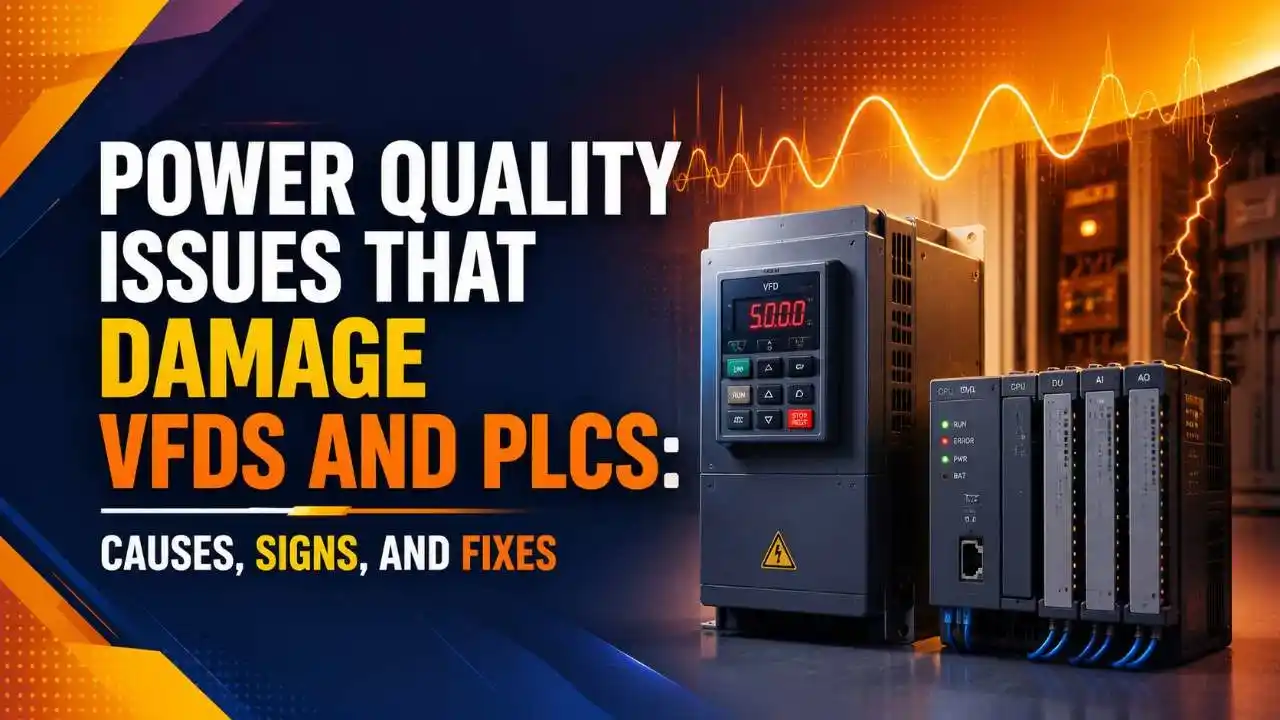
A brief voltage sag, a surge, harmonic distortion, or electrical noise is often enough to disturb both devices. These power quality issues usually start barely noticeable, then escalate into abnormal behavior, unplanned stoppages, and downtime that is both costly and hard to trace, often leading a technician to replace a sensor, motor, or PLC that was never actually the problem.
This guide covers the seven power quality issues most responsible for VFD and PLC damage, exactly how each one shows up on the equipment, and the nine practical ways to catch these problems before they cause a shutdown.
Why VFDs and PLCs Are So Sensitive to Power Quality Issues
A VFD rectifies incoming three phase AC into a DC bus before generating a variable frequency output to the motor, and that DC bus has to stay stable to function correctly. A PLC depends on clean, ripple free low voltage DC power, usually produced by a compact switch mode supply. Both designs assume the incoming power is close to ideal, which is precisely the assumption power quality issues violate every time they occur.
The 7 Power Quality Issues That Damage VFDs and PLCs
These seven power quality issues account for the large majority of VFD and PLC failures reported across industrial and marine automation systems.
Voltage Sags and Dips
A voltage sag is a brief drop below normal voltage, usually lasting only a few cycles. On a VFD, a sag commonly trips an under voltage fault, drops the DC bus voltage, costs the motor torque mid task, and can shut the drive down entirely if it happens during acceleration.
On a PLC, the same sag often triggers an unexpected reboot, interrupts program execution partway through a cycle, and causes input and output modules to briefly malfunction. Voltage sags are one of the most frequent reasons behind PLC restarts and unplanned line stoppages.
Voltage Surges and Spikes
A surge is a brief rise in voltage lasting only milliseconds. On a VFD, a surge can damage the IGBTs, blow the input rectifier, trigger an overvoltage fault code, and damage the control board itself.
On a PLC, the same surge frequently burns out the internal power module, causes an outright power supply failure, or corrupts memory that was mid write at the moment the surge hit.
Harmonic Distortion
Harmonic distortion is a departure from the standard sinusoidal waveform, usually caused by non linear loads elsewhere on the same system. On a VFD, harmonics show up as excessive heating, nuisance overcurrent trips, transformer and cable overheating, and reduced overall drive efficiency.
On a PLC, the same distortion introduces power supply noise, unstable input and output readings, and extra heating inside the control module itself.
Electrical Noise (EMI and RFI)
Electrical or radio frequency interference is one of the harder power quality issues to trace, since it degrades signal integrity without necessarily touching the supply voltage at all. On a VFD, this typically appears as erratic motor speed, encoder misreadings, and random fault trips with no obvious cause.
On a PLC, the same noise shows up as fluctuating analog signals, false triggering on digital inputs, and lost communication over Ethernet, RS485, or Profibus links.
Phase Imbalance
Phase imbalance occurs when voltage or current magnitude differs noticeably across the three phases. On a VFD, this drives motor overheating, pushes excess current onto one phase specifically, and reduces available torque and efficiency.
On a PLC, phase imbalance shows up less directly, mainly as an overheated power supply and a shortened lifespan for internal components exposed to the resulting stress.
Poor Grounding and Bonding
A physically weak, corroded, or improperly installed ground creates an unstable electrical reference for the whole system, and it is one of the power quality issues most often missed during a routine inspection. On a VFD, this typically causes nuisance tripping, overcurrent or ground fault alarms, and noise finding its way into control circuits that should be isolated from it.
On a PLC, poor grounding shows up as communication dropouts, a frozen HMI, and generally erratic input and output behavior that seems to come and go without a clear pattern.
Transients and Switching Disturbances
A transient is a fast, energetic voltage pulse, often triggered by nearby switching events like contactors or capacitor banks engaging. On a VFD, a transient can push the DC bus into overvoltage, damage the input bridge, and cause a sudden, unplanned drive shutdown.
On a PLC, the same transient can force a power supply reset, corrupt memory mid operation, and leave logic execution genuinely unpredictable until the unit is power cycled.
A voltage sag rarely gets blamed for the fault it actually caused. A trip gets treated as a drive problem, a reset gets treated as a PLC problem, and a communication dropout gets treated as a network problem, when power quality issues are often sitting quietly at the center of all three.
%20-%203.jpeg)
How to Identify Power Quality Problems Early
These nine checks are how experienced maintenance teams catch power quality issues before they escalate into a full shutdown.
Watch Fault Codes
Track frequent VFD or PLC fault codes rather than clearing and forgetting each one.
Check for Heating
Look for excessive heat in VFDs, PLCs, and motors compared to their normal baseline.
Monitor Voltage Live
Track real time voltage fluctuations rather than relying on a single spot reading.
Inspect Analog Signals
Watch for instability in analog readings that has no process explanation.
Watch for Dropouts
Note any communication dropouts on Ethernet, RS485, or Profibus links.
Run Harmonic Analysis
Perform a proper power harmonic analysis rather than assuming the waveform is clean.
Inspect Grounding
Physically check grounding and shielding quality rather than trusting the drawing.
Review Event Logs
Analyze historical trends and event logs for recurring patterns across time.
Use Thermal Imaging
Scan panels and connections to catch hidden heating issues before they fail.
Watch: Power Quality Troubleshooting
This video from Eaton's Power Systems Experience Center covers a methodical approach to tracing power quality issues back to their actual source.
Video: "Power Quality Troubleshooting", Eaton PSEC, via YouTube.
FAQs on Power Quality Issues Affecting VFDs and PLCs
You May Also Like
Power Harmonics Explained: Causes, All 4 Types, and the IEEE 519 Standard
Harmonic distortion is one of the seven power quality issues covered above, and it deserves a closer look on its own. This guide breaks down what causes power harmonics, all four core harmonic types, how they damage equipment, and the IEEE 519 limits used to keep them in check.
Read Full Article →What we learn today
- Seven recurring power quality issues, sags, surges, harmonics, noise, phase imbalance, poor grounding, and transients, account for most VFD and PLC damage in the field.
- VFDs tend to fail loudly with visible fault codes, while PLCs often fail quietly through resets, frozen HMIs, or dropped communication links.
- Power quality issues in one part of a plant can affect equipment elsewhere through the shared electrical system.
- Catching these problems early takes a combination of fault code tracking, live voltage monitoring, harmonic analysis, and physical grounding checks.
- Replacing a sensor, motor, or PLC without first checking for power quality issues often wastes time and money while the real cause stays in place.