
UPS Working Principle Explained: Standby, Line-Interactive, and Online Types
The gap between mains power failing and a backup generator actually starting can be several seconds. A UPS exists entirely to cover that gap, and how it does it, instantly or with a brief stumble, depends entirely on which of three designs sits inside the box.
A UPS bridges the gap between mains power failing and backup power taking over, protecting critical loads from data loss and equipment damage. This guide covers UPS working principle, its core components, and the three main topologies: standby, line-interactive, and online.
What is a UPS?
An Uninterruptible Power Supply (UPS) is an electrical device that provides immediate backup power when the main utility supply fails or drops outside acceptable limits. Unlike a standby generator, which can take seconds or longer to start, a UPS supplies power from stored energy, almost always batteries, either instantly or within milliseconds, bridging the gap until a generator starts or utility power returns.
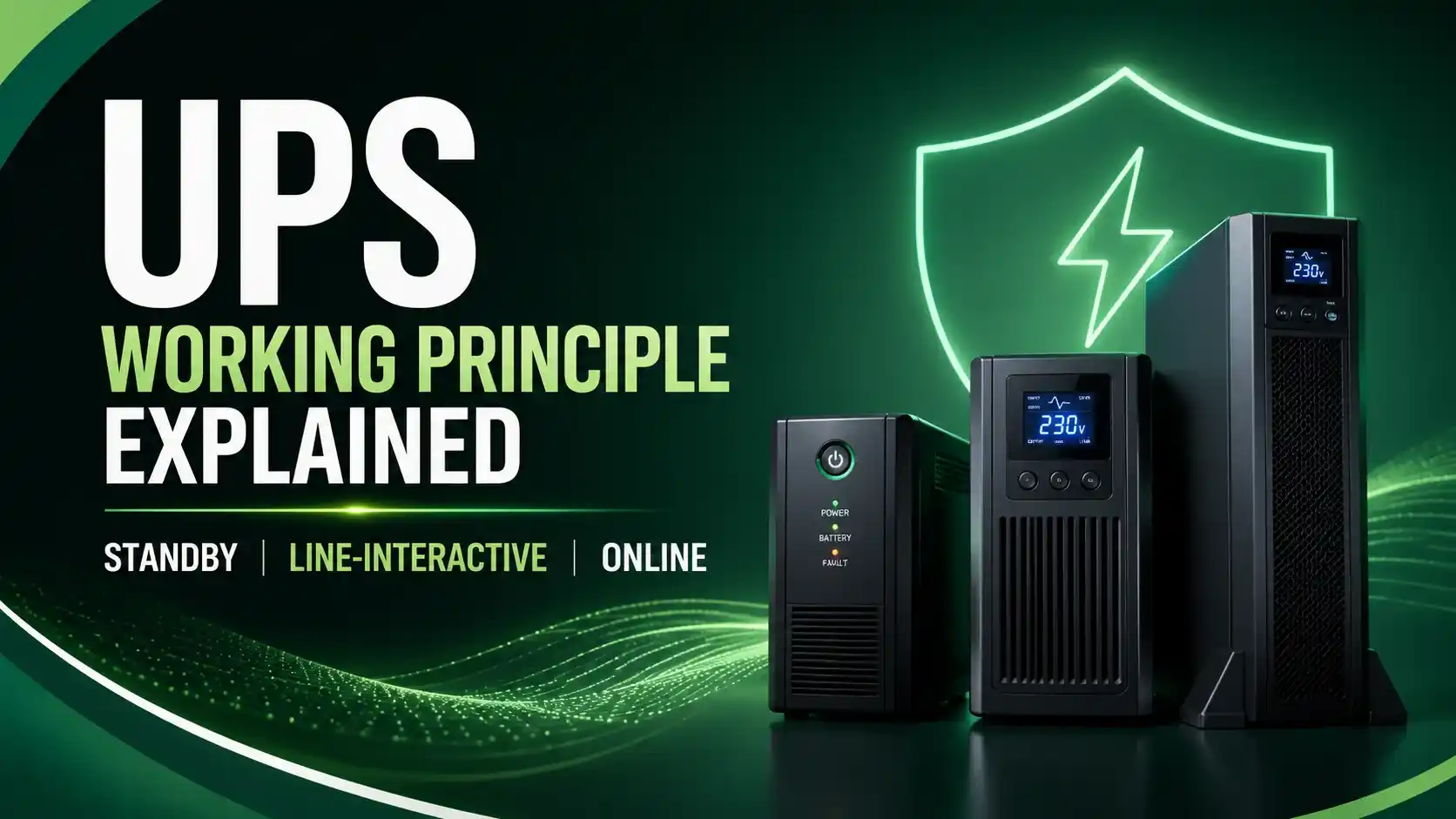
Beyond simple backup, a UPS also conditions incoming power, correcting problems like voltage sags, surges, and electrical noise before that power ever reaches sensitive connected equipment. A basic UPS consists of four core parts: a rectifier/charger (converts AC to DC to charge the battery), a battery (stores energy), an inverter (converts DC back to AC for the load), and a transfer switch (routes power between mains and battery/inverter).
Real Life Example
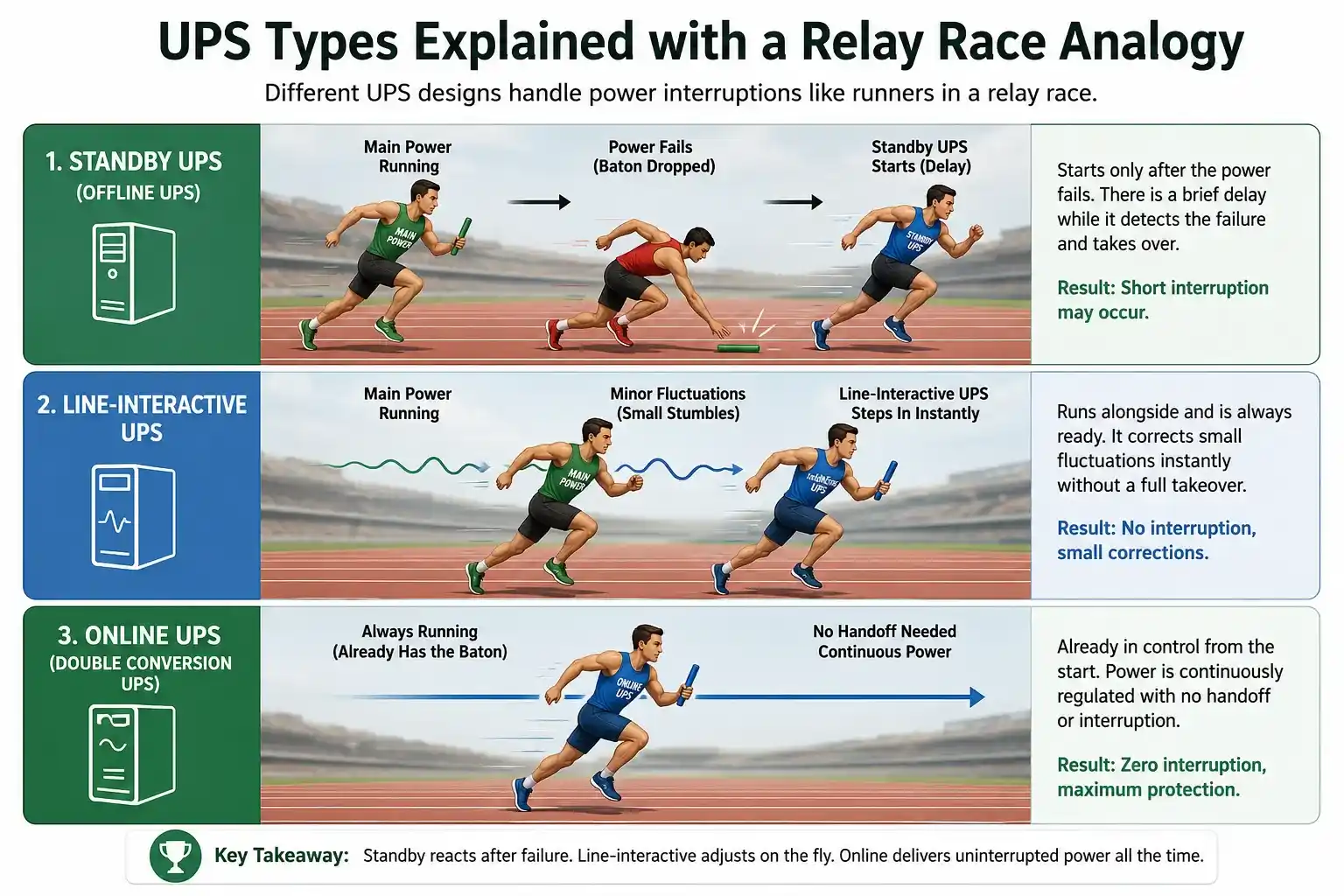
Think of a relay race. A standby UPS is like a runner who starts sprinting only after noticing the baton has already been dropped, there's a brief scramble before they catch up. A line-interactive UPS is like a runner jogging alongside, ready to grab the baton the instant it's needed, correcting their pace slightly for small stumbles without ever fully taking over. An online UPS is like a runner who is already carrying the baton the entire race, so there's no handoff moment at all, just one continuous, unbroken effort from start to finish.
The Three UPS Topologies
Standby (Offline) UPS
Passes mains power directly to the load under normal conditions. Switches to battery and inverter only when a failure is detected, with a transfer time of roughly 3 to 10 ms. Lowest cost, suited to home PCs and non-critical loads.
Line-Interactive UPS
Adds a multi-tap autotransformer that corrects minor voltage sags and surges by switching taps, without drawing on the battery. Only switches fully to battery for larger disturbances. Common in small business and departmental servers.
Online (Double-Conversion) UPS
Continuously converts incoming AC to DC, then back to AC through the inverter, so the load is always powered from the inverter, isolated from raw mains. Zero transfer time. Highest cost, used for data centers and mission-critical systems.
Comparison Table
Applications
DCS and PLC Panels
UPS backup protects control system continuity during brief utility outages.
Data Centers
Online double-conversion UPS is standard for servers needing zero transfer time.
Hospitals
Operating theaters and critical care equipment rely on UPS backup for patient safety.
Telecommunications
Network equipment and switching stations need continuous, clean power.
Banking Systems
Transaction and data integrity depend on uninterrupted, conditioned power.
Alarm and Safety Systems
Fire alarms and emergency signaling require guaranteed backup power availability.
UPS Working Principle: Video Walkthrough
Frequently Asked Questions About UPS Systems
- RealPars, What Is a UPS? (Uninterruptible Power Supply)
- Electrical4U, Uninterruptible Power Supply (UPS): Block Diagram and Explanation
- Vertiv, What Are the Different Types of UPS Systems?
What We Learn Today
- A UPS bridges the gap between mains power failure and backup power, using stored battery energy
- Standby UPS switches to battery only on failure, the cheapest and most basic option
- Line-interactive UPS corrects minor voltage issues via an autotransformer without touching the battery
- Online UPS continuously runs the load through its inverter, providing zero transfer time and full isolation
- A UPS also conditions power, correcting surges, sags, and noise, not just providing backup during outages