Ammonia is toxic to fish, eats up oxygen in rivers and decides how hard your blowers must work. Measuring it online, right in the aeration tank or at the outlet, turns nitrification from guesswork into a controlled, energy saving process.
Sewage and effluent treatment plants must remove ammonia before discharge, and aeration to do it is their biggest power bill. An ammonia analyzer gives the live reading that keeps the effluent legal while blowers run only as hard as needed.
What Is an Ammonia Analyzer?
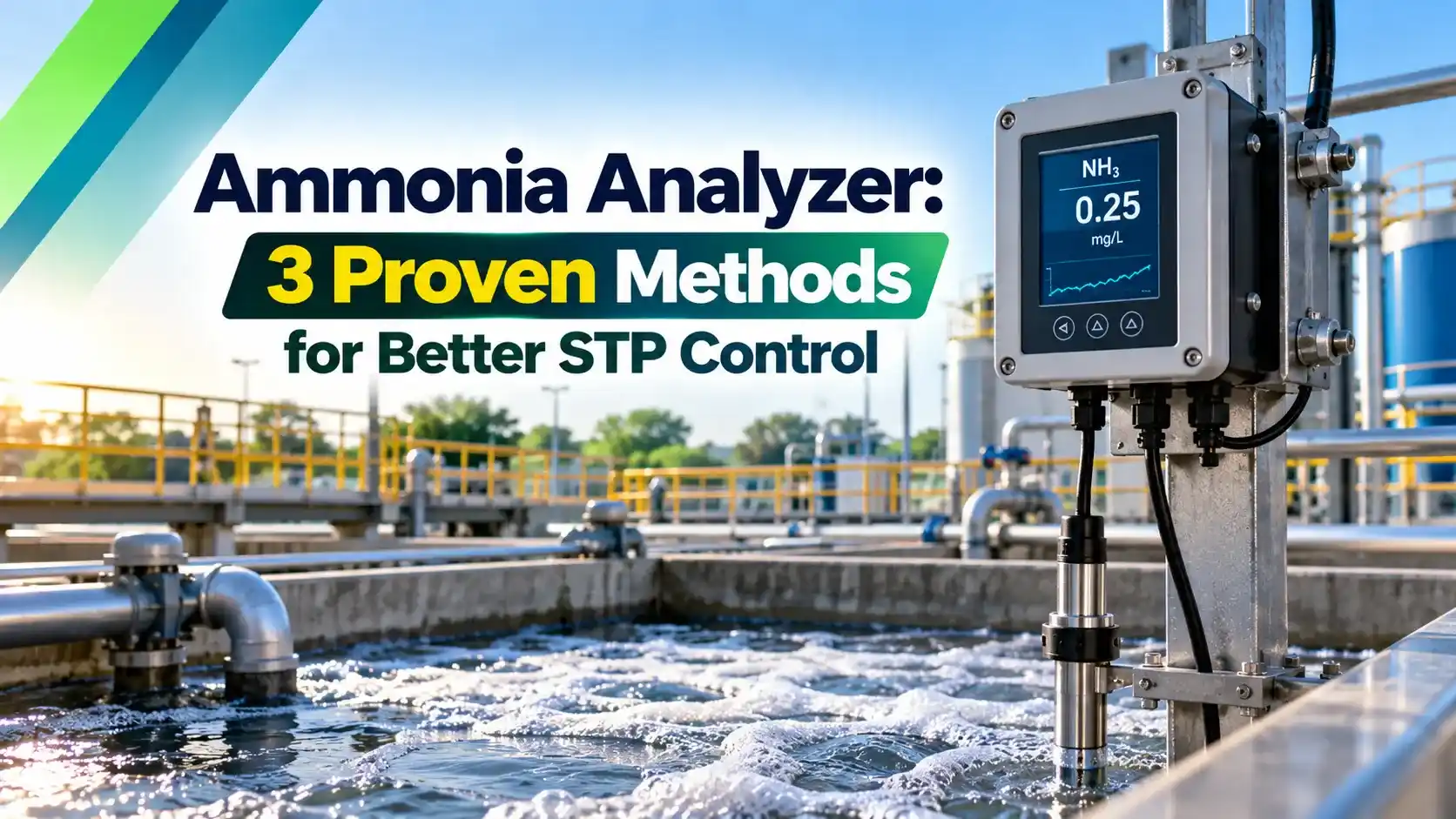
An ammonia analyzer is an online instrument that continuously measures the concentration of ammonia and ammonium in water, usually reported as ammonia nitrogen, NH4 N, in mg/l. It is used in sewage treatment plants, effluent plants, drinking water works and power plant cycles alongside the pH sensor and the dissolved oxygen probe.
In water, ammonia exists in two forms that change into each other with pH and temperature. Free ammonia, NH3, is the form that is toxic to fish, while ammonium, NH4 plus, dominates at the near neutral pH found in most treatment tanks.
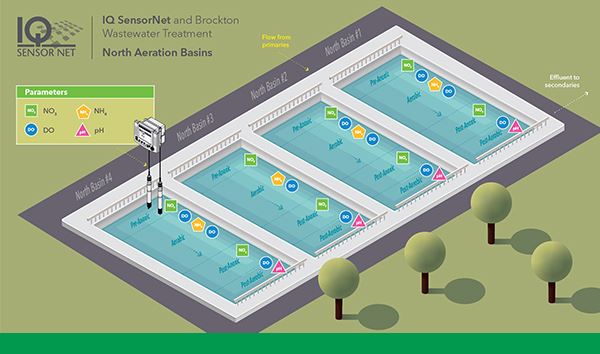
The diagram shows how a plant using an ammonia analyzer places ammonium, nitrate and oxygen sensors along an aeration basin. Each reading tells operators how far nitrification has progressed at that point in the tank.
3 Proven Ammonia Analyzer Measurement Methods
An ion selective membrane develops a voltage that follows the ammonium activity, read against a reference electrode.
The sample is made strongly alkaline, NH3 gas crosses a membrane and shifts the pH of an inner electrolyte.
Salicylate or indophenol chemistry forms a blue green dye, and a photometer measures its colour.
The ion selective electrode, or ISE, type of ammonia analyzer is a probe that sits directly in the tank. Its output follows the Nernst equation, close to 59 mV per tenfold change in ammonium at 25 °C, so a two point calibration sets the slope and offset.
Potassium ions look very similar to ammonium and cause a positive error in an ISE. Endress+Hauser solves this in its ISEmax CAS40D sensor with a separate potassium electrode for compensation, plus a chloride electrode for the nitrate channel.
A gas sensing ammonia analyzer adds sodium hydroxide to raise the sample pH above about 11, turning nearly all ammonium into dissolved NH3 gas.
The gas diffuses through a hydrophobic membrane and changes the pH of a thin electrolyte film, which an internal glass electrode reads. Because only the gas crosses the membrane, dissolved ions and colour cannot interfere.
A colorimetric ammonia analyzer is a small wet chemistry lab that draws a sample, adds reagents and measures absorbance after a fixed reaction time. The same photometric idea is used in the residual chlorine analyzer, and it gives the lowest detection limits for clean water.
Ammonia and ammonium swap places around pH 9.25 at 25 °C. At pH 7.5 less than 2 percent of the total is free NH3, yet that small share causes most of the toxicity to fish.
| Feature | ISE Probe | Gas Sensing Electrode | Colorimetric |
|---|---|---|---|
| Installation | Directly in tank | Panel with sample line | Panel with sample line |
| Reagents | None | Sodium hydroxide | Several chemicals |
| Response | Continuous, seconds | Batch, minutes | Batch, 5 to 15 min typical |
| Interference | Potassium, needs compensation | Volatile amines | Turbidity, colour |
| Best range | Aeration tanks, 1 mg/l and up | Effluent, mid to low | Drinking water, trace levels |
| Upkeep | Membrane caps, cleaning | Membrane, electrolyte, reagent | Reagents, tubing, filters |
Free Ammonia From Total Ammonia Nitrogen
Discharge limits in India list both ammonical nitrogen and free ammonia, so engineers often convert an ammonia analyzer reading from one into the other. The fraction of total ammonia nitrogen, or TAN, present as free NH3 depends on pH and temperature through the dissociation constant.
Free fraction f = 1 ÷ (1 + 10 ^ (pKa minus pH))
Free NH3 as N = TAN × f, and as NH3 multiply by 17 ÷ 14
Example:
TAN = 20 mg/l, pH = 7.5, T = 25 °C
pKa = 0.09018 + 2729.92 ÷ 298.15 = 9.246
f = 1 ÷ (1 + 10 ^ 1.746) = 0.0176
Free NH3 = 20 × 0.0176 × 17 ÷ 14 = 0.43 mg/l
The pKa expression is the widely used Emerson relation for fresh water. Raise the pH to 8.5 in the same example and the free ammonia jumps to about 3.7 mg/l, which shows why pH control matters at the outlet.
Free Ammonia Calculator
Second Worked Example: Oxygen Needed for Nitrification
Nitrifying bacteria need about 4.57 g of oxygen to convert 1 g of ammonia nitrogen into nitrate. A plant treating 10 MLD with 30 mg/l of ammonia nitrogen in the feed must therefore remove 300 kg of nitrogen per day.
That load needs 300 × 4.57 = 1371 kg of oxygen per day for nitrification alone, on top of the oxygen for BOD removal. This is why an ammonia analyzer at the tank inlet is so useful, since the load changes hour by hour.
Ammonia Limits and Why Plants Measure It
Schedule VI of the Environment (Protection) Rules, 1986 sets general discharge standards of 50 mg/l for ammonical nitrogen and 5 mg/l for free ammonia into inland surface water. State pollution control boards often impose tighter consent conditions on new sewage and effluent plants.
An ammonia analyzer is also a direct measure of how well nitrification is working. A rising ammonia analyzer reading usually warns of low oxygen, toxic shock or cold weather well before turbidity or TOC values show a problem.
How an Ammonia Analyzer Controls Aeration
Ammonia based aeration control, or ABAC, puts the ammonia loop on top of the oxygen loop in a cascade arrangement. The outer loop decides how much oxygen is really needed, and the inner loop uses the optical DO sensor to deliver it.
YSI reports that the Brockton plant in Massachusetts, treating 14 MGD to a total nitrogen limit of 3 mg/l, runs its north basins on ABAC with a variable 1 to 5 mg/l ammonium setpoint. Its south basins hold a fixed 2.5 mg/l oxygen setpoint instead.
June 2024 SCADA data showed the ABAC basins using about 45 percent less energy per MGD than the fixed oxygen basins. The blowers in such schemes are usually driven by a VFD, so lower air demand turns directly into saved kWh.
Tune the ammonia loop slowly, with minutes of integral time, because nitrification responds over tens of minutes. A fast outer loop simply makes the DO setpoint swing, as described in PID tuning.
Installing an Ammonia Analyzer Probe or Sample Line
- Place the probe where ammonium stays above about 1 mg/l for most of the day.
- Keep at least 30 cm below the surface and away from diffuser plumes.
- Use the cleaning system, compressed air or brush, on a fixed cycle.
- For panel analyzers, keep the sample line short and filtered.
- Shade the panel and keep reagents away from heat and sunlight.
- Bring the 4 to 20 mA or fieldbus signal to the DCS with alarms.
- Mark a grab sample point right next to the sensor.
YSI found in a pilot study that probes reading above 1 mg/l for most of the day give the best control signal. An ammonia analyzer placed where ammonia is always near zero cannot tell the controller how much margin is left.
Ammonia Analyzer Maintenance Routine
At Brockton, operators check each ammonium sensor monthly against grab samples, which takes about 40 minutes per sensor. YSI advises taking reference samples when ammonium is at or below 2.5 ppm and filtering them immediately so bacteria cannot change the result.
Filter the grab sample at the tank edge and test it within minutes. Unfiltered samples keep nitrifying in the bottle and read lower than the probe saw.
Where an Ammonia Analyzer Is Used
In drinking water, ammonia matters because it consumes chlorine and forms chloramines. Readings from the ammonia analyzer and the chlorine analyzer are therefore read together, often on the same SCADA alarm screen.
In power plant cycles, ammonia dosing raises feedwater pH, and operators confirm the dose with specific conductivity trends as well as analyzer readings.
Troubleshooting Ammonia Readings
A slow, steady drift on an ISE ammonia analyzer usually means a fouled or ageing membrane, while sudden steps point to air bubbles, cable damage or a reference problem. Compare with a lab result and check the measurement uncertainty of both methods before adjusting anything.
Readings that rise with potassium rich industrial waste suggest that compensation is missing or faulty. For colorimetric units, check reagent age, blocked tubing and the sample filter first, a routine shared with other online analyzers.
The Endress+Hauser ISEmax system has an integrated pH measurement. That lets it compensate the ammonium load reading at the aeration basin inlet without a separate probe.
- Live data for nitrification and aeration control.
- Proven energy savings with ABAC schemes.
- Early warning of process upsets and toxic shocks.
- Continuous proof of discharge compliance.
- ISE probes drift and need monthly checks.
- Potassium interferes unless compensated.
- Colorimetric units use reagents and have delays.
- Sample systems can block with solids and grease.
Endress+Hauser ISEmax Application Note
Ammonium ISE Sensor Video
Ammonia Analyzer FAQ
It measures ammonia and ammonium in water and usually reports the result as ammonia nitrogen in mg/l. Some models also calculate free ammonia from the measured pH and temperature.
Plants use the reading to control aeration and to prove discharge compliance to the pollution control board. It is one of the most useful online parameters in a modern sewage plant.
An ion selective membrane lets ammonium ions set up a voltage against a reference electrode. The voltage changes by about 59 mV for every tenfold change in concentration at 25 degrees.
Because potassium gives a similar signal, good sensors include a potassium electrode for compensation. A two point calibration then sets the slope and offset of the probe.
Colorimetric analyzers using salicylate or indophenol chemistry usually reach the lowest detection limits. They suit drinking water and final effluent where values are very small and limits are strict.
ISE probes are less precise but respond continuously and need no reagents at all. That makes them the usual choice for aeration control directly inside the tank.
It is a cascade scheme where an ammonia loop sets the target for the dissolved oxygen loop. Air is added only when the ammonia analyzer shows that nitrification really needs it.
YSI reports about 45 percent lower energy per MGD at the Brockton plant compared with fixed oxygen control. Actual savings vary with plant design, blower type and load patterns.
Schedule VI of the Environment (Protection) Rules sets 50 mg/l of ammonical nitrogen for discharge to inland surface water. It also limits free ammonia to 5 mg/l for the same discharge route.
State boards may set tighter consent limits for a specific plant or river stretch. Always check the consent to operate before choosing the range of an ammonia analyzer.
Compare the probe with a filtered grab sample about once a month. Apply an offset if the error is consistent, and recalibrate fully after changing membrane caps.
Automatic cleaning should run on a short cycle to keep biofilm off the membrane. Colorimetric units also need fresh reagents well before the expiry date printed on the bottles.
At higher pH more ammonium loses a hydrogen ion and turns into free NH3. The split is controlled by a dissociation constant near pH 9.25 at 25 degrees.
In the worked example, free ammonia rises more than eightfold when pH goes from 7.5 to 8.5. Warmer water pushes the balance even further toward the toxic form.
Related Articles
- Optical Dissolved Oxygen Sensors
- pH Sensor Working
- Residual Chlorine Analyzer Working
- TOC Analyzer Working Principle
- Turbidity Measurement Guide
External References
- ISEmax CAS40D Nitrification Control Note, Endress+Hauser
- Ammonia Based Aeration Control and Energy Efficiency, YSI
- Ion Selective Electrode, Wikipedia
What We Learn Today
- An ammonia analyzer measures ammonium as NH4 N using an ISE probe, a gas sensing electrode or a salicylate or indophenol colorimetric method.
- Free ammonia depends on pH and temperature, so 20 mg/l of TAN at pH 7.5 and 25 °C gives only about 0.43 mg/l of free NH3.
- Ammonia based aeration control cut energy per MGD by about 45 percent at the Brockton plant, according to YSI field data.