
A TOC analyzer measures the mass of carbon bound in organic compounds dissolved in a water sample. It is a key water quality parameter in pharmaceutical manufacturing, semiconductor fabrication, and wastewater treatment.
All TOC analyzers work by the same three-step process: remove or quantify inorganic carbon, oxidise all remaining organic compounds to CO2, and measure the CO2 produced to calculate the TOC concentration.
TOC is expressed in mg/L or ppb. Ultrapure water for semiconductor fabrication must contain less than 1 ppb TOC.
Pharmaceutical purified water under USP 643 must be below 500 ppb. Potable water limits are typically below 2 mg/L.
We will cover what TOC, TC, and IC mean, the three main oxidation methods used in TOC analyzers (combustion, UV persulfate, and wet chemical), how CO2 is detected after oxidation, the calibration procedure, and the key industrial and regulatory applications of online TOC monitoring.
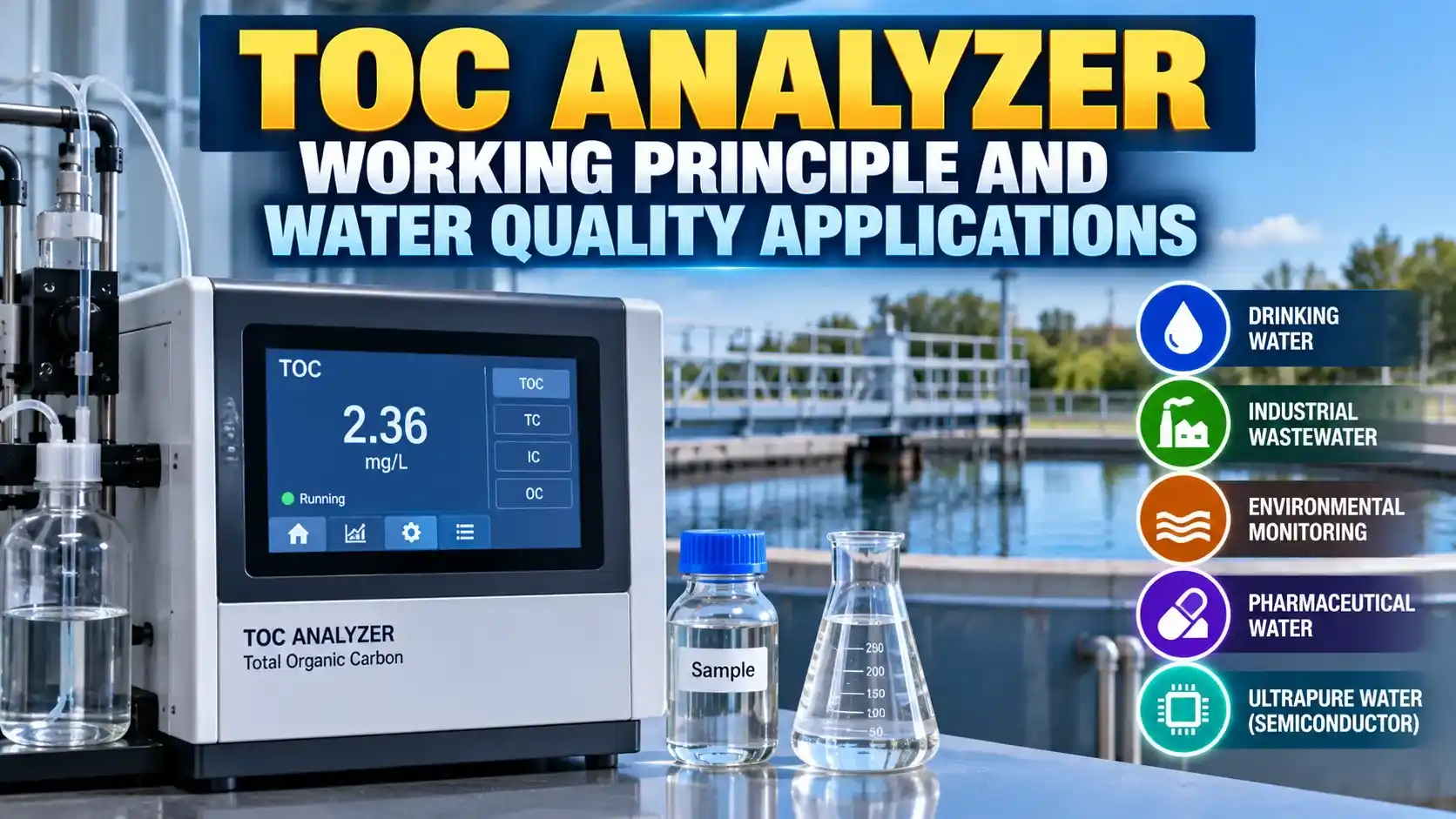
What Is TOC and How Does It Differ from TC and IC?
Total Carbon (TC) is the sum of all carbon-containing species in a water sample: organic and inorganic. The inorganic carbon (IC) fraction comes mainly from dissolved CO2, bicarbonates, and carbonates.
TOC is the carbon bound in organic compounds.
The relationship is: TOC = TC minus IC
A TOC analyzer either measures TC and IC separately and calculates the difference, or removes IC by acidifying and sparging before oxidation (the NPOC method). Most online analyzers use NPOC.
Dissolved organic carbon (DOC) is TOC measured on a filtered sample (0.45 micron filter). In most treated water applications, TOC and DOC are used interchangeably because particulates are negligible.
Three Oxidation Methods Used in TOC Analyzers
The oxidation method determines how organic compounds in the water sample are converted to CO2 for measurement. Each method has different oxidation efficiency, matrix suitability, and detection limit.
The water sample is injected into a combustion furnace at 680 to 900 degrees C packed with a platinum catalyst. All organic compounds are oxidised to CO2 at this temperature.
Best for: high TOC samples (0.5 to 30,000 mg/L), samples with complex matrices, samples with high particulate content. Used in environmental labs and industrial wastewater.
The water sample is acidified to convert IC to CO2 and sparged to remove it. Persulfate reagent is added and the sample is irradiated with UV light.
Hydroxyl radicals from UV photolysis of persulfate oxidise organic compounds to CO2.
Best for: low to medium TOC (0 to 25 mg/L), clean water matrices (pharmaceutical, semiconductor, drinking water). Most common method in online process TOC analyzers.
The water sample is combined with a strong oxidising reagent (persulfate, dichromate, or ceric sulfate) and heated to 100 to 130 degrees C. The reagent oxidises organic compounds to CO2.
Best for: online monitoring of industrial wastewater with moderate TOC, matrices where UV absorption would reduce the persulfate method's efficiency (coloured or turbid samples).
Three Steps Every TOC Analyzer Follows
CO2 Detection Methods: NDIR vs Membrane Conductometry
| Parameter | NDIR Detection | Membrane Conductometry |
|---|---|---|
| Principle | CO2 absorbs infrared light at 4.26 microns. The reduction in transmitted IR intensity is proportional to CO2 concentration. Uses the same NDIR cell principle as the gas analyzers discussed in the NDIR article. | CO2 permeates a hydrophobic gas-permeable membrane from the liquid sample into a pure water stream. The dissolved CO2 lowers the conductivity of the pure water stream. The conductivity change is measured and converted to CO2 concentration. |
| Detection range | 0.1 mg/L to thousands of mg/L depending on cell path length and sample flow | Sub-ppb (0.001 mg/L) to approximately 25 mg/L. Preferred for ultrapure water TOC measurement at ppb levels. |
| Sensitivity | Good for process water and wastewater (ppm range) | Excellent for ultrapure and pharmaceutical water (ppb range). Can detect less than 0.1 ppb TOC. |
| Matrix sensitivity | Some gases in the carrier stream (H2O, SO2) can interfere with the 4.26 micron CO2 band. A membrane dryer removes moisture before the NDIR cell. | Only CO2 permeates the hydrophobic membrane. Other gases and dissolved species do not cross, giving high selectivity. Temperature control of the conductivity cell is critical. |
| Typical application | Industrial wastewater, environmental monitoring, drinking water, process water (0.1 to 1000 mg/L range) | Pharmaceutical water (USP 643), semiconductor ultrapure water, high-purity process water where TOC must be below 500 ppb |
TOC Analyzer Calibration and Validation
TOC analyzers are calibrated using certified reference standard solutions. The most widely used calibration standard is sucrose or potassium hydrogen phthalate (KHP) dissolved in ultrapure water to a known TOC concentration.
Water Quality Applications of TOC Analyzers
Watch: How TOC Analyzers Work
TOC Analyzer Questions Engineers Ask
Related Articles on This Site
- Conductivity Sensor Working Principle Explained
- Conductivity Sensor Cell Constant and Calibration
- What Is a pH Sensor and How Does It Work?
- Turbidity Measurement Guide: Sensors and Applications
- How Do Optical Dissolved Oxygen Sensors Work?
External References
- Total Organic Carbon and Its Measurement | ELGA LabWater
- Basics of TOC and Conductivity in Pharmaceutical Water | Veolia Water Technologies
What We Learn Today
- TOC equals Total Carbon minus Inorganic Carbon. A TOC analyzer removes IC by acid sparge, oxidises organic compounds to CO2 by combustion, UV persulfate, or wet chemical oxidation, then measures the CO2 by NDIR or membrane conductometry. The oxidation method determines the measurement range and matrix suitability.
- NDIR covers ppm-range TOC in process and environmental water. Membrane conductometry achieves sub-ppb detection for pharmaceutical and semiconductor ultrapure water. USP 643 system suitability requires both KHP and sucrose standards, with acceptance criteria for pharmaceutical water monitoring.
- Key applications include pharmaceutical PW and WFI (USP 643 limit 500 ppb), semiconductor ultrapure water (limit 1 ppb), drinking water TOC for disinfection by-product control, industrial wastewater as a COD/BOD surrogate, power plant condensate, and cooling water organic contamination monitoring.