
Continuous chlorine monitoring keeps drinking water safe and stops overdosing that wastes chemicals and harms equipment.
A residual chlorine analyzer continuously measures how much disinfectant remains in treated water after the chlorine demand is satisfied. Operators use that live value to control dosing pumps and prove that the water leaving the plant is safe.
What Is a Residual Chlorine Analyzer?
A residual chlorine analyzer is an online instrument that measures the chlorine left in water after disinfection, usually in mg/L or ppm. It sends a 4 to 20 mA signal to the PLC or SCADA so dosing can be trimmed automatically.
Chlorine added to water first reacts with organic matter, iron and other impurities. Only the chlorine left after this demand protects the water as it travels through pipes, and that is the residual we measure.
It is one of the most important analytical measurements in any water plant. Too little chlorine allows bacteria to survive, while too much causes taste complaints and corrosion.
Indian drinking water standard IS 10500 asks for a minimum free residual chlorine of 0.2 mg/L. Many utilities target a slightly higher value at the plant outlet so the far end of the network still stays above that limit.
Free, Combined and Total Chlorine
Free chlorine is the sum of hypochlorous acid and hypochlorite ion. Hypochlorous acid is by far the stronger disinfectant, so the balance between the two matters a lot.
When ammonia is present, chlorine forms chloramines, which are called combined chlorine. Some utilities dose chloramines on purpose because they last longer in large networks.
Total chlorine is free plus combined chlorine. Always confirm which value your permit or process requires before ordering an analyzer, because the sensor or reagent differs.
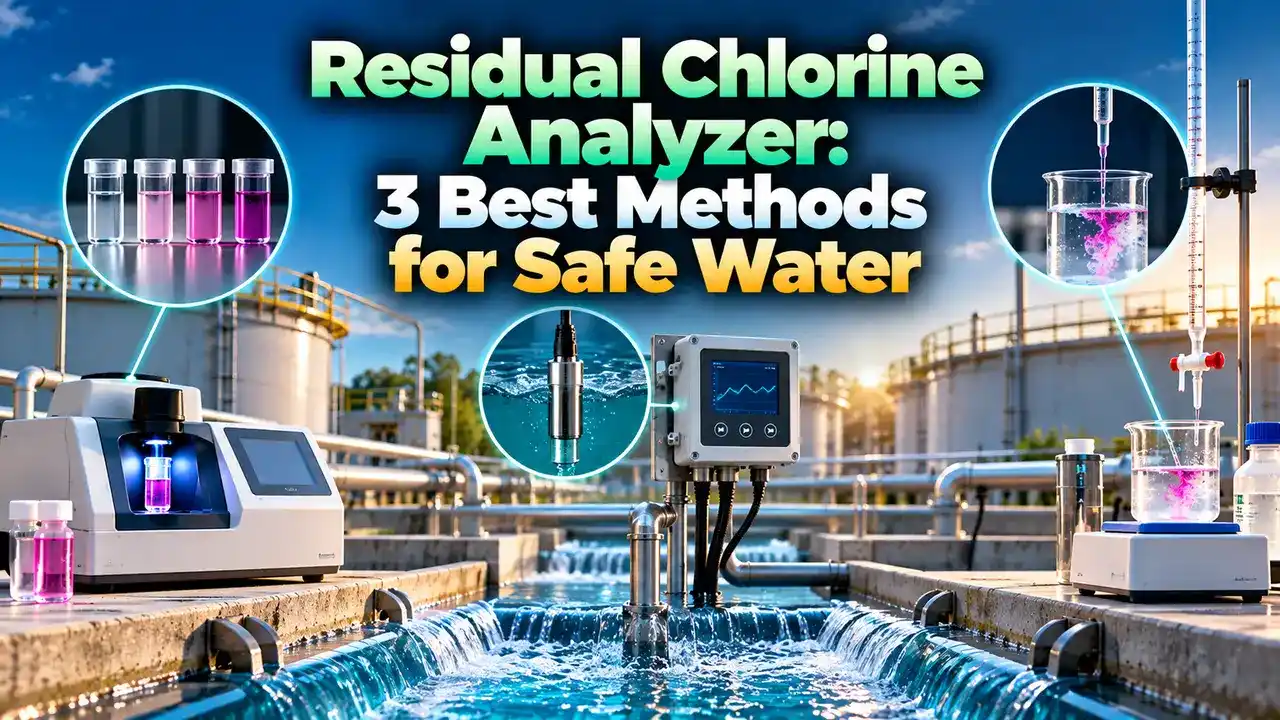
3 Best Measurement Methods
A membrane covered electrode cell measures current proportional to chlorine that diffuses through.
Bare electrodes in the sample, often with self cleaning beads.
A reagent turns the sample pink and a photometer reads the colour intensity.
Amperometric sensors give a fast, continuous signal with no reagents to buy. However they respond mainly to hypochlorous acid, so pH changes must be compensated.
DPD analyzers take a sample every few minutes, add reagent and read the colour at around 515 nm. They are factory calibrated and largely unaffected by pH, temperature and flow swings.
pH Effect on Free Chlorine
pKa of hypochlorous acid is about 7.5 at 25 °C
Worked example at pH 8.0:
pH minus pKa = 8.0 minus 7.5 = 0.5
10^0.5 = 3.162
HOCl percent = 100 ÷ (1 + 3.162) = 24.0 percent
At pH 7.0:
10^(7.0 minus 7.5) = 0.316
HOCl percent = 100 ÷ 1.316 = 76.0 percent
So a pH shift of just one unit changes the strong disinfecting fraction from 76 to 24 percent. This is why every amperometric free chlorine panel includes a pH sensor for compensation.
Without pH compensation, an amperometric reading can drift badly even when the true free chlorine is constant. DPD methods avoid this problem because the reagent buffers the sample.
5 Steps in an Online DPD Analysis Cycle
A typical cycle takes about two to three minutes. Reagent bottles usually last around one month, and tubing needs replacement roughly every six months.
Because the method is a batch measurement, it is slower than an amperometric sensor. For fast dosing loops, some plants combine both methods.
Amperometric vs DPD Residual Chlorine Analyzer
| Feature | Amperometric | DPD Colorimetric |
|---|---|---|
| Reagents | None | Monthly reagent refill |
| Response | Continuous and fast | Every 2 to 3 minutes |
| Calibration | Periodic against grab sample | Factory calibrated |
| pH effect | Needs compensation | Minimal |
| Maintenance | Membrane and electrolyte change | Reagent and tubing change |
| Waste stream | Sample only | Sample plus reagent |
Amperometric designs suit plants that want low running cost and fast control. DPD suits regulatory reporting and total chlorine, where accuracy and traceability matter most.
YSI notes that amperometric readings can become unreliable when sample pH, temperature, flow or pressure swing by more than about 20 percent. Stable sample conditions are the secret to good amperometric performance.
Where a Residual Chlorine Analyzer Is Used
Chlorine is rarely measured alone. It usually sits on the same panel as turbidity, pH, conductivity and ORP to give a full picture of water quality.
In food plants, chlorinated rinse water often feeds CIP systems. Monitoring the residual prevents both microbial risk and corrosion of stainless steel.
Installation and Maintenance Tips
Take the sample from a well mixed point after enough contact time, and keep the sample line short. A long line lets chlorine decay before it reaches the sensor.
Hold sample flow and pressure steady with a flow regulator or constant head overflow. Verify the reading weekly against a handheld DPD test and adjust the slope if needed.
Replace membranes and electrolyte on the interval the manufacturer states, typically every few months. Keep spare reagent in stock so DPD units never run dry.
Wastewater plants often add optical dissolved oxygen sensors on the same sample line. Sharing one sample conditioning panel saves space and simplifies maintenance.
Hypochlorous Acid Fraction Calculator
Try pH 6.5 and you will see that most free chlorine is in the strong acid form. Many plants therefore control pH to get more disinfection from the same dose.
- Continuous proof of safe disinfection.
- Automatic dosing reduces chemical cost.
- Early warning of chlorine demand changes.
- Data logging for regulatory reports.
- Amperometric sensors need pH compensation.
- DPD units use reagents and create waste.
- Sample conditions must stay stable.
- Regular verification with grab samples is needed.
DPD vs Amperometric Guide PDF
Chlorine Residual Measurement Video
Residual Chlorine Analyzer FAQ
Related Articles
- Importance of Analytical Measurements
- What Is a pH Sensor
- ORP Measurement Explained
- Turbidity Measurement Guide
- TOC Analyzer Working Principle
External References
- Chlorine Measurement DPD vs Amperometric, YSI
- Residual Chlorine Analyzer, Chemtrac
- Amperometric Chlorine Measurement Principle, Endress+Hauser
- Amperometric Probes or DPD Analyzers, Hach
- Hypochlorous Acid, Wikipedia
What We Learn Today
- This analyzer measures the chlorine left after demand, which proves safe disinfection.
- pH controls how much free chlorine is in the strong hypochlorous acid form.
- Amperometric suits fast reagent free control, while DPD suits accurate compliance reporting.