
Gas Analyzers Explained: O2, CO2, and NOx Measurement Working Principles
A power plant stack gas stream is invisible, odorless to a human nose at these concentrations, and yet three different physical tricks, magnetism, ion conduction, and infrared absorption, can each read exactly what's inside it.
Gas analyzers measure the concentration of specific gas components like O2, CO2, and NOx in a process or emission stream, each using a physical principle matched to that particular gas. This guide explains zirconia and paramagnetic oxygen analyzers, NDIR analyzers, and chemiluminescence NOx detection.
Why Different Gases Need Different Analyzer Principles
No single sensing technology measures every gas well. Oxygen analyzers exploit oxygen's unusual magnetic and electrochemical properties. Carbon-based gases like CO2, CO, and CH4 are measured almost universally using infrared absorption, since these molecules absorb infrared light at specific, well-defined wavelengths. NOx, being a fast, low-concentration combustion byproduct, is often measured using a light-emitting chemical reaction called chemiluminescence rather than infrared absorption.
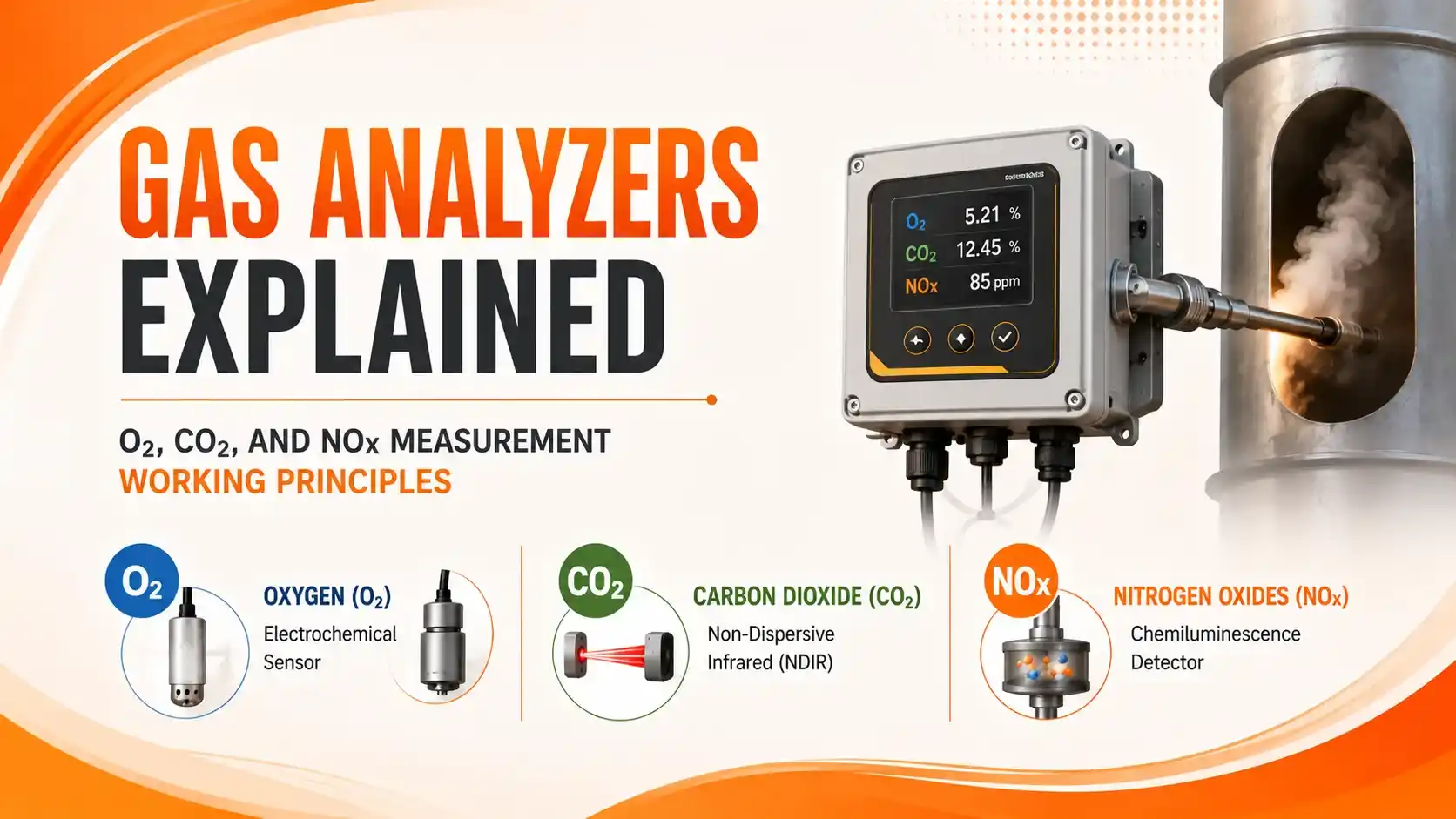
These analyzers are central to process control and environmental compliance across combustion, chemical, and power generation industries, feeding continuous emissions monitoring systems (CEMS) that regulators require at many industrial facilities.
Real Life Example
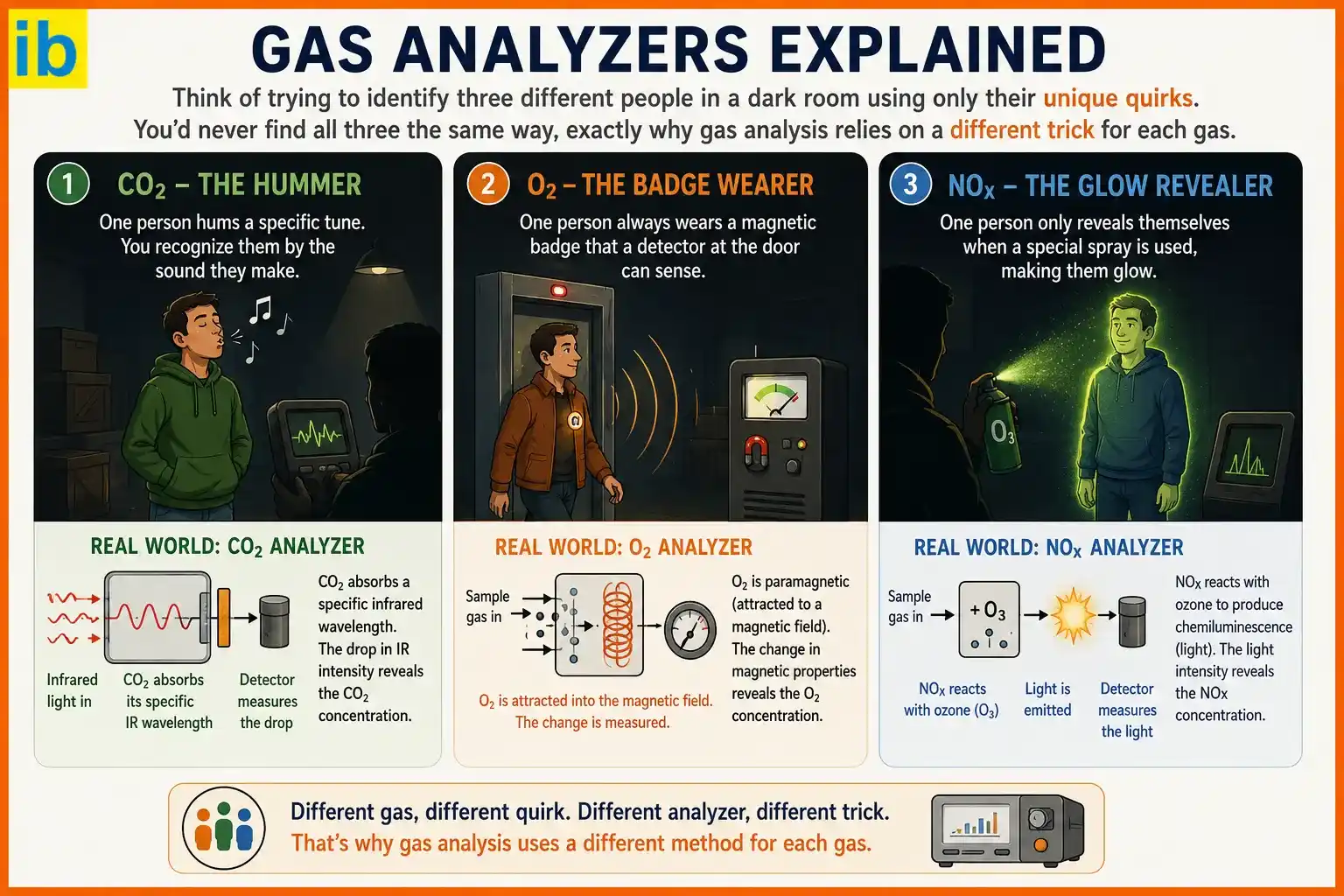
Think of trying to identify three different people in a dark room using only their unique quirks: one hums a specific tune (like CO2 absorbing a specific infrared wavelength), one always wears a magnetic badge that a detector at the door can sense (like oxygen's magnetic attraction), and one only reveals themselves when they react chemically with a specific chemical spray that makes them glow (like NOx reacting with ozone to emit light). You'd never find all three the same way, exactly why gas analysis relies on a different trick for each gas.
Oxygen Analyzer Technologies
Zirconia (ZrO2) Analyzer
A heated zirconium dioxide ceramic element conducts oxygen ions at high temperature. The voltage generated between electrodes on either side, following the Nernst equation, depends directly on the oxygen concentration difference between process gas and a reference gas.
Paramagnetic Analyzer
Exploits oxygen's paramagnetic property, its attraction to a magnetic field. A small dumbbell of nitrogen-filled glass spheres suspended in the sample deflects proportionally to oxygen concentration, detected optically.
Electrochemical Analyzer
Oxygen diffuses through a membrane into an electrochemical cell, generating a current proportional to concentration. Common in portable and lower-cost fixed analyzers, with a finite sensor lifespan.
NDIR: How CO2, CO, and CH4 Are Measured
Non-Dispersive Infrared (NDIR) analyzers pass infrared light through a sample cell containing the process gas. An optical filter in front of the detector transmits only the specific narrow wavelength band that the target gas molecule absorbs, while other gases in the mixture ideally don't absorb at that same wavelength. The more target gas present, the more infrared light gets absorbed before reaching the detector, and that attenuation is directly proportional to gas concentration.
NDIR technology covers CO2, CO, CH4, SO2, and NO with excellent selectivity and no moving parts, making it durable, low-maintenance, and well suited to continuous industrial measurement. Multi-component NDIR analyzers can measure several of these gases simultaneously using separate optical filters and detectors within a single instrument.
NOx Measurement: Chemiluminescence
Nitrogen oxides (NOx), primarily NO and NO2, are commonly measured using chemiluminescence detection rather than infrared absorption. The sample gas is mixed with ozone (O3) generated by the analyzer itself. NO reacts with ozone to form excited nitrogen dioxide (NO2*), which emits light as it decays back to its ground state, a reaction called chemiluminescence. A photomultiplier detects this light, and its intensity is directly proportional to the NO concentration present.
Comparison Table
Applications
Continuous Emissions Monitoring (CEMS)
Regulatory compliance requires continuous stack gas monitoring at many industrial facilities.
Combustion Control
O2 trim control optimizes boiler and furnace air-fuel ratio for efficiency and emissions.
Chemical Process Monitoring
Gas composition monitoring supports safety and product quality in chemical processes.
Steel and Cement Plants
Process gas analysis supports furnace control and environmental compliance.
Biogas and Landfill Gas
CH4 and CO2 analysis supports biogas quality monitoring and energy recovery.
Automotive Emissions Testing
NDIR and chemiluminescence analyzers support engine emissions certification testing.
Gas Analyzers: Video Walkthrough
Frequently Asked Questions About Gas Analyzers
- HORIBA, Structure and Operating Principle of Gas Analyzer Using NDIR
- Fuji Electric, Gas Analyzer Operating Principles
- Wikipedia, Nondispersive Infrared Sensor
What We Learn Today
- No single technology measures every gas well; each analyzer type exploits a physical property specific to its target gas
- Oxygen analyzers use zirconia, paramagnetic, or electrochemical principles based on oxygen's unique properties
- NDIR analyzers measure CO2, CO, and CH4 via gas-specific infrared absorption, with no moving parts
- NOx is typically measured via chemiluminescence, detecting light from an NO-ozone reaction
- Sample conditioning is critical; skipping it is a common cause of unreliable field measurements