
In a balanced linear load the neutral carries almost nothing, but computers, LED drivers and drives change that picture completely. Third harmonic currents add up in the neutral and can push it above the phase current, overheating cables that looked perfectly sized on paper.
Modern electronic loads send third harmonic currents into the neutral, where they add instead of cancelling. Correct neutral conductor sizing uses the harmonic content of the load to decide whether the cable is chosen on phase current or on neutral current.

What Is Neutral Conductor Sizing?
Neutral conductor sizing is the process of choosing the cross section of the neutral in a 3 phase 4 wire or single phase circuit so that it can carry its real current, including harmonics, without overheating. It sits alongside normal cable sizing and ampacity checks and is often the step that engineers forget.
For many years designers simply used a neutral equal to the phase, or even half of it, because the neutral of a balanced load carries little current. That habit is no longer safe in offices, data centres and plants full of electronic loads, as explained in power harmonics explained.
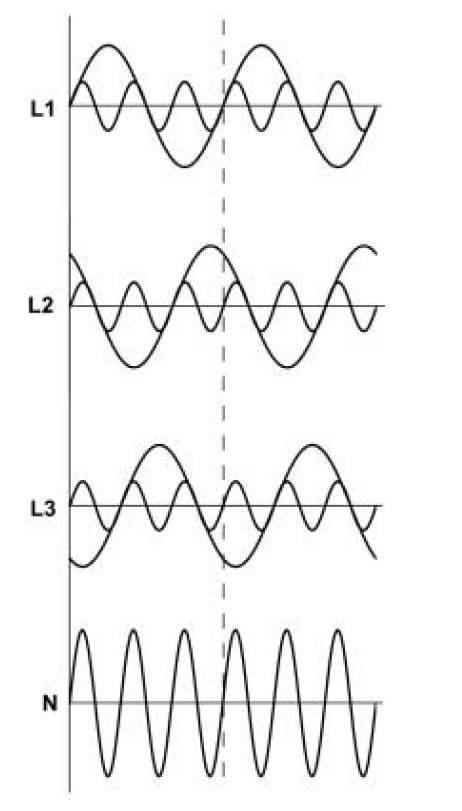
The figure shows why neutral conductor sizing needs care in 3 phase 4 wire systems. The fundamental currents of the three phases are 120 degrees apart and cancel in the neutral, but the third harmonic currents are in step with each other and add directly.
Why Triplen Harmonics Add in the Neutral
A third harmonic wave has three cycles for every one cycle of the fundamental. Shifting it by 120 fundamental degrees moves it by 360 of its own degrees, so the third harmonic of phase R, Y and B lines up perfectly.
The same is true for the 9th, 15th and every odd multiple of three, which together are called triplen or triple N harmonics. These zero sequence currents return only through the neutral, so the neutral current equals three times the triplen current of one phase.
I3 = h × Ib, where h is third harmonic content as a fraction of phase current
Example: Ib = 39 A, h = 40 percent
I neutral = 3 × 0.40 × 39 = 46.8 A
Neutral current is 1.2 times the phase current
Single phase rectifier loads such as SMPS units, LED drivers and small UPS systems draw short pulses of current near the voltage peak. Their spectrum is rich in third harmonic, which is why office distribution boards are the classic place for hot neutrals.
Jan Desmet and Angelo Baggini, in their Leonardo Power Quality Initiative guide republished by Power Quality Blog, state that the neutral current can theoretically reach 1.73 times the phase current. They report about 1.61 times for typical computer loads and note that neutral currents near 170 percent of phase current are seen in harmonic rich installations.
A wye connected transformer secondary feeding nonlinear loads carries triplen currents back through its neutral to the delta primary, where they circulate inside the winding. This is one reason transformers serving IT loads run hotter than their kVA meter reading suggests.
Why Neutral Conductor Sizing Matters in Modern Plants
Without proper neutral conductor sizing, an overloaded neutral gives no warning on most MCB based protection schemes, because standard breakers and fuses watch only the phases. The cable insulation then ages quickly, terminals discolour and, in the worst case, a neutral fails open.
An open neutral in a 3 phase 4 wire system shifts the star point and can put close to line voltage across single phase equipment on the lightly loaded phase. The resulting damage to computers and instruments is costly, and the root cause is usually poor neutral conductor sizing combined with high THD in the load current.
Before trusting an old drawing, clamp a true RMS meter on the neutral of a busy lighting or IT board. If the neutral reads close to or above the phase currents, the harmonic content is high and the neutral needs a fresh check.
4 Proven Rules From IEC 60364 5 52 Annex E
For neutral conductor sizing, IEC 60364 5 52, the international wiring standard, gives in its Annex E a simple table for 4 core and 5 core cables in which all four or five conductors share the same size. The table links third harmonic content to a reduction factor and to the current used when you select cable size for load current.
| Third harmonic in phase current | Size the cable on | Reduction factor |
|---|---|---|
| 0 to 15 percent | Phase current | 1.0 |
| Above 15 to 33 percent | Phase current | 0.86 |
| Above 33 to 45 percent | Neutral current | 0.86 |
| Above 45 percent | Neutral current | 1.0 |
The factor of 0.86 accounts for four loaded conductors inside one sheath and works like other cable derating factors. Above 45 percent the neutral current is so dominant that a cable sized on it already has spare capacity in the phases, so no further reduction is needed.
Neutral Current and Cable Size Calculator
Enter the design phase current and the third harmonic content as a percentage of that phase current. The calculator applies the four Annex E rules and gives the current you should use when you pick a 4 core cable from the ampacity table.
Step 2: h = 40 percent lies in the 33 to 45 percent band
Step 3: Sizing current = 46.80 ÷ 0.86 = 54.42 A
Choose a 4 core cable whose installed rating is at least 54.42 A
Second Worked Example With Lower Harmonics
For a second neutral conductor sizing case, take the same 39 A circuit feeding mostly motor loads with a few VFDs, where measurement shows 20 percent third harmonic. The neutral current is 3 × 0.20 × 39 = 23.4 A, still below the phase current.
The 20 percent value falls in the 15 to 33 percent band of the neutral conductor sizing table, so the cable is chosen on the phase current divided by 0.86. That gives 39 ÷ 0.86 = 45.35 A, which is the value you take into the ampacity table.
At exactly 33.3 percent third harmonic in each phase, the neutral current equals the phase current. That is why the IEC table switches from phase based to neutral based sizing near this value.
Reduced, Full and Oversized Neutral Options
Neutral smaller than phase, allowed only for large phase conductors with low harmonics and a protected neutral.
Neutral equal to phase, the normal choice for single phase circuits and small 3 phase circuits.
Neutral larger than phase, often 1.5 or 2 times, or a cable chosen on neutral current.
IEC 60364 5 52 allows a reduced neutral only when the phase conductor is larger than 16 mm² copper or 25 mm² aluminium, the expected neutral current including harmonics is within the reduced rating and the neutral is protected against overcurrent. The neutral must still be at least 16 mm² copper or 25 mm² aluminium in that case.
In single phase two wire circuits the neutral carries the full load current, so it is always the same size as the phase. Small 3 phase circuits up to 16 mm² copper also use a full size neutral, which is standard practice in Indian panel building under IS 732, and the same thinking applies when you do busbar sizing for the neutral bar.
Neutral Conductor Sizing Step by Step
For neutral conductor sizing on new projects without measurements, use typical spectra from the load makers or treat IT and LED lighting circuits as high harmonic. For existing plants, a power quality analyser on the incomer gives the real third harmonic content, and the same survey helps when sizing an active harmonic filter.
Where a neutral larger than the phase is needed, a simple solution is to run single core cables and lay two parallel neutral cores. Make sure both cores have identical length and termination so that they share the current equally.
Myths About the Neutral
Protection and Installation Practice
In TN systems, IEC requires overcurrent detection on the neutral when its cross section is smaller than the phase or when harmonic current may exceed its rating. Four pole breakers with a neutral trip element, described in MCB vs MCCB vs ELCB vs RCCB, are the common way to provide it.
- Measure neutral current with a true RMS clamp meter.
- Record third harmonic content at the board with an analyser.
- Compare neutral current with the rating of the neutral core.
- Inspect neutral terminals and links for discolouration.
- Check that 4 pole breakers have a correctly set neutral element.
- Confirm neutral busbar size matches the design current.
- Repeat a thermal scan after adding new IT or LED loads.
- Prevents hidden overheating of cables and busbars.
- Reduces risk of open neutral and voltage shift.
- Keeps insulation life close to design value.
- Gives room for future electronic loads.
- Needs harmonic data that may not exist at design stage.
- Larger cables and 4 pole devices add cost.
- Annex E covers only third harmonic in equal size cores.
- Parallel neutrals need careful installation.
Applications Where the Neutral Needs Extra Care
Research Paper on Neutral Size Selection
Video on Triplen Harmonics and the Neutral
Neutral Conductor Sizing FAQ
It is the selection of the neutral cross section so that it carries its real current, including harmonics, without overheating. It applies to single phase and 3 phase 4 wire circuits.
In modern installations the neutral can carry more current than the phases. Ignoring this leads to hot cables, damaged terminals and the risk of an open neutral.
The third harmonic of each phase is shifted by 360 of its own degrees, so all three are in step. They add arithmetically in the neutral instead of cancelling, unlike the fundamental currents.
The neutral current therefore equals three times the third harmonic current of one phase. The same applies to the 9th, 15th and other triplen harmonics.
It is a reduction factor for a 4 core or 5 core cable when the neutral is also loaded. The neutral adds heat inside the same sheath, so the cable rating is lowered.
It applies when third harmonic content is above 15 and up to 45 percent. Below 15 percent and above 45 percent the factor is 1.0.
IEC allows it only when the phase is larger than 16 mm² copper or 25 mm² aluminium and harmonic current is low. The neutral must also be protected against overcurrent.
Even then the neutral must be at least 16 mm² copper or 25 mm² aluminium. Single phase circuits always need a full size neutral, whatever the load type.
The Leonardo Power Quality Initiative guide gives a theoretical maximum of about 1.73 times the phase current. Typical computer loads give around 1.61 times the phase current.
Values near 170 percent of phase current are reported in real harmonic rich buildings. This is why careful neutral conductor sizing and 200 percent neutrals are common in IT installations.
Use a true RMS clamp meter or a power quality analyser on the neutral conductor. Average responding meters can read much lower than the real value on distorted waveforms.
Take readings at the busiest time of day and note the third harmonic percentage. Compare the result with the neutral rating and the Annex E calculation.
Yes, the neutral bar in a panel carries the same current as the neutral cable feeding it. It must be sized for the calculated neutral current, not just for half the phase rating.
Many older panels have a half size neutral bar. Check it before adding large IT or LED lighting loads to the board.
Related Articles
- Power Harmonics Explained
- Harmonic Distortion THD Calculation
- Cable Sizing and Ampacity Explained
- Cable Derating Factors
- Active Harmonic Filter Working and Sizing
External References
- Neutral Conductor Size Selection for Balanced and Harmonic Infested Electrical System, IJET
- Neutral Sizing in Harmonic Rich Installations, Power Quality Blog
- Harmonics in Electrical Power, Wikipedia
What We Learn Today
- Triplen harmonics such as the 3rd, 9th and 15th are in phase across R, Y and B, so they add in the neutral instead of cancelling out.
- Neutral conductor sizing under IEC 60364 5 52 Annex E uses the third harmonic content to choose phase or neutral current and a 0.86 or 1.0 factor.
- A reduced neutral is allowed only for large phase conductors with low harmonics and a protected neutral, while IT and LED boards often need oversized neutrals.